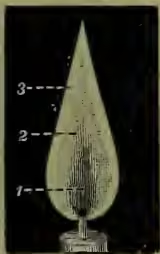
Showing 1, area of non-combustion; 2, area of partial combustion; 3, area of complete combustion.
Flamingo (Phœnopterus), a genus of remarkable birds, usually regarded as forming a distinct family, Phœnopterygidae, near the Anseres or ducks and geese, considered by Huxley as 'completely intermediate between the Anserine birds on the one side and the storks and herons on the other.' The genus includes eight species, four of which are American (in Chili, Galapagos, Mexico, West Indies), while the others are distributed in Africa, South Europe, India, and Ceylon. The bill is very peculiar, longer than the small head, and suddenly bent downwards in the middle; the neck is very long and thin; the same adjectives are even more applicable to the legs; the short toes are webbed. The flamingoes live sociably on marshy shores, usually of the sea, but sometimes of fresh water. They wade in the water, stirring up the bottom with restless feet, and grub for small animals. In thus fishing, the neck is bent upon itself so that the upper half of the spoon-like bill is turned downwards. The edges of both upper and lower jaw are furnished with small transverse plates, which serve, as in common Anseres, for a sieve, allowing the escape of the mud, but retaining the small worms, crustaceans, molluscs, fishes, &c., on which the birds feed. The upper surface of the tongue is beset on the sides and base with flexible, recurved, horny spines.
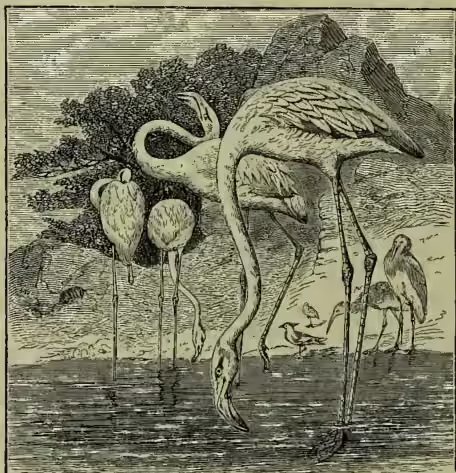
The flamingoes are birds of powerful flight, and fly like geese in strings or wedge-shaped flocks. They also swim in deep water, but the legs are too long to be well adapted for this purpose. They are habitual waders, and the webbed membrane of the feet helps to support them on soft muddy bottoms. Hundreds feed and nest together, and, being large and richly coloured, form a brilliant assembly, their exquisite pink plumage sometimes making a striking contrast against a background of dark-green mangroves. The nests are mounds of mud, from 8 to 15 inches in height, gradually raised year after year, and built at distances of 3 to 4 feet apart. During incubation the females, according to some, sit with their legs dangling down behind; but Mr Blake, who watched them carefully, says that the limbs are folded under the birds in the usual fashion. The nesting occurs about the end of May, the hatching about a month later. There is usually only one egg. One species (Ph. ruber or anti-quorum) occurs in Europe, from spring to autumn, on Mediterranean coasts, and within the century as far north as the Rhine. It measures about four feet from bill to tail, and stands about six feet high from bill to feet. The male in full plumage is for the most part of a rose-red colour; the female, and the young for several years, are less brilliant. The young birds were among the delicacies of the ancients. See H. A. Blake, in Nineteenth Century (December 1887); Chapman and Buck, Wild Spain (1893).