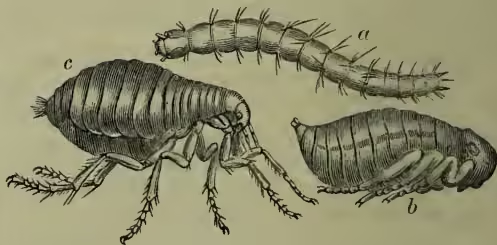
Flea, a name applicable to any member of the small order Siphonaptera or Aphantiptera, of which Pulex irritans is a familiar example. They are wingless insects, probably related to flies; with saw-like, biting jaws (mandibles); with other mouth-appendages (labial palps) adapted for sucking; with legless, biting, maggot larvae. The compressed shape of the body, the long, powerful, bristly legs, which are able to take such relatively gigantic leaps, and the abdomen with eight rings bearing bristles may be readily perceived on the common species; while microscopic examination will show the biting and sucking mouth-appendages, the small eyes and minute antennæ, and two pairs of little bristly scales, like remnants of wings, on the second and third segments of the thorax. The eggs, usually not numerous, are laid in safe corners, or in the fur, feathers, &c. of the animal infested; the hatching is rapid (six to twelve days), and bristly, footless larvae emerge; after a few (eleven) days' voracity these form cocoons, and so rest in pupa quiescence for variable periods. In summer the entire development of Pulex irritans occupies about a month. The fleas a larva; b, pupa or nymph; c, perfect insect. are all ectoparasitic on warm-blooded animals, and the numerous species are more or less rigidly confined to diverse furred and feathered hosts. The common flea (Pulex irritans) is sometimes regarded as the only species of the genus Pulex, and the others are ranked as species of Ceratopsyllus, &c.; but this seems rather in honour of man as being the host of the first-named flea than from any real difference. It seems probable that the flea of the dog is an intermediate host of a tapeworm common in that animal. The muscular energy of these pests has been utilised in 'flea-exhibitions,' in which tamed captives drag miniature carriages, and perform similar exercises. As regards their leaping powers, Kirby and Spence have the following note: 'Aristophanes, in order to make the great and good Athenian philosopher, Socrates, appear ridiculous, represents him as having measured the leap of a flea. In our better times scientific men have done this without being laughed at for it, and have ascertained that, comparatively, it equalled that of the locust, being also two hundred times its (the flea's) length.' Where fleas prevail in spite of cleanliness, recourse may be had to insecticide preparations, the modern substitutes for the old-fashioned fleabane and wormwood. According to Tusser, 'where chamber is swept and wormwood is strown, no flea for his life dare abide to be known.' The more formidable Chigoe (q.v.) or Jigger is separately noticed. See Frank Buckland, Curiosities of Natural History; Taschenberg, Die Flöhe (1880); W. A. L. Philopssyllus, Der Floh, von literarischer und naturwissenschaftlicher Seite beleuchtet (1880).