Fluting, the mouldings in the form of hollows or channels cut vertically on the surface of columns. The idea is supposed to have been originally derived from the bundles of reeds tied together which formed the early columns of the Egyptians. Flutes were adopted by the Greeks as ornaments to their
Doric, Ionic, and Corinthian columns, and were retained by the Romans in their architecture. The Tuscan is the only style without flutes. In Doric (fig. 1) there are twenty flutes on the circumference, and the curves meet with a sharp edge.
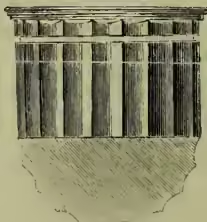

These curves are supposed, in Greek Doric, to be cleftical, and they are carried up across the necking to the base of the cap. In the other styles there are twenty-four flutes on the circumference (fig. 2). These are semicircular and separated by a small fillet, and, before reaching the necking and the base, are terminated with semicircular top and bottom.
Flutes are said to be cabled when they are filled in to about one-third of their height from the base with a convex bead. This is done to strengthen the column and protect the flutes. In countries where Roman remains are abundant, as in the south of France, fluting was sometimes adopted by the early medieval architects, as at Arles and Autun. In Italy also traces of this decoration are visible during the middle ages; but the flutes are not limited to the vertical form—in Romanesque Architecture (q.v.) they assumed many varieties of forms, such as curves, zigzags, &c., twisting round the shafts.