Flying-fish, species of Exocetus and Dactylopterus, bony fishes which, though not indeed true fliers like birds or bats, are able to progress for some distance in the air, quite above the surface of the water. The genus Exocetus is included in the family Scombriscidae not far from the Pikes; while the genus Dactylopterus is referred to the Cataphraeti, nearly allied to the Gurnards.
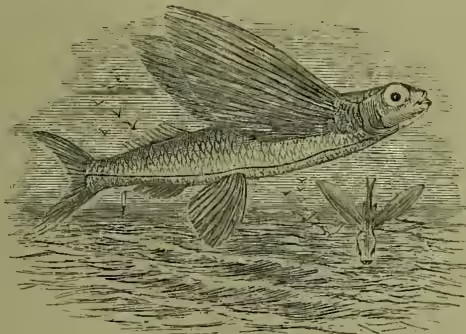
(1) Exocetus (Flying Herrings).—There are over forty known species of this genus, mostly in the warmer seas. Two have occasionally been seen near British shores, one of which (E. volans) ranges from Australia through the Indian Ocean, while the other (E. volitans) is common in the Mediterranean. The long pectoral fins, which extend to the anals or even to the tail, form the most characteristic feature. The usual length of the body is about a foot. Their 'flight' has been much discussed, with the following general results. The fins are kept distended like a parachute, and are not moved like the corresponding ap- pendages of birds or bats; deviation from a straight course, whether lateral or vertical, is due to air-currents, except when the animals in their progress dip their tail into the water and give a stroke; 'their flight is rapid, but gradually decreasing in velocity, greatly exceeding that of a ship going 10 miles an hour, for a distance of 500 feet;' they 'fly' most in rough weather, and farthest when more or less against the wind; in a calm their course is parabolic like that of a projectile, and close to the water, but they are liable to be lifted by the air-pressure over high waves, or by the wind on to the decks of ships; they leave the water when frightened, but also apparently from the mere exuberance of their constitutional activity. They swim and often 'fly' in shoals, and are chased by coryphenes (so-called 'dolphins') and other fishes, as well as by sea-birds. They are good for eating, and are often netted by the natives of the South Sea islands and elsewhere.
(2) Dactylopterus (Flying Gurnards).—Of this genus three species are known, abundant in the
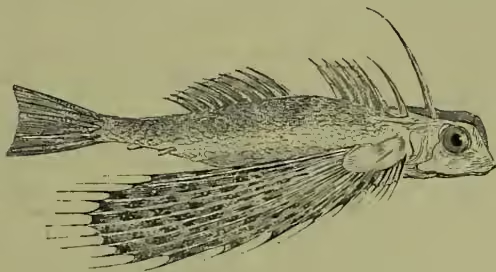
Mediterranean, the tropical Atlantic, and Indo-Pacific. The young have comparatively short pectoral fins, and cannot lift themselves, but the adults 'fly' after the above-described fashion. They are larger and heavier than the Exoceti.
See Günther, Study of Fishes (1880); Möbius, Flic-gende Fische (1878).