Football. Probably no game has ever been able to count upon so much popularity and so many opponents at one and the same time as the now great English winter pastime of football. When it was first played it is impossible to say, but in one form or another the game has existed for very many centuries, in spite of an amount of opposition that would have completely extinguished a less attractive form of exercise. As in the case of cricket, and indeed many other ball games, opinions are divided as to whether football sprung up on English soil or was an importation. The Greeks had a game to a certain extent resembling football, which was played with the kind of ball known as harpaston, and one set of players had to force the ball into that portion of the ground guarded by a rival team in any way they chose. Amongst the Romans, too, there was a game played with a large inflated ball, the follis; and, though it is evident this was only struck with the hand, yet the ball used was undoubtedly similar to the football of later years. No trace of the game as at present understood has, however, been discovered beyond the limits of Britain, where it has flourished for centuries. That football in its early days was played with a boisterous vigour that very closely approached brutality, and often led to breaches of the peace, ample proof is adduced by the numerous attempts made to prohibit it. As early as 1314 a proclamation was issued by Edward II. forbidding the hustling over large balls (ragaries de grosses pelotes), which it is to be presumed had reference to football. In 1349 the game, designated in the statute by its present name, was objected to by Edward III.; and similar measures were adopted with a view to its suppression by Henry IV. (1401) and Henry VIII.; while during the reign of Elizabeth the game was forbidden upon pain of imprisonment. Despite these prohibitive measures and much hostile criticism, football continued to be regularly pursued by the people at large until the middle of the 17th century, when it began to decline in popularity, the change being due possibly to the influence of Puritanism. It was not, however, allowed to die out altogether, and after being kept alive by the younger generation it ultimately became a regular item in the public school curriculum. This flame was fanned by the athletic revival of the 19th century, and it is now an open question whether the votaries of football do not outnumber those of cricket.
The description of game played in the early ages was like that of the present day in that it consisted in forcing the ball through goals which were then defined by objects dependent upon the spot where the game was decided. The ball at the start was placed as now midway between the two goals, and each side, consisting of any number of players, endeavoured to gain the upper hand by any device or strategy. The game was played either in the street, on a field, or 'across country,' when in some instances the goals were several miles apart. Shrove Tuesday was the great football day. Until 1540 a game took place annually on this day on the Roodee, at Chester, and in some parts of England a game similar in character is still indulged in. The ball was kicked or thrown at the discretion of the player, and in the struggle to gain or retain possession of the ball there was some exceedingly rough work. A description of such a contest played as recently as 1888 was given in The Field of March 3 of that year. Joseph Strutt, writing in 1801, describes the game of that time, and by its close affinity it is evident that this was the prototype of the old hacking and tripping game, an early development of Rugby Union football.
Football at the public schools was and is still of very varied character, the rules of the game having, as an admirable authority has suggested, been probably drawn up to suit the capacity of the playground. Where the ground, as at Rugby School, took the form of a large meadow, there running with the ball, the consequent tackling or collaring, and the rough tactics adopted in the primitive game could be indulged in without fear of serious danger; but not so in the circumscribed and more general kind of playground, with, in many cases, its flagged pavement. Here it was necessary that the rougher element should be eliminated; and hence arose the game in which kicking the ball was alone permissible, to be subsequently known by the name of Association football.
About the middle of the 19th century clubs began to be formed by old public school boys. The Sheffield and Hallam clubs, playing the 'dribbling' or non-handling game, were started in 1857; a year later the celebrated Blackheath Club was formed for the purpose of promoting the 'carrying' game; and in 1858 came the institution of the famous Richmond Club. Others of course followed, and in 1863 a praiseworthy attempt was made to determine upon one code of rules to govern all players. This attempt failed, but a body, to be ever afterwards known as the Football Association, was in the same year formed by the 'dribbling' clubs, who were numerically stronger than the followers of Rugby. The latter section was content to remain without organisation until 1871, when the Rugby Football Union sprang into existence. Under the management of the societies named, the game has improved and grown in marvellous manner, until it stands unrivalled in Great Britain as a winter pastime. International and all other kinds of matches are played, and so extraordinary is the popularity of football that nearly 30,000 people have been known to attend a single match, while a company numbering 10,000 is by no means a rare occurrence; and since 1888 there have been some clubs organised as limited liability companies, which have declared fair dividends.
The diagram on the following page will give some idea of the field of play.
In Rugby Union football the area for play is usually 110 yards by 75 yards; each goal is composed of two upright posts exceeding 11 feet in height from the ground, and placed 18 feet 6 inches apart, with a cross-bar 10 feet from the ground. For a match the opposing sides number fifteen each, and are generally disposed of as follows: one full back, three three-quarter backs, two half-backs, and nine forwards. The arrangement of the
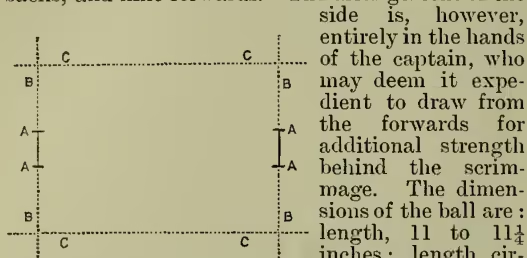
In the Rugby Union game the four corners outside the lines marking the field of play are known as touch in goal. side is, however, entirely in the hands of the captain, who may deem it expedient to draw from the forwards for additional strength behind the scrimage. The dimensions of the ball are: length, 11 to inches; length circumference, 30 to 31 inches; width circumference, to 26 inches. From these it will be gathered that the ball, weighing from 12 to 13 oz., is oval in shape. It is the object of each side to obtain as many tries or goals as possible. At the present time matches in England are decided by a number of points; a goal from a try or drop-kick scores three points; from a free kick (penalty for infringement of offside and other rules), two points; for a try, one point is allowed. In other portions of Great Britain a goal counts more than any number of tries, an arrangement which is not of the most equitable kind. A try is gained when a player touches the ball down in his opponents' goal. This is accomplished by a player, when not offside, dodging his opponents and crossing the goal-line at any spot. A player is put offside if he enters a scrimage from his opponents' side, or, being in a scrimage, gets in front of the ball, or when the ball has been kicked, touched, or is being run with by any of his own side behind him—i.e. between himself and his own goal-line. A side having so touched the ball down, one of the players of the same side must bring it up to the goal-line in a straight line from the spot where it was touched down, and thence walk out with it in a line parallel to the touch-lines such distance as he thinks proper and there place it for another of the side to kick. Should the ball be kicked directly over the cross-bar (not over either post) it is a goal. A goal may, however, be obtained by a drop-kick (made by letting the ball fall from the hands and kicking it the very instant it rises) at any time during the game; or from a place-kick (made by kicking the ball after it has been placed in a nick made in the ground for the purpose of keeping it at rest) or a drop taken as a free kick for a fair catch (a catch made direct from a kick, throw forward, or a knock on by one of the opposite side), or as an award for a penalty.
For Association football the maximum size of ground is 200 yards by 100; the minimum, 100 yards by 50. The most popular dimensions are 120 yards by 80, and for cup tie matches, which are exceedingly numerous, the field of play must not be less than 110 yards by 70. The goal-posts are placed eight yards apart, with a bar across eight feet from the ground. In this game only goals count, and to obtain a goal the ball must be passed between the goal-posts under the bar. No player is permitted to carry (take more than two steps when holding the ball), knock on (strike or propel the ball with hand or arm), or handle (play the ball with hand or arm) the ball under any pretence whatever, except in the case of the goal-keeper, who, within his own half of the ground, may use his hands in defence of his goal, either by knocking on or throwing, but not carrying the ball. A goal cannot be scored from a free kick—the penalty for handling the ball, offside play, or when a player sends the ball over his own goal-line. The ball in the Association game is of an average circumference of not less than 27 inches and not more than 28 inches. Matches are played between sides numbering eleven each, the players being generally disposed as follows: a goal-keeper, two backs, three half-backs, and five forwards. As at Rugby Union, the greatest factor towards success is the working together of the whole team.
At the present time, even, complaints are frequent that football is associated with a large number of accidents. It certainly cannot be argued that the game is one of gentle character; but it is beyond doubt that the large majority of mishaps occur through the non-observance of those rules which the governing bodies have from time to time drawn up with a view to the elimination of the rough element.
In many parts of the world besides Great Britain football has of recent years spread in a remarkable way, but it has perhaps taken the strongest hold in Australia, New Zealand, and Canada. The latter two countries each sent a team to England in 1888; and in the early part of the same year a body of English football players visited Australasia, and found there opponents quite worthy of them. Two games are played in Australasia, the one being strictly according to the English Rugby Union code, the other a combination of the two styles so well known in Great Britain. In the Victorian or Australasian game, which is played almost universally in Victoria, New South Wales, and South Australia, the ball has to be bounded by the player while running, and in this particular the game differs from both Rugby Union and Association. It is with the New Zealanders chiefly that Rugby Union finds favour, but both games are exceedingly popular with the public, who muster in their thousands at the more important matches. Comparatively little Rugby Union is played either in Canada or the United States, but in both countries the Association game flourishes, the team from the former country which visited England, as mentioned above, proving how assiduous had been their practice. Until the last quarter of the 19th century football was less known in the United States; but, under the New York and Paterson clubs, the game grew rapidly, and in April 1884 was formed the American Football Association. The game is very popular in the colleges and schools, where an elaborated form of the English Rugby is played; the ball is advanced by carrying, passing, or kicking, and the playing of the 'team' is regulated by secret signals. A variety of football is very popular with some Indian tribes, as the Washoes of Nevada.