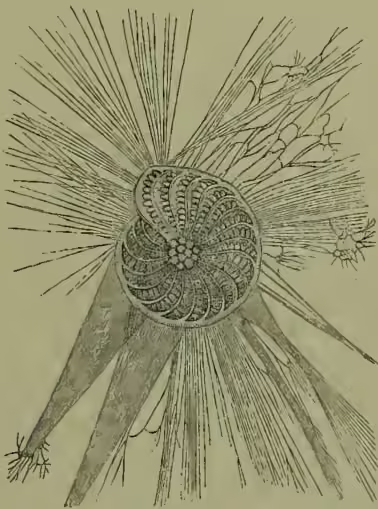
Foraminifera, a class of unicellular animals or Protozoa, almost always marine in distribution, most characteristically provided with limy shells, which have formed the chalk of the past and are now forming similar deposits in the deep sea. A living Foraminifer, often about the size of a pin's head, consists of a central nucleated mass of protoplasm, of a shell surrounding this, and of long, branched, and interlacing threads of living matter streaming outwards, with food-absorbing and locomotor functions.
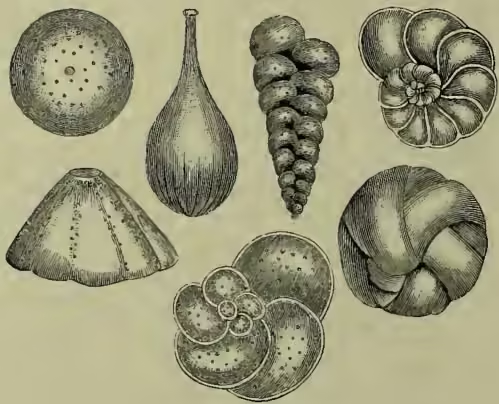
Description.—The shell, which is much better known than its tenant, is characteristically calcareous, chambered, and covered with minute holes. But it is occasionally chitinoid, and often sandy, while a few forms approach Radiolarians in being flinty. At first a simple enough insheathing test, and so remaining in many forms, the shell is very generally added to, so as to cover successive overflows of growth. The ways in which fresh chambers are formed—in linear series, in spirals, and the like—produce types of architecture of great beauty and variety, as to the building of which we can only conceal our ignorance by calling them organic crystallisations. The spirals often look like miniature sketches of the shells of Nautili, snails, and other molluscs. When partitions are formed between successive chambers they leave apertures through which bridges of protoplasm preserve the vital continuity. On the outer surface the outflowing protoplasm may reserve for itself one relatively large aperture, or a couple, or a few, but most characteristically there are numerous minute holes left all over the shell.
The internal protoplasm, so far as observed, is homogeneous, except for granules, frequent pigment, and the essential nucleus or nuclei. On the outflowing processes, which are more irregular and interlaced than is usual in Radiolarians, granules stream outwards and inwards in active currents. The colouring matter often resembles that of the diatoms on which the organisms so largely feed. The general absence of vacuoles, contractile or otherwise, is another of the contrasts between Foraminifera and Radiolarians, and is probably associated with the non-pelagic life of the former. Partner plant-cells or symbiotic algae have been but rarely seen within Foraminifers, whereas they are almost constant in Radiolarians. Multiplication typically takes place by a sort of internal budding. The nucleus divides into several, round each product of nuclear division the protoplasm gathers, and thus are formed young individuals which are eventually enclosed in shells and liberated from the parent. Division of the entire animal has also been observed in a few cases. Dimorphism, or the occurrence of two diverse forms (possibly male and female) in one species, has been noticed, but no conjugation or incipient sexual union. In a few cases—e.g. Mierogromia socialis—a number of individuals are united to form a loose colony, a primitive kind of association exhibited by not a few Protozoa. Most modern forms are small, below half an inch in diameter, and many very much less, down to microscopic dimensions. The largest living species (Cyclocyclus carpenteri) measures slightly over 2 inches across the shell, and recalls the extinct giant Nummulites, many of which were as large as half-crowns.
Distribution.—The Foraminifera are mostly marine, and occur at all depths; a few (Globigerinids), like the Radiolarians, are pelagic; most live on submerged objects or at the bottom. A few from brackish and even fresh water are known, and one species (Gromia terreola) has gone ashore. The pelagic forms as they die sink gently to the bottom, and are there forming, especially at depths between 1000 and 2000 fathoms, great beds of Globigerina ooze or modern chalk. In other regions sandy-shelled forms predominate at the bottom.
In marine geological strata from the Silurian onwards Foraminifera abound. Chalk consists almost wholly of fossil Globigerinids, and the Nummulites have contributed largely to the great Eocene limestones. The animal nature of Eozoon (q.v.) from the pre-Cambrian strata is now generally denied, and is at least very doubtful.
Position and Classification.—The Foraminifera were so named by D'Orbigny in 1826, and placed beside the Cephalopods, to the shells of some of which the tests present a mimetic or prophetic resemblance. The title referred not, as might be supposed, to the superficial apertures on the shell, but to the communications between successive chambers. Hertwig would call them Thalamophora, in allusion to the typical chambered shell; while Carpenter emphasised the living network of processes in the title Reticularia. Accenting as they do the amoeboid phase of cell-life, the Foraminifera have their place beside Amœbæ, Radiolarians, and Sun-animalcules in the Rhizopod division of Protozoa (q.v.). They were formerly classified as Perforate and Imperforate according to the presence or absence of numerous apertures on the test, but as this distinction separates apparently adjacent forms it is no longer generally adopted. By Brady, who has described the Challenger collection in a monumental monograph, they are classified in ten families, of which Gromia, Miliolina, Astrorhiza, Lituolina, Textularia, Chilostomella, Lagena, Globigerina, Rotalia, and Nummulites are the name-giving types. In Gromia the shell is chitinous, flexible, and with a single aperture; in the related Shepheardella there is an aperture at each end of an elongated test. The test of Miliolina is normally of lime, but in brackish water tends to become chitinous, and at great depths a siliceous film. Irregular sand particles form the primitive test of Astrorhiza, and the use of detached sponge spicules led to the related Haliphysema being mistaken for a very simple sponge. Among Lituolidae, Parkeria and Loftusia are relatively large forms—about two inches in diameter and length respectively. A peculiarly interesting Challenger form among the pelagic Globigerinids—Hastigerina murrayi—has the shell surrounded by a zone of bubbly protoplasm, and in its vacuoles and internal shell suggests Radiolarian characteristics. The species of Foraminifera are legion, probably above two thousand. They are interesting, as illustrating complexity and beauty of architecture at the very threshold of life, and important both in the making of the earth and in the present-day economy of submarine life.
See EOOZON, NUMMULITES, OOZE, PROTOZOA, RADIO-LARIANS; Brady, Challenger Report, 1884; Bütschli, Protozoa (Bronn's Thierreich); Carpenter, Parker, and T. Rupert Jones, Intro. to Study of Foraminifera (Ray Soc. Lond. 1862); Schultze, Organismus der Polythalamien (Leip. 1854); and other works cited in Sherborn's Bibliography of Foraminifera (1888).