Fountain, a basin or an artificial structure for the supply or the ornamental display of water. There are fountains of every form and variety, from simple springs with their natural basins to the most elaborate monumental structures, in which ornamental jets and artificial basins are combined. In civilised countries fountains have at all times been considered as public monuments of the greatest importance; and, where the source of their supply has not been provided by nature on the spot, immense labour and expenditure have been incurred to make up for the deficiency. The splendid Aqueducts (q.v.) of the Romans are instances of the important light in which they regarded the fountains of their cities. Every Roman town had at least one aqueduct, the water from which was distributed to as many fountains as the population required.
In early times utility was the first object of a fountain, and the ornamental features of the structure into and through which the water was led were strictly developments of their original utilitarian purpose. Springs were highly valued, especially in lands where water was scarce; many of them were associated with the names of saints, and sacred traditions accumulated around them. Sometimes, therefore, such springs were built around for protection, statuary figures of their patron saint were placed in niches, and artificial basins were provided to contain the water. In towns where a number of persons might require to draw at one time a large basin was erected with a pillar in the centre, from which pipes radiated all round—each with its separate jet to supply the running water—while the basin was used for washing the pitchers. Many examples of this kind of fountain remain throughout Italy and in the older German towns, of which the fountain at Viterbo and the Schöner Brunnen at Nuremberg may be mentioned as examples. The pillar is sometimes surmounted by a statue, or has one or more smaller basins with ornamental streams and jets of water falling from tier to tier. A beautiful fountain of this nature existed in the royal palace at Linlithgow, and a modern reproduction of it may be seen in front of Holyrood Palace at Edinburgh.
Where modern views of water-supply and sanitation are carried out, under which water is led into each household by gravitation, great public fountains have become purely ornamental structures.
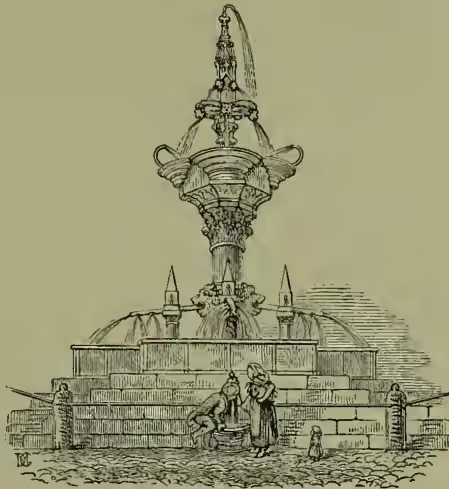
Small pillar fountains are yet commonly placed on streets and places of public resort for wayfarers, and similarly basin fountains are provided for horses and other animals. The Metropolitan Drinking Fountain Association was formed in London in 1859. Of ornamental fountains the most magnificent display is at Versailles. Paris also contains several very remarkable fountains, and in England the display at the Crystal Palace, Sydenham, is very fine. Chatsworth is remarkable for its fountains, one of which is said to throw a jet of water 267 feet high. Although Rome has lost four-fifths of the aqueducts which so lavishly supplied her with fresh water in the time of the Empire, she is still unsurpassed for the number, beauty, and utility of the public fountains which adorn her streets and palaces.
In connection with recent international exhibitions, a method of artificially controlling and illuminating fountain jets has been elaborated, by which a great variety of effects and chromatic combinations are obtained. Within a large basin a series of jets are arranged, and under the basin is a subterranean chamber with plate-glass discs under each jet. Powerful electric lights are provided in the chamber, so that the jets are illuminated from below, each with one or more lamps. By a mechanical contrivance slips of coloured glass can be at will interposed between the arc-light and the jet, and it is the duty of an operator in the chamber to vary and change the glasses in accordance with signals sent to him. The jets are forced and controlled by one or more pumping engines in a station apart, in which the requisite engines and dynamo-machines for producing the electric light also are placed. In a separate manipulating tower there is a system of levers, pushes, and signals, by which the operator has direct control of the water-jets, and the means of giving signals to the officer in the subterranean chamber to produce such combinations and change of colours as he may desire. In this way the height and combination of jets and the colour of the light illuminating them can be instantaneously varied; and the effects by night are very striking.