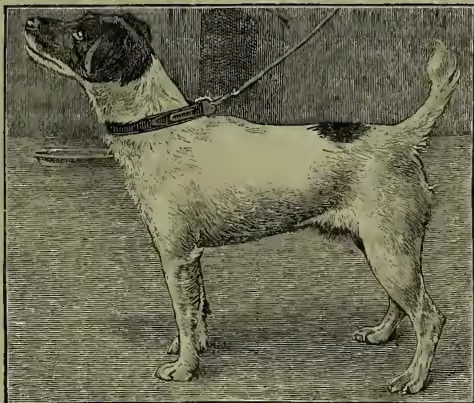
Fox-terrier. The origin of the fox-terrier is somewhat obscure. From the earliest days of hunting a small dog has been used to follow the fox to its earth, but it is difficult to say when this dog became identical with the modern fox-terrier. The terriers which ran with hounds until the middle of the century were of all colours and coats; their owners, acting on the adage 'handsome is as handsome does,' bred solely for work and not for appearance. The white terrier with hound marking being found most suitable, it was bred with care, and became a distinct breed. Some smooth fox-terriers were exhibited about the year 1865, and, speedily catching the public taste because of their handy size and suitability to the house, soon became the most popular breed of the day. The wire-haired fox-terrier was not exhibited in public until the year 1872, the breed having a class set apart for it at Glasgow in that year. As the coat of this variety of the fox-terrier requires some attention, especially when kept for exhibition, it is not so common as the smooth section, though rapidly increasing in popularity. The chief points of the fox-terrier are: head, long, flat, rather narrow, but with powerful jaws and teeth; ears, small, V-shaped, and drooping forward; nose, black; eyes, small; back, short and strong; tail, generally cut short, set on high, carried gaily; fore-legs—an important point—must be straight, showing no ankle, good bone; hind-legs, rather straight, with long and powerful thighs; feet, round with arched toes; colour, white with black or tan markings—a point of little importance; weight, not more than 17 lb.; coat, in the smooth variety, short, hard, and dense; in the rough variety it should be half-an-inch long, but without any silkiness. The expression of the fox-terrier should be keen and hard, full of life and fire. Though the fox-terrier should not be quarrelsome, he should be ready to face anything in the way of his legitimate work. He is unequalled as a companion; and, as many fox-terriers have been kept for generations merely as companions, soft and degenerate specimens of the breed are common. But a genuine fox-terrier is of a bright and cheerful disposition, a splendid vermin-killer, fast enough to hunt, and small enough to enter an earth. See R. B. Lee, History of the Fox-terrier (1889).