Fox, the name of a number of species of the family Canidae (q.v.), most of which are now referred to the genus Vulpes, distinguished from the genus Canis (see DOG) by certain minute differences in the form of the skull and of the teeth, the more elongated body, slender, pointed muzzle, elliptical, somewhat oblique pupil, and bushy tail. Representatives of the genus are found in the greater part of the northern hemisphere, but are conspicuously absent from South America.
The following species demand separate notice: (1) The Common Fox (Vulpes alopecx) measures on an average 4 feet in length, of which 16 inches are occupied by the tail; and 14 inches in height; the weight is from 15 to 22 lb. The head is broad, the brow flattened, and the muzzle rapidly tapering, long, and slender; the mouth is furnished with 42 teeth. The body, though apparently thick, owing to its hairy coat, is really lank, but strong and mobile; the legs are slender. The anal glands are strongly developed, giving the animal its well-known odour. The colour above is reddish-brown; the brows, shoulders, and posterior portion of the back, as far as the root of the tail, are shot with white, the hairs in these regions having white tips. The hair on the lips, cheeks, and throat is white, and a streak of the same colour runs down the legs; the breast and belly are ashy and the flanks whitish gray, the feet red, the ears and toes black, and the tail reddish shot with black, and usually with a white tip. These various tints blend gradually into each other, and produce a tout ensemble which renders the animal remarkably inconspicuous.
Sportsmen have an extensive technical vocabulary for all that concerns the fox: the female is a 'vixen,' the young, 'cubs;' his head, a 'mask' or 'pate,' his feet 'pads,' and his tail a 'brush;' his dung is known as 'billet,' and his home is a 'kennel,' or, if underground, an 'earth.'
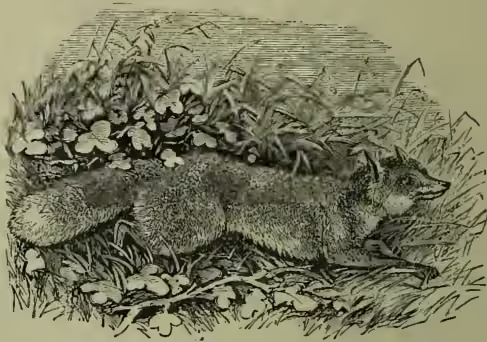
Foxes occupy burrows in the ground, generally utilising those which have been made by badgers, while occasionally they live in company with these animals. These dens are preferably on the sides of hills, the apertures leading downwards and outwards, and consist of a central chamber with several means of exit. When suitable burrows are wanting, hollows under piles of stones, or even hollow trees have been used.
The fox's food embraces a wide range of nutriment, from a fawn or a lamb to beetles, or even vegetables or fruit; nothing comes amiss. Mice form a large percentage of his diet, and when half-sated he will play for long with his food before eating it. He hunts almost exclusively by night, and in his wanderings chooses the most secluded ways and takes advantage of every particle of shelter which the nature of the ground affords when passing from one covert to another. He is fond of warmth, and if undisturbed will bask for long in the sunshine; he runs rapidly and with great endurance, swims well, and has been known to climb trees in the search after eggs. The usual cry is a short bark, most commonly heard at the pairing season; the young ones use their voices freely when hungry. The pairing takes place in February, and the period of gestation is 60-63 days. Before the birth of the young, of which there are usually 4-7, the vixen pulls out the hair from her belly, partly to provide a soft bed for her offspring and partly to expose her nipples ready for their use. When born they are very helpless (both eyes and ears being closed) and covered with smooth brown fur. At six weeks old they appear outside the burrow, and at three months go hunting either alone or with the mother, who tends them with the utmost solicitude, and will face any danger or run any risk in their defence. A vixen has more than once been caught with no more than a mouse in her own stomach carrying home a plentiful supply of larger game to her young.
The fox's mental qualities are of a very high order. His cunning is proverbial, and his knowledge of localities and ability to profit by experience have been highly developed in an arduous struggle for existence. 'More elegant than his relatives in mien and bearing; sharper, more prudent, calculating, and adaptive; of strong memory and sense of locality, resourceful, patient, resolute; equally skilled in jumping, slinking, crawling, and swimming, he seems to unite in himself all the qualifications of a perfect highwayman, and, when his lively humour is also taken into consideration, produces the impression of a highly educated artist in his own line.' When taken very young the fox has been successfully tamed, but he does not exhibit that capability for domestication for which his congener the dog is so remarkable. With this latter, however, he agrees in the parasites by which he is infested and the diseases to which he is liable. Even hydrophobia has been known to attack him, and to have been by him communicated to human beings. He has many enemies; the wolf and dog attack and kill him even when they do not devour; the hawk and eagle take the cubs, and the latter sometimes the adults. His chief foe is man. In northern countries where he is abundant the fox is slaughtered for his fur. The skins are brought from Poland, Russia, and the whole of Siberia. The black variety is much rarer and consequently more valuable than the red.
In Britain the fox has a factitious value as the object of a time-honoured sport, which, though it leads to his being pursued to the death by horse and hound, is still the sole reason why he has not long ago shared the fate of the wolf (see FOXHUNTING). In former days many foxes were dug out of their holes in Germany for the sport of 'tossing.' Long, narrow nets were spread out in front of the holes, the opposite ends of each being held by a lady and gentleman; as soon as reynard in his attempt to escape ran upon the net this was suddenly tightened and the unfortunate creature hurled aloft like a schoolboy in a blanket; and this was repeated until he happened to fall upon solid ground and endured his tormentors.
Several varieties of the common British form are known to sportsmen; the Greyhound Fox, which occurs in the mountainous parts of England and Scotland, is tall, long-limbed, and strong; the Mastiff Fox is shorter and stouter, whilst the Cur Fox is known by his black-tipped tail. In addition to these several more conspicuous variations have received names and been by some regarded as distinct species. The Coal Fox (V. alopec) is found in Switzerland and Bavaria, and has a black-tipped tail. The Cross Fox (V. crucigera) is distinguished by a longitudinal dark line down the back and a transverse one over the shoulders. The Black-bellied Fox (V. melanogaster) is restricted to the south of Europe, and is sufficiently described by its name.
The Red Fox of North America (V. fulvus) is very little removed from its European congener: it is not so enduring, but runs with great speed for about 100 yards. Its skin is eagerly sought, and no less than 60,000 come annually to the London market.
(2) The Gray Fox (Vulpes cinereo-argentatus, V. virginianus; sometimes made the type of a distinct genus Urocyon) is somewhat smaller than his European relative, and has comparatively longer legs and a shorter tail; the colour is a peculiar speckled gray, due to the hairs being white at the roots and black with white rings in the distal portions. It is abundant in the southern United States, but does not occur north of Maine. It is not so swift as the red fox, but is even more cautious and timid, though its habits are in general similar. It has been seen to stalk game like a pointer.
(3) The Corsac or Steppe Fox (Vulpes corsac) is the Asiatic representative of the common fox; than this it is decidedly smaller, measuring at most 3 feet in length; it is also somewhat taller, and shorter in the tail, and has a rounder pupil. The colour in summer is reddish, but in winter it becomes paler owing to the development of a white ring round the individual hairs near their extremities. The throat, lower surface of the body, and inner surfaces of the legs are yellowish-white, and there is a three-cornered, dark-gray patch in front of each eye. The tail is dark above, and has a black tip. This species extends from the Caspian Sea to Mongolia, wherever there are extensive steppes, but it never occurs in forests or mountains. Its habits are like those of the European form. It is eagerly pursued by the Kirghiz and Turcomans for the sake of its fur: all the ordinary means are employed for its capture, and in addition eagles are trained to hunt it, and it is forcibly dragged from its earth by an apparatus resembling a magnified corkscrew. About 50,000 skins are said to come into the market annually.
(4) The South African Desert Fox (Vulpes caama) is only about half the size of the European fox, and is said to live almost entirely on ostrich eggs, which it rolls from the nest to its burrow and then breaks against a stone.
(5) The Fennec (Vulpes zerdo or V. cerdo) is a delicately-formed little creature, remarkable for its large eyes and enormous ears, which have led some authorities to place it in a special genus (Megalotis). It is found in the deserts of northern Africa and the adjoining parts of Asia, and lives in burrows in the ground, usually near the roots of shrubs. Unlike the common fox it excavates its own home, and is able to dig so rapidly that it can often hide in this manner when pursued. Small birds are its favourite food, but it will also eat lizards, beetles, and grasshoppers, or even vegetable products such as dates or melons: fennecs have been supposed by some to be 'the little foxes that spoil the vines' of Scripture. They produce three or four young ones at a birth, which are tenderly cared for by the mother. When taken young they soon become very tame; they are captured by snares fastened at the entrance of their burrows, and, strange to say, they make no attempt to bite the nooses, though they struggle hard to break them.
(6) The Arctic Fox (Vulpes lagopus) is very well characterised by its short, blunt snout, rounded ears, short legs, and hairy covering to the soles of the feet, whence the specific name. The summer coat is brownish or gray above and on the sides, and white below; but as winter approaches the colour of the whole becomes pure white, although individuals are occasionally observed which have not changed their hue. The species is distributed over the polar regions of both the Old and New Worlds, as well on islands as on continents: it only wanders exceptionally south of the 60th parallel of latitude. The cubs are born in the latter half of June, the vixen choosing a cleft in the rock or some similar position for her nursery. Its food consists of any animals which it is strong enough to overpower, especially mice and lemmings; but in case of need it will eat creatures of any kind that may be cast up by the sea, and will even venture into the huts of the Eskimo and steal whatever it can carry away, whether edible or no. When food is abundant it will conceal it and return to its store in time of need. In character it presents a curious mixture of cunning and of impudence. Steller records that during his stay on Behring Island the foxes would come and try to take the meat from the hands of himself and his comrades, gnaw their boots, or sniff around their faces as they lay asleep; and also that in spite of numbers being slain they did not become shy. That this was not entirely due to lack of acquaintance with human beings is shown by their exhibiting the same characteristics in
Norway. When young they can be easily tamed, and as pets have the advantage of being free from the disagreeable odour associated with most foxes. The fur is a marketable article, though not so valuable as that of the other species. About 10,000 skins are brought to Britain yearly.