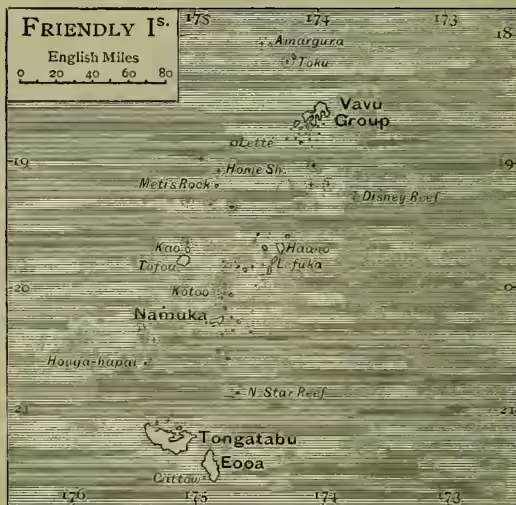
Friendly Islands, or TONGA GROUP, lie 250 miles ESE. of Fiji (q. v.), number 32 inhabited and about 150 small islands, and consist of three sub-groups, with a collective area of only 385 sq. m. Tonga-tabu (130 sq. m.) is the largest; and next in importance are Eooa, Vavu, Namuka and Lefuka, Tofoa, Late, and Kao. The great majority are of coral formation; but some are volcanic; there are several active volcanoes, such as Tofoa (2781 feet) and Late (1787); and earthquakes are frequent. During a severe volcanic disturbance in October 1885 a small island 20 miles north-west of Honga Hapai was upheaved, and named Sandily Island, after the government schooner which first visited it. A treaty was concluded with Germany in 1876, with Great Britain in 1879; the convention between Britain and Germany in 1886 provided for the neutrality of this archipelago, and in 1899 Germany renounced all her rights here in favour of Britain. The Friendly Islands were discovered by Tasman in 1643, but received their collective name from Cook, who visited them in 1777. Both these navigators found the soil closely and highly, cultivated, and the people apparently unprovided with arms. The climate is salubrious, but humid; hurricanes are frequent. Among the products of the islands are tropical fruits, copra, coffee, sponges, cocoa-nuts, and arrowroot. The imports in 1894 amounted to £82,531, and the exports to £67,633. The flora resembles that of the Fiji group; but the native animals are very few. In the south part of Tonga-tabu there is an ancient monument of two perpendicular rectangular blocks of stone about 40 feet high, with a slab across the top, and thereon a stone bowl. The stones must have been brought by sea.
The Friendly Islands were first visited by missionaries in 1797. In 1827 the work of evangelisation fell into the hands of the Wesleyan Methodists, and, after a lengthened and perilous struggle with the savage paganism of the inhabitants, it was crowned with success. Almost all the islanders (who, unlike the Fijians, belong to the fair Polynesian stock) are now Christians; many can speak English, and schools are numerous. In mental development, skill in house-building, &c., they are superior to other South Sea islanders. They are, however, decreasing in numbers; once estimated at 40,000 or 50,000, they had dwindled to 17,500 in 1893. The various islands used to be governed by independent chiefs, but in 1845 they were brought under the rule of King George (1818-93), who in 1862 gave the islands a 'constitution' and summoned a parliament. He was succeeded by his great-grandson, George II. See H. S. Cooper's Coral Islands (1880), and Basil Thompson's Divisions of a Prime Minister (1895).