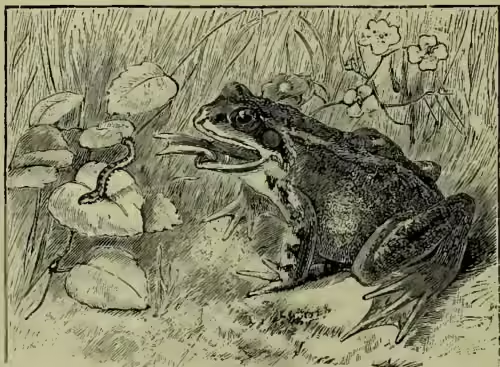
Frog, a genus (Rana) of tailless Amphibians; but the name, usually with some prefix or other, is often extended to the members of related genera or even of related families—e.g. to the obstetric frog (Alytes), to the tree-frogs (Hylidae), or to the peeping frogs (Hyloides). The common frog in Britain is Rana temporaria, distinguished from the edible frog, R. esculenta, which has been introduced into Britain, by slight differences in colouring, by the presence of a dark, triangular patch extending backwards from the eye, and by the absence of the dilatable sacs (at the back corners of the mouth) which intensify the croaking of the 'Cambridge-shire Nightingales.' The general shape is an elongated oval, of which the head occupies about a third; a hump on the back marks the end of the distinct vertebrae and the beginning of an unsegmented portion known as the urostyle. The tail has completely disappeared, the young animal having literally lived upon it during part of its metamorphosis. The arms are short, the fingers four and unwebbed, and the innermost is swollen in the males; the hind-legs are long and muscular, well adapted for both leaping and swimming, with an elongated ankle, five webbed toes, and an internal 'tarsal tubercle' like a hint of a sixth. The skin is soft and glandular, with pigment cells admitting by their changes of a slight alteration in colour. The external nostrils are situated near the tip of the snout; the eyes have a movable lower lid; the tympanum or drum of the ear is readily seen somewhat farther back.
General Life.—The frog, aquatic in its youth, generally remains near water. In dry weather it hides itself, and great numbers are often seen to issue forth on the welcome return of rain. Their leaping and swimming deftness need no remark. The adults feed upon living animals, insects, and slugs. These are caught on the large viscid tongue, which being fixed in front of the mouth and free behind, can be thrown rapidly outwards, and even more rapidly retracted. In winter the frog 'hibernates' or lies torpid, buried in the mud at the bottom of the pool, and great numbers of individuals may be dug up in winter all clustered together. During this season certain 'fatty bodies,' situated on the top of the reproductive organs, and apparently degenerate portions of the kidney, become reduced in size, being probably the ovaries and testes, which become functional in the month of March. Then it is that the frogs congregate together for breeding purposes, and that the males with their vigorous croaking serenade their more weakly-voiced mates, preceding the birds in announcing the approach of spring. The titles bull-frog, blacksmith-frog, sugar-miller, &c., applied to certain species, obviously refer to their notable vocal powers.
The frog generally contains some interesting parasites—a hermaphrodite threadworm or Nematode (Angiostomum nigrovenosum) in the lungs, a fluke or Trematode with many suckers (Polystomum integerrimum) in the bladder, and a ciliated Infusorian with many nuclei (Opalina ranarum) in the hindmost part of the alimentary canal.
Life-history.—The eggs of the frog are familiar to almost all; each is a little dark ball enclosed in a glutinous sheath which swells in the water into a clear round globe. The egg has most black pigment in its upper half, the heavier yolk sinking for the most part to the lower hemisphere. They are fertilised just as they leave the female, which the male is at the same time embracing. The division of the ovum is complete but unequal, the upper hemisphere with the 'formative protoplasm' soon exhibiting a larger number of smaller cells than the lower portion, which chiefly consists of yolk to be gradually absorbed by the embryo (see EMBRYOLOGY).
By the tenth day after the eggs are laid the head, body, and tail of the young frog may be distinctly seen. Following the lines of its ancestral history (why or how is a difficult question), the animal becomes fish-like, with a long tail and with three pairs of external gills on its neck. About a fortnight after the laying the young tadpoles are hatched, and, jerking themselves out of the gelatinous mass, swim freely in the water. They are still mouthless, and live on their still unexhausted capital of yolk. They have a paired sucker underneath their head, by means of which when tired they attach themselves to water-weeds or other objects. In a few days, however, they gain a mouth, 'bordered by a pair of horny jaws, and fringed with fleshy lips provided with horny papillæ.' The whole arrangement reminds one of that of the lamprey. As the tadpole hungrily feeds on fresh-water weeds (algæ, &c.), the hitherto short alimentary canal becomes elongated, furnished with a liver and pancreas, and, when the animal is big enough to dissect, may be readily seen coiled up like a watch-spring. About the time when mouth and anus have been opened the four gill-slits or clefts, opening from the pharynx to the exterior, may also be seen, and very soon the original external gills shrivel, and are replaced by an internal set. As the latter develop, a fold of skin grows over them, forming a gill-chamber which by-and-by closes so much that only a single exit aperture remains, and that on the left side. Through this the water taken in for respiration by the mouth passes to the exterior, after washing the gills on its way.
The tadpole thrives on its vegetarian diet, and rapidly grows bigger and stronger; the large tail is a powerful swimming organ, and the adhesive suckers are less and less used. The limbs bud forth, but the anterior pair, hidden by the gill-covers above referred to, are longer of becoming distinctly visible. By the end of the second month the tadpole has attained to the level of the double-breathing fishes or Dipnoi (see FISHES); in other words, the lungs become useful, the gills for a while persist, but, as the animals get into the habit of coming oftener to the surface to breathe, these latter organs gradually degenerate.
Two or three weeks more, and a remarkable change—a metamorphosis—occurs, in which the tadpole rises above the fish level and becomes a distinct amphibian (see AMPHIBIA, for figures, &c.). The tadpole ceases to feed upon algæ, and begins to live at the expense of its tail, from which wandering blood-cells or 'leucocytes' carry the nutriment to other parts of the body. A casting of the outer layer of skin takes place; the gills are finally lost; 'the horny jaws are thrown off; the large frilled lips shrink up; the mouth loses its rounded suctorial form and becomes much wider; the tongue, previously small, increases considerably in size; the eyes, which as yet have been beneath the skin, become exposed; the fore-limbs appear, the left one being pushed through the spout-like opening of the branchial chamber, and the right one forcing its way through the opercular fold, in which it leaves a ragged hole' (Milnes Marshall). As these momentous changes progress, and as the supply of food afforded by the tail begins to be exhausted, the animal recovers its appetite, but this time carnivorously, feeding on available animal matter, or even on its fellows. At this stage tadpoles will clean a skeleton beautifully, and Buckland describes them as showing a great avidity for animal food, crowding round a dead kitten, and nibbling at the toes of little boys who wade in pools where they abound. With the change of diet the abdomen shrinks, stomach and liver enlarge, the intestines become both narrower and shorter. The tail shortens more and more till it is completely absorbed; the hind-limbs lengthen; and eventually the animal leaps ashore—a tiny frog. For a considerable time the tadpole appears to be neither male nor female, but differences in nutrition, &c. decide the question of sex. In ordinary circumstances there are about as many males as there are females, but Jung has shown that by increasing the quality of food from fish to beef, from beef to frog flesh, he could increase the percentage of females to about ninety. See EMBRYOLOGY, ENVIRONMENT, REPRODUCTION, SEX; while for details of life-history, Milnes Marshall's book should be consulted.
Distribution and Related Species.—The common Brown Frog (R. temporaria) is widely distributed in Europe and Asia; 'it is the most northerly of known species, ranging in Norway to beyond the seventieth parallel of latitude. In the Alps it still frequents the waters at an elevation of 8000 feet.' It is of course abundant in most parts of Britain, and is common enough in Ireland, where, however, it is said to have been introduced in 1696.
Of wider distribution is the Green or Edible Frog (R. esculenta), which also occurs in Britain, though not believed to be indigenous. Its habitat extends from Scandinavia to North Africa, from France to Japan. Widely distributed in the United States are two forms—the Shad- or Leopard-frog (R. halcina) and the Wood-frog (R. sylvatica)—which some regard as identical with our common species. The common Bull-frog of North America (R. catesbiana) is often brought to European zoological gardens, has an appetite big enough to engulf a sparrow, and a croaking power proportionate to its large size. Like the edible frog on the Continent, it is not unfrequently cooked. A large Indian species (R. tigrina), another relatively huge, toad-like species (R. adspersa) from tropical Africa, a single species from West Australia (R. papua), and another solitary form (R. krefftii) from the Solomon Islands deserve to be mentioned. The genus is unrepresented in the southern parts of South America and in New Zealand.
Related Genera.—The family of true frogs or Ranidae includes about two hundred species, ranked in eighteen genera. They have always teeth in the upper jaw, and a certain technical peculiarity in the breastbone. One of the most curious forms (which have always teeth in the upper jaw) is the arboreal genus Rhacophorus, the 'flying frog' described by Wallace, in which the webs between both fingers and toes are much developed. The tips of the fingers are dilated, and serve for attachment to smooth or vertical surfaces. The arboreal habit is a resource which brings with it several physiological adaptations, which must not be too much insisted upon in classification, for, as Huxley observes, the common brown frog 'at a year old will climb up the vertical side of a glass vessel, flattening out the ends of its toes, and applying its belly against the surface of the glass, like a tree-frog.' Frogs, like other amphibians, are usually unrepresented in oceanic islands, but, besides the species of Rana already mentioned as occurring in the Solomon Islands, three forms of Cornufer, ranked among the Ranidae, ought to be noted on account of their habitat in the Fiji Islands. The Dendrobatidae form a family of small tree-frogs nearly allied to the Ranidae, but without teeth. From one species (D. tinctorius) the savage tribes of some parts of South America are said to extract a deadly poison for their arrows. Less nearly allied to the Ranidae are the toothless toads (Bufonidae), the horned toad (Ceratophrys), the true tree-frogs (Hylidae), the 'midwife-toad' or obstetric frog (Alytes obstetricans), the tongueless Surinam toad (Pipa americana), which are separately discussed (see TOAD, TREE-FROG, &c.).
The use of frogs for food is regarded with unnecessary prejudice in Britain, but is very common on the continent of Europe. The species chiefly used is the edible frog (R. esculenta), which greatly abounds in ponds and slow streams in France, southern Germany, and Italy. They are taken for the market by nets and by a kind of rake, and are sometimes specially fattened in preserves. The hind-legs are most frequently cooked, but other muscular parts may be utilised. They are usually dressed with sauces, and in flavour and tenderness are comparable to chicken. The African species (R. adspersus) is said to be much used by the native tribes, and the gigantic bull-frog figures as a rarity in the transatlantic menu. The frog furnishes a very convenient vertebrate type to the comparative anatomist, embryologist, and physiologist, and is in this connection much more useful than on the dining-table.
See AMPHIBIA, BULL-FROG, NEWT, TOAD, TREE-FROG; and for showers of frogs, SHOWERS. See also St George Mivart, The Common Frog ('Nature' series, Lond. 1874); A. Milnes Marshall, The Frog: an Introduction to Anatomy, Histology, and Embryology (3d ed. 1888); Ecker and Wiedersheim, Anatomie des Froches (3 parts, 1864, 1881, 1882; trans. by Haslam, 1889); for figures, G. B. Howes, Atlas of Practical Elementary Biology (1885); Bell's British Reptiles (1839); Leydig's Anura Batrachia d. Deutschen Fauna (Bonn, 1877); Hoffmann in Bronn's Thierreich, VI. (1873-78); British Museum Catalogue of Amphibia; and Hatchett Jackson and Rolleston, Forms of Animal Life (1888).