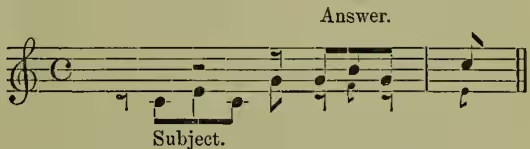
Fugue is the form of musical composition in which all devices of counterpoint, or the art of combining independent ideas in music, find their most fitting use. The laws which govern it are as strict as numerous, and can only be very generally summarised. The 'subject' chosen as the basis of the composition should present a complete and distinct individuality, which to be readily recognised in its permutations should be well marked. It is given out by any one part, and immediately taken up by a second—its follower or pursuer (fuga, 'a flight'). This 'answer,' as it is called, is identical in form with the subject, or slightly modified in accordance with a rule which requires the upper division of the octave (G to C in the scale of C) to correspond to and 'answer' the lower (C to G). During the 'answer' the first part supplies an accompaniment or 'counter-subject,' which should be a figure of contrasted character, and interesting enough to enable

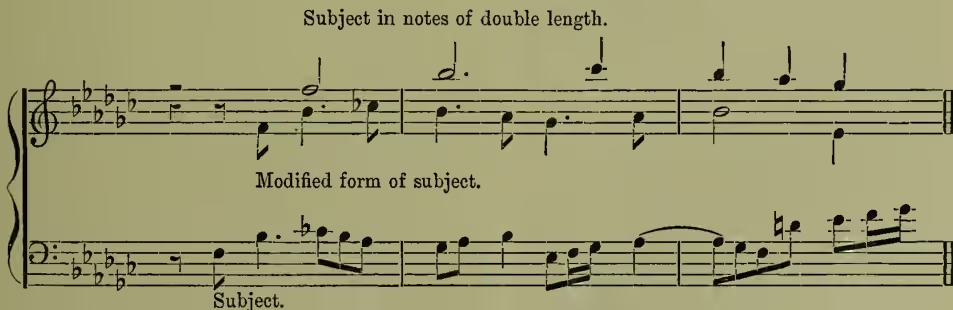
it to play its important part in the subsequent development. A third part joins by enouncing the subject, while a fourth, fifth, even a sixth part may be added, entering alternately with the answer, subject, and answer. The introduction of all the parts constitutes the first section, and is called the 'exposition.' During the development, which finds its place in the second section, the composer should show his skill in the use of imitation, canon, &c., and so arrange his material that the intricacy and interest gradually increase. Before the conclusion of the fugue he should present a stretto, in which the parts press on and overlap each other in their enunciations of the subject.
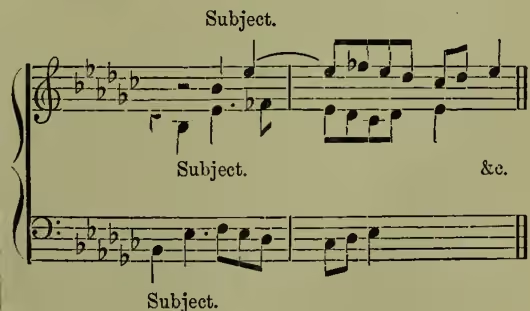
A 'pedal point'—a bass note held while the upper parts move in as skilful a complication as the composer can devise—usually precedes the final cadence. 'Episodes,' or matter connected or in character with the subject, may be introduced throughout the development to afford variety, but these must be short, and must not be allowed to distract the attention. When two or three subjects are treated simultaneously the fugue is called double or triple.
Formulated early in the history of modern music, the vocal fugue was elaborated during the 'golden age of counterpoint' in the end of the 16th century. A new world was opened to it by Frescobaldi, who freed it from the limitations of the human voice, and first wrote instrumental fugues. Sebastian Bach, in his vocal and instrumental fugues, shows a genius which has never been rivalled. Mendelssohn was peculiarly gifted in this branch of composition, and many vocal fugues with most brilliant and effective instrumental accompaniments are to be found in his oratorios.
Although fugues in composition and performance have always been more or less 'caviare to the general,' the opinion of sound musicians in the present as well as the past is unanimous as to their value, interest, and the beauty of those by the standard writers. Details in construction have continually changed and developed during the three centuries of the existence of fugues, and textbooks are as numerous as teachers. Those by Sir F. Gore Ouseley (prescribed at Oxford University); Jadassohn and his predecessor, Richter, of Leipzig Conservatorium; and Dr Higgs' Primer are probably of more use to-day than the famous works of Albrechtsberger, Reicha, &c. Bach's Art of Fugue is a collection of fifteen fugues, four canons, &c. on one subject—a practical and invaluable illustration from the hand of the greatest master of counterpoint. See article 'Fugue' in Stainer and Barrett's Dictionary of Musical Terms.