Furnaces. Furnaces perform one of the most important of functions, and on them largely depend the power and economical efficiency of the steam-engine. Great care and skill, combined with an intimate knowledge of the laws which regulate combustion, must be exercised in the designing and construction of furnaces for steam-boilers. They may be considered as divided into three parts. (1) The fire-chamber, where combustion begins, the fuel is split up into its constituent gases, and the remainder consumed. (2) The combustion-chamber, where combustion of the gases is completed, and the heat applied. (3) The arrangements for the supply of air, and its mixture with the heated gases. In the combustion of fuel there are two leading conditions to be observed—viz. to obtain as complete combustion of the fuel with as little waste of heat as possible, and to apply as much of the heat as is practicable to those parts of the boiler where evaporation will be greatest. These two conditions are somewhat difficult to realise in a furnace, and, while the best method of applying heat is well known, the portion available out of a given quantity bears but a very small proportion to what is lost or wasted under the most favourable circumstances. The supply of air is a most important factor; too much has the effect of chilling and diluting the gases, reducing the temperature of the furnace, and diminishing the force of the draught; while too little causes the gases to escape unconsumed, and results in great waste. The proper supply of air is therefore a very difficult matter to accomplish, especially when there is an ever-varying demand for it, as is the case with solid fuel. Liquid or gaseous fuel does not present the same variation. It has been found that the best effect is obtained from furnaces with forced draught—i.e. sending a steady flow of air under pressure through the incandescent fuel by means of a fan or other mechanical contrivance. With the ordinary chimney draught, the heated products of combustion must be allowed to escape at a high temperature, say 600°, and at a speed of about 30 feet per second, in order to maintain an effective draught. With artificial draught, the heat can be retained in the furnace a much longer time, and a balance established between the pressure of the atmosphere and the heat inside. Also the waste heat, instead of rushing away at great velocity, may be made to do work in heating the air for the furnace or the feed-water for the boiler; and is thus allowed to escape only when deprived of its power of doing useful work. The difference in efficiency is said to exceed 25 per cent. in favour of artificial draught.
A good furnace ought to be able to burn a large quantity of coal on a small area of fire-grate. The amount of fuel consumed in different kinds of furnaces varies greatly, and shows the power that forced draught gives. A land-boiler furnace burns about 14 lb. of coal, a marine furnace 16 to 24 lb., and a locomotive, with the draught increased by the escaping steam, from 80 to 200 lb. on the square foot of fire-grate in one hour. The great objects to be desired in furnace management are the exact apportionment of air to the varying wants of the fuel, so as to convert all the carbon to carbonic acid and the hydrogen to water, an equal and high temperature of the furnace, and that the grate-bars be always covered with fuel. Granted these conditions, and we obtain the best effect from the furnace, without smoke. Smoke may be caused by too much as well as too little air, especially with a low temperature in the furnace. Too much air reduces the heat of the furnace and gases below the temperature for combustion, and so smoke is formed. The same result comes from a deficient supply of air to take up all the carbon, a portion of which escapes as smoke. At the same time, with a high temperature in the furnace, insufficient air does not cause smoke; carbonic oxide instead of carbonic acid is formed, and one-half of the heat is wasted. In practice, deficient boiler power is a fertile cause of smoke, from having to urge the fire beyond its capacity. Self-feeding furnaces are more economical and efficient than those which are fed by hand.
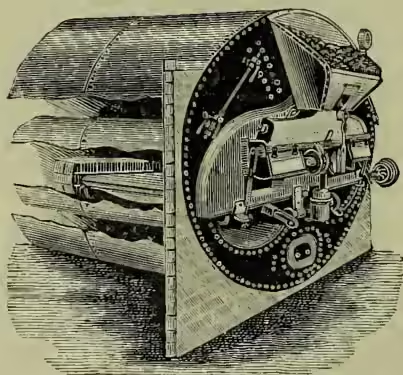
Fig. 1 shows one of the most successful. A large hopper fixed in front of the boiler contains a supply of fuel for a stated period, and requires no further attendance until its contents are consumed. There is an opening at the level of the grate, through which the coals are thrown on to the bars. It is claimed for this self-feeding furnace that it more nearly approaches in regularity firing by hand than any other in use, but there is no smoke when once in operation, and a saving of 10 per cent. in fuel. Figs. 2 and 3 show the best arrangement of flues. The flame on leaving the grate passes through the central tube, descends and returns along the bottom to the front, where it splits and passes on both sides to the chimney. For Blast-furnaces, &c., see GLASS, IRON, COPPER, LEAD, STEEL, REVERBERATORY FURNACE, ELECTRIC FURNACE; also BOILER, HEAT, OVEN, POTTERY, STEAM-ENGINE.