Furze (Ulex), a European genus of very branched and thorny shrubs, with linear sharply-pointed leaves, solitary flowers, and two-lipped calyx, belonging to the order Leguminosæ, sub-order Papilionaceæ. The Common Furze (U. europæus), also called Whin and Gorse, is common in many of the southern parts of Europe and in Britain, although not reaching any considerable elevation, and often suffering from the frost of severe winters; whereas in mild seasons its flowers may be seen all winter, hence the old proverb, 'Love is out of season when the furze is out of blossom.' It is hence scarcely known in any of the northern parts of the Continent; and Linnaeus is said to have burst into exclamations of grateful rapture when he first saw Wimbledon Common covered with furze bushes glowing in the profusion of their rich golden flowers. Furze is sometimes planted for hedges, but occupies great breadth of ground without readily acquiring sufficient strength; nor is it thickened by cutting.
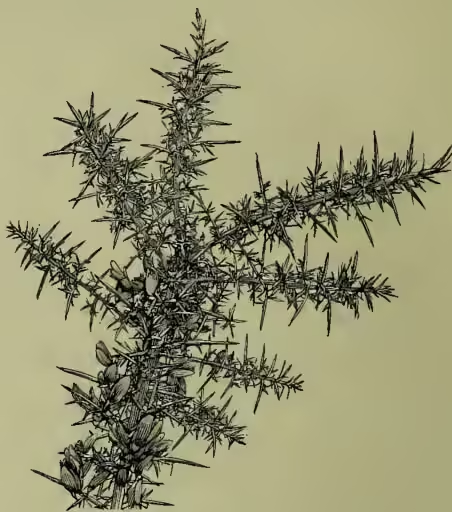
It affords a wholesome fodder, especially when young, or when its thorns are artificially bruised; it is also useful for sheep in winter, and on this account is burned down to the ground by sheep-farmers when its stems become too high and woody, so that a supply of green succulent shoots may be secured. Furze is also esteemed as a cover for rabbits, foxes, &c. A double-flowering variety is common in gardens. A very beautiful variety called Irish Furze (U. strictus for some botanists) is remarkable for its dense, compact, and erect branches; the Dwarf Furze (U. nanus) is perhaps also a mere variety.
The seedling whin is of interest as bearing two or more ternate leaves just after the cotyledons. These are followed by simple leaves, as in a shoot of broom, and thereafter the characteristic spiny leaves and branches soon begin to appear (see fig. 2, and compare those of seedlings in ACACIA).
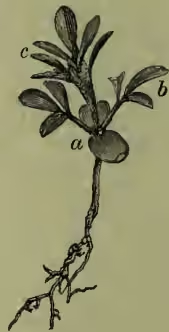
Seedling Furze:
a, cotyledons; b, first pair of leaves, ternate; c, succulent leaves, simple.