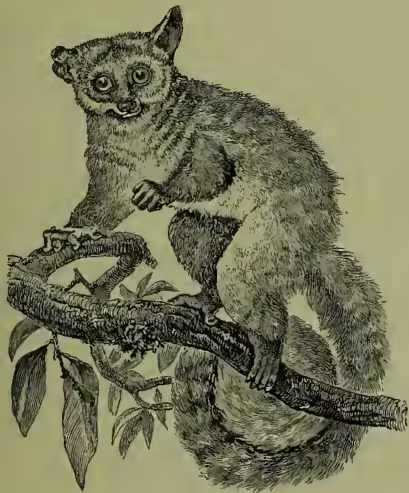
Galago, a genus of large-eared, long-tailed, African Lemurs (q.v.), arboreal and nocturnal in habit, living on fruit and insects. They vary from the size of a rabbit to that of a rat, are covered with thick soft woolly fur, have somewhat bushy tails longer than the body, and hind-legs longer and stronger than the arms, with two of the ankle bones (calcaneum and navicular) greatly elongated. The head is round like a cat's; the eyes are large with oval pupils contracting in daylight to vertical slits; the ears are naked and very big, expanded during activity, but rolled together when the animal rests. The digits are strong and well adapted for grasping the branches; all bear nails except the second on the hind-foot, which is clawed. The dentition suggests insectivorous rather than vegetarian diet. The female is said to bear one young one at a birth, and often carries it about. Soft nests are also made in the branches. The Galago proper (G. senegalensis or Otolonicus Galago) is a pretty animal with woolly fur, grayish fawn above, whitish beneath. It seems to be distributed throughout tropical Africa, and is known in Senegal as 'the gum animal' from its frequent habitat in mimosa or gum-acacia forests, and from its alleged habit of gum-chewing. They sleep with bowed head and tail curled round them during the day, but at night they are as active as birds, watching for moths and small animals, on which they spring with great adroitness. They are said to form a favourite article of food in Senegal. The largest species (G. or O. crassicaudatus) measures a foot in length, not including the bushy tail, which is 15 or 16 inches more. 'In Zanzibar the Komba (G. or O. agisymbanus) is said frequently to make itself intoxicated with palm-wine, so that it falls from the tree and gets caught.' It is readily tamed and utilised to catch insects and mice in the houses. There are numerous species, sometimes distributed in sub-genera.