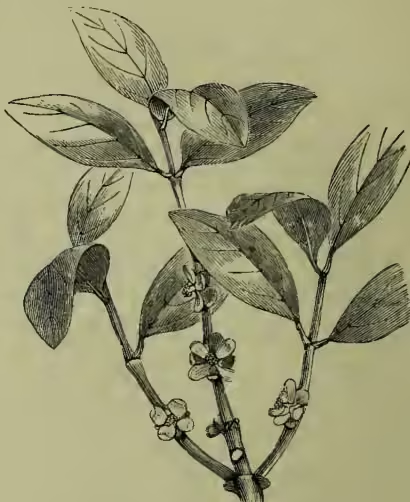
Gamboge, or CAMBOGE, a gum-resin, used in medicine and the arts, the produce chiefly of Garcinia Morella (Gambogia gutta or Hebradendron gambogioides), a tree of the order Guttiferae (sub-order Clusiaceæ), a native of Cambodia (hence the name), Ceylon, Siam, &c. The gamboge-tree attains a height of 40 feet, has smooth oval leaves, small polygamous flowers, and clusters of sweet and edible fruits. When the bark of the tree is wounded the gamboge exudes as a thick, viscid, yellow juice, which hardens by exposure to the air. It is generally collected in a joint of bamboo, and a single tree will yield sufficient to fill three joints 20 inches in length and inch in diameter. From this cause it is found in commerce in the form of sticks or cylinders having the markings of the bamboo on the outside. When of good quality it is of a rich, orange-brown tint, and should not show a rough granular surface when broken. Since yellow is a colour sacred to Buddha, gamboge is in much request in Singhalese temples, alike for vestments and decorations. The finest gamboge comes from Siam.—American gamboge, which is very similar, and is used for the same purposes, is obtained from Vismia guianensis, and other species, shrubs of the order Hypericæ. Gamboge occurs in commerce in three forms: (1) in rolls or solid cylinders; (2) in pipes or hollow cylinders; and (3) in cakes or amorphous masses. The first two kinds are the purest. Good gamboge contains about 70 per cent. of resin and 20 per cent. of gum, the remainder being made up of woody fibre, fecula, and moisture. Medicinally it acts as a violent purgative, seldom administered alone. It is employed in water-colour painting, in the staining of wood, and in the formation of a golden lacquer for brass. It can be readily bruised, forming a brilliant yellow, slightly inodorous powder, and possesses a disagreeable acrid taste.
—Gambrinus, a mythical king of Flanders, to whom is ascribed the invention of beer. His figure is familiar in German beer-cellars, often seated astride a cask, a foaming tankard in his hand.