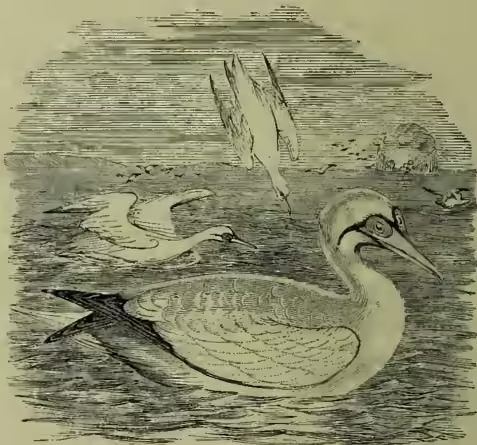
Gannet (Sula), a genus of web-footed birds, in the family Sulidae, and the order Steganopodes, which also includes pelicans, cormorants, and snake-birds. The head is large, the face and neck naked, the bill straight and strong, longer than the head; the toes (4) are long, and all connected by the web. The genus includes about eight species, from temperate and cold seas. They fly, swim, and dive well, but are awkward on land; they feed upon fishes, live socially, and nest in crowds on cliffs and rocky islands. The best-known species of Gannet is the Solan Goose (S. bassana), whose popular name is akin to the Icelandic sulan, 'a gannet,' while it derives its specific title from the Bass Rock of the Firth of Forth. It is common enough in north Europe from March to October, but migrates southwards—e.g. to Gibraltar, in late autumn. Lundy Isle, the Bass Rock, Ailsa Craig, St Kilda, Suliskerry, and Skellig (Ireland) are celebrated British breeding-places. The entire length of the solan goose is about three feet; its general colour milk-white, the crown and back of the head pale yellow, the quill-feathers of the wings black. The young bird, when newly hatched, has a naked bluish-black skin, but soon becomes covered with a thick white down, so that it resembles a powder-puff, or a mass of cotton. When the true feathers appear they are black, with lines and spots of dull white, so that the plumage of the young is very unlike that of maturity. The bird is long-lived, and takes about four years to come to maturity. It extends its flight to great distances from its rocky headquarters, pursuing shoals chiefly of such fish as swim near the surface, particularly herring, pilchards, and related forms. The presence of a shoal of pilchards often becomes known to the Cornwall fishermen from the attendant gannets. When feeding, the bird always flies against the wind at an altitude of not more than about 100 feet above the surface of the sea. When it espies a fish it instantaneously stops, and with wings half distended, stoops and swiftly cleaves the air. When within a yard or two of the surface, and just as it makes the plunge, the wings are clapped close to its sides. Thus the bird enters the water like a bolt. The nests on the rocks are roughly built of seaweeds and marine grasses, and are huddled together on the available ledges and nooks. The single egg has a chalky white colour, and the surface of the shell is rather rough. During incubation the goose will often allow itself to be touched with a stick without rising from the nest. The number of gannets that annually visit the Bass Rock in the Firth of Forth is estimated at from sixteen to twenty thousand. The young are killed by cliffmen who are lowered down the rock by a rope; they are valued for the sake of their down, flesh, and oil, which bring a profit to the person who rents the rock. On and around the Bass gannets are seen in prodigious numbers, the air around the rock being filled with them, like bees around a hive, and the rock itself whitened by them and their accumulated excrements. The deafening noise of the harsh cries they utter when they are excited or disturbed adds to the impressiveness of their snowflake-like numbers. The flesh is rank and oily; but that of the young, baked, is eaten to a considerable extent in many places, and is even reckoned a delicacy. The eggs are considered by many connoisseurs to be a decided delicacy. They are boiled for twenty minutes, and eaten cold, with vinegar, salt, and pepper. S. variegata, extremely abundant in some parts of the southern hemisphere, is said to be the chief producer of guano; and S. piscator is the well-known phlegmatic booby.