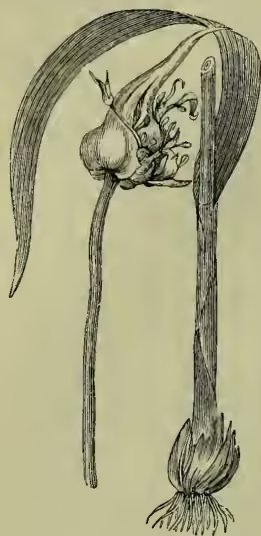
(Allium sativum).
Garlic (Allium sativum, see ALLIUM), an herb cultivated from the earliest ages on account of its wholesome and characteristically flavoured bulbs. These break readily up into a dozen or more 'cloves' or subordinate bulbs, which are the developed axillary buds of the exhausted scale-leaves of the parent bulb; and this circumstance is of much service, alike in cultivation and in regulating the quantity used in cooking. This varies greatly with national taste, from a maximum in Spain to a minimum in Britain. in Spain to a minimum in Britain. The plant seems to have been introduced along the Mediterranean from the East in very early times, its original home being perhaps the Kirghiz steppes: it is recorded as part of the rations of the Egyptian pyramid-builders, and there perhaps the Jews acquired their fondness for it. It was, however, forbidden to the priests of Isis. The Roman soldiers were given garlic as an excitant (whence the peace-loving maxim, allium ne comedas); and the same regimen was applied in the still recent days of cock-fighting. It had also many medicinal applications.—Many of the species of Allium are popularly called garlic, with some distinctive addition. A. olcraceum is sometimes called Wild Garlic in England, and its young and tender leaves are used as a pot-herb.
Garlic, OIL OF. When the leaves, seeds, or bulbs of garlic and other allied plants are distilled with steam, about 0.2 per cent. of a brown oil, with acrid taste and strong disagreeable odour, passes over. By purification it is obtained as a pale yellow oil having the odour of garlic, and it is then found to consist of the sulphide of allyl, . This oil is nearly related to the pungent oil of mustard, , an isomer of the sulphocyanide of allyl, and is of much interest chemically, but it is of no importance from an industrial or popular point of view.