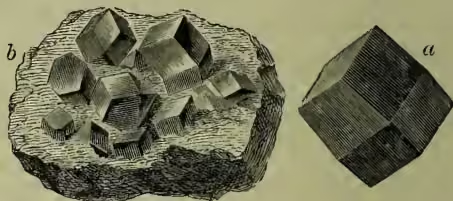
a, a detached crystal; b, portion of rock with embedded crystals.
Garnets, a group of minerals that crystallise in the cubical system. Their commonest form is the rhombic dodecahedron, or a combination of this with the icositetrahedron. Their composition may be represented by the general formula, , where ; . Thus we have lime-alumina, iron-alumina, magnesia-alumina, manganese-alumina, lime-iron, and lime-chrome garnets. Garnets have a hardness ranging from about 7 to 8. Their lustre is vitreous and resinous, and they are rarely transparent and very seldom colourless. The most common colour is some shade of red, but brown, yellow, green, and even black varieties are known. Some of the better known kinds are as follows:
Lime-alumina Garnets.—Grossular (grossula, 'a gooseberry'), so called from its green colour—the tint is usually rather pale—found in Siberia and in Norway; Essonite or Cinnamon-stone (q.v.); Succinite, amber-coloured, from Ala, Piedmont; Romanzovite, brown or brownish-black, from Kimito, in Finland.
Iron-alumina Garnets.—Almandine, the precious or oriental garnet of jewellers; red, transparent; occurs as a rock-constituent in many crystalline schists and granites, and occasionally also in trachyte, and is met with in the sands and alluvial soils which have resulted from the disintegration of such rocks, as in Ceylon, Pegu, Hindustan, Brazil, Greenland, Scotland, &c. Iron-alumina garnets are often crowded with enclosures, have a somewhat dull lustre, and are full of flaws; such are usually known as common garnet. Common garnet often occurs massive, and not infrequently forms a very considerable part of certain kinds of rock, as garnet-rock, eklogite, and granulite.
Magnesia-alumina Garnets.—These are somewhat uncommon—the best known being the black garnets from Arendal in Norway. Another is Pyrope, which is transparent and of a blood-red colour. Carbuncle (q.v.) is the name given by lapidaries to a pyrope cut en cabochon or ‘tallow-drop.’ It occurs in serpentine and in the loose soils derived from the breaking-up of that rock, as in Bohemia, where it is used as a gem. It does not occur in crystals, but in rounded or angular grains.
Manganese-alumina Garnets are met with, chiefly in small grains and crystals in schists and granites, near Aschaffenburg, in Spessart (Franconia); in the Ardennes, Piedmont, Connecticut, &c. The Franconian locality has given its name to this garnet—Spessartine, which is of a deep hyacinth or brownish-red. Many of the garnets which occur in the granites of Scotland are rich in magnesia, but from the abundance of ferric oxide which they contain they are included under the iron-alumina group.
Lime-iron Garnets.—Of these the most important is Melanite, velvet-black and opaque; it occurs as a rock-constituent in various volcanic rocks (phonolite, leucite-lava, and tuff), as at Frascati (Albano Mountains, near Rome), Laacher See, near the Rhine, Oberbergen (Kaiserstuhl), &c. Other varieties are Topazolite, yellow, green, and greenish-yellow; Aplome, green, brownish, and sometimes yellow.
Lime-chrome Garnets.—Uwarowite, an emerald-green garnet, translucent at the edges, found in the Urals.
The garnets of commerce are brought from Bohemia, Ceylon, Pegu, and Brazil; the most esteemed kinds (coming originally from Syriam, in Pegu) are vulgarly called Syrian garnets. They are violet-purple; and now and again very fine specimens almost vie in colour with the oriental anethyst. The stones vary in size from the smallest that can be worked to the size of a hazel-nut. Larger ones are common enough, but these are rarely free from flaws or impurities.