Garter, THE MOST NOBLE ORDER OF THE. This renowned order of knighthood was instituted by King Edward III., at what exact date has been matter of dispute, but most probably on 18th January 1344. Edward, having laid claim to the French throne, assumed the style of king of France. He had been partially successful in his first French campaign, and, meditating a second expedition, he resolved to institute an order of knighthood in honour of his successes past and to come, and as a means of rewarding some of his most distinguished comrades in arms. Hence the colour of the emblem chosen was blue, the French livery colour, and the motto, Honi soit qui mal y pense (i.e. 'Dishonoured be he who thinks ill of it'), was appropriate whether it applied to the French expedition or to the order itself. The tradition is that the choice of both emblem and motto was determined by a trivial incident. The Countess of Salisbury dropped her garter when dancing with the king, and the king, picking it up, tied it round his leg; but, observing the queen's jealous glances, he returned it to its fair owner with the remark, Honi soit qui mal y pense. The order was originally founded in honour of the Holy Trinity, the Virgin Mary, St George of Cappadocia, and St Edward the Confessor; but St George was always accounted its especial patron, so much that it has sometimes been called the 'Order of St George.' By the original constitution the Knights Companions were to be twenty-five in number exclusive of the sovereign, and were to assemble yearly on the eve of St George in St George's Chapel, where each was assigned a stall. Subsequent statutes authorised the admission into the order, in addition to the twenty-five companions, of foreigners of distinction, and such descendants of George II. (extended to descendants of George I. in 1831) as should be elected, always excepting the Prince of Wales, who was of necessity a companion; also of extra knights, which last, however, have always, on vacancies occurring, been incorporated into the number of the twenty-five companions.
The habits and ensigns of the order originally consisted of the garter, surcoat, mantle, and hood, to which were afterwards added the collar and George, the star, and the under habit.
This order has, unlike all others, for its principal emblem neither chain nor badge, but the garter, which, at first of light-blue silk with the motto sometimes set in pearls, rubies, and diamonds, is now of dark-blue velvet about an inch wide, with the motto in gold letters. It is worn on the left leg a little below the knee; and when the sovereign is a queen, she wears it, as sovereign of the order, on the left arm above the elbow. The statutes forbade the companions to appear in public without it, yet in the effigies on their monuments it is often wanting. The practice of surrounding the armorial insignia of the companions with the garter began in the reign of Henry V.; and the first sovereign on whose tomb this usage was complied with was Henry VII. An embroidered garter with the motto of the order seems to have been formerly worn on the left arm of the wives of companions.
The manifold variations in the colour, form, and material of the mantle, surcoat, and under habit at different times need not be described here. As at present worn, the mantle is of purple velvet lined with white taffeta, having on the left shoulder the badge of the order, namely, a silver escentcheon charged with a red cross for the arms of St George, and encircled with the garter and motto, as in the annexed cut. In chapters it is worn over the uniform or court dress. The surcoat, a short gown without sleeves, is made of crimson velvet lined like the mantle with white taffeta. The hood, worn on the right shoulder of the mantle, and now a meaningless appendage, is made of the same velvet as the surcoat, and similarly lined. When it ceased to serve its original purpose of a covering for the head, a cap was introduced in its place, which is now ornamented with ostrich-feathers, and in the centre of them a lofty tuft of black heron's feathers, the whole attached to the hat by a clasp of diamonds.
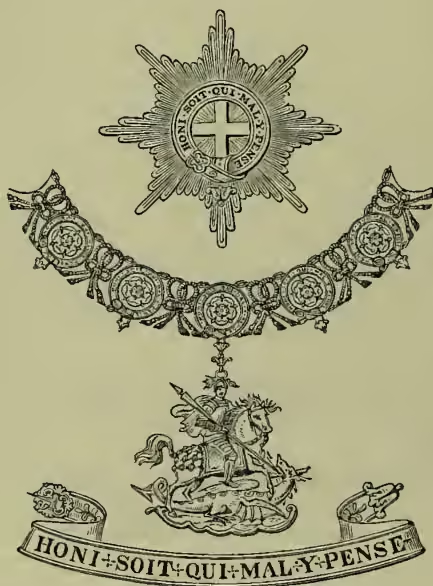
Star, Collar and George, and Garter.
The under habit, introduced by Charles II., need not be described in detail, and the costume is completed by white silk hose and white shoes and red heels. The garter worn on the right leg is of white silver riband with a large silver rosette. The sword is straight, of an ancient pattern with a cross-guard hilt, all gilt, the scabbard of crimson velvet.
The collar was introduced by Henry VII., probably in consideration of a similar ornament being the principal ensign of the Golden Fleece and other orders instituted in the 15th century; but it was first ordered to be worn in 1544. It consists of twenty-six pieces in which interlaced knots of cords alternate with double roses, each surrounded with the garter and its motto, these roses being alternately white within red and red within white; and pendent from one of the roses is the George, or figure of St George piercing the dragon. The collar and George were appointed to be worn on all solemn feasts; and provision was also made for a lesser George to be worn on other occasions attached to a chain or lace of silk, for which was afterwards substituted a dark-blue riband. The lesser George is surrounded with the garter and motto.
In respect that the mantle on which are the arms of St George within the garter is only worn on special occasions, Charles I. in 1626 introduced another badge to be worn on the cloak or coat, in which the cross of St George (not in a shield) is surrounded by the garter, and, to make it more splendid, ordered the whole to be surrounded with rays of silver. While the badge worn on the ordinary dress, popularly known as the star, is thus irradiated, that on the mantle has remained unaltered.
On the occurrence of a vacancy, a chapter (consisting of the sovereign and six knights) is appointed to meet, in which the new companion is elected, the election being practically a form, and the choice lying with the sovereign. The knight elect, if at hand, appears and is invested. If absent, the garter and George are sent him by Garter King of Arms. In case of a foreign prince being elected, some person of distinction is sent along with Garter to invest him. In later times, the ceremony of election has often been dispensed with, the investiture taking place privately, and the ceremonies connected with installation are now done away with. Each knight has his stall in St George's Chapel, Windsor; the knight elect used to get his predecessor's stall, but a system of promotion has latterly been introduced. The garter-plates of the knights, containing their arms and style, remain permanently, and those placed there in the reign of Henry VII. rank among the most valuable heraldic relics in Europe.
The officers of the order are the Prelate, who has always been the Bishop of Winchester; the Chancellor, formerly the Bishop of Salisbury, now (in consequence of a change in the division of the respective sees) the Bishop of Oxford; the Registrar, who is the Dean of Windsor; Garter King of Arms; and the Gentleman Usher of the Black Rod.
Knights of the Garter write K.G. after their names. Though the military character of this fraternity no longer exists, it has retained till the present day its pre-eminence among the orders of knighthood of Europe. For two centuries past the twenty-five companions have been almost exclusively peers or the eldest sons of peers. See Ashmole's Institution, Laws, and Ceremonies of the Order of the Garter (1672); and Sir Harris Nicolas' History of British Orders of Knighthood (1842).