Gas and Gases. Gas, a term applied by Von Helmont (1577-1644) to vapour not yet shown to be condensable, and possibly suggested by the Dutch geest, 'spirit,' 'ghost.' It now signifies either (1) a vaporous substance not condensed into a liquid at ordinary terrestrial temperatures and pressures, or (2) one which at ordinary temperatures is not condensable into a liquid by pressure alone. In both these senses, air under ordinary atmospheric conditions is a gas; when cold enough it is not a gas but a vapour, and pressure alone can then condense it. Sulphurous acid gas is ordinarily gaseous, but it is a 'vapour' because pressure alone will condense it at ordinary temperatures. Above 30.92° C. (87.67 F.) carbonic acid is a true gas; no pressure will then liquefy it; but at 30.92° C. a pressure of 77 atmospheres, and below 30.92° C. progressively smaller pressures will condense it; at and below that temperature (Andrews's Critical Temperature) gaseous carbonic acid is a 'vapour,' condensable by pressure alone. Saturated steam is, in the same sense, a permanent gas at all temperatures above 720.6° C.; it cannot be liquefied by pressure unless its temperature be below that limit. The critical temperature for hydrogen is - 240.4° C.; but the lowest temperature that has been actually produced (by the evaporation of liquid oxygen into a vacuum) is - 223° C. (Wroblewski); hydrogen alone among gases has not yet been condensed. It was believed that Messrs Cailletet of Paris and Raoul Pictet of Geneva had, in 1877, succeeded in condensing hydrogen as well as all the other gases then believed to be non-condensable; but as to hydrogen this is now considered doubtful. Hydrogen conducts itself under varying pressures and temperatures in such a way as to show that, if it could be exposed to - 240.4° C., 13.3 atmospheres' pressure would condense it (Wroblewski).
Gases have small densities: hydrogen has, compared with water, a density, at 0° C. and 760 mm. barometric pressure (32° F. and 29.922 in.), of 0.0000895682, and air a density of 0.0012932. Taking hydrogen as a standard, oxygen is very nearly 16 times, nitrogen 14, air 14.47, carbonic acid 22 times as heavy.
Gases have no free surface-boundary, but occupy any space within which they may be confined. The smaller the space within which a given quantity of gas is confined, the greater is the expansive pressure which it exerts on the walls of the containing vessel; approximately, for a given quantity at a given temperature, the pressure varies inversely as the volume (Boyle's Law, Mariotte's Law), or the pressure multiplied by the volume gives a constant product: . This law is fairly well obeyed by such gases as air; but in all gases, other than hydrogen, it is observed that there is with progressively increasing pressures a fall in the value of the product , which attains a minimum and then rises; and even with hydrogen the apparent exception has been removed by the labours of Wroblewski, who found that at very low temperatures the same phenomena were observed in that gas; and that, in general, if we draw curves representing, for a series of gases, the respective pressures at which the minimal values of occur at various temperatures, then if our diagrams are so plotted out as to represent the respective temperatures and pressures in terms not of degrees or millimetres, but as multiples of the critical temperature (measured from - 273° C. as absolute zero) and of the corresponding critical pressure of each gas, the curves are, for all gases, the same. Under circumstances which are similar with respect to the critical temperature and pressure, therefore, all gases behave similarly in this respect; and hydrogen acts at - 183° C. (the temperature of boiling oxygen), but not at - 103.5° C. (the temperature of boiling ethylene), like air and other gases at ordinary terrestrial temperatures. Carbonic acid gas, in order to act like hydrogen at - 103.5° C., must be at a temperature of about 1287° C.; both are then at a temperature about five times their respective critical temperatures, measured from absolute zero. When the temperature of a given quantity of gas is altered, the product is altered so as, to a first approximation, to be proportional to the absolute temperature (- 273° C. = 0° Abs.). There are, however, some abnormalities: keep the pressure constant and let the volume increase, and we have a certain coefficient of expansion under constant pressure, which is approximately of the bulk at 0° C. for each C. degree of increase in temperature; keep the volume constant and let the pressure increase, and we have a coefficient of increase in expansive pressure, which ought to be the same and is very nearly the same as the previous coefficient; but not exactly so. The former coefficient is, except in hydrogen, a very little larger than the latter; in the readily condensable gases the product rises more rapidly than the absolute temperature; and with progressively ascending pressures, the rate of increase of itself rises more markedly in the easily condensable gases than in air. These phenomena indicate the existence of inter-molecular forces between the particles of a gas, which manifest themselves the more clearly the nearer is the approach towards liquefaction; when the liquid state has been reached there is cohesion within the liquid. That gases are compressible by increase of pressure above the atmospheric, as well as dilatable by diminution of pressure, follows from what has been said; if the pressure be doubled the volume will be halved, and vice versa. When gases are compressed, work is done upon them, and the compressed gas tends to expand; when the pressure is wholly or partly relieved, the gas expands and does work, as in the air-gun or in compressed-air machines. The pressure at all points in the same horizontal level is, or soon becomes, the same; whence, if pressure be applied to one part of a mass of gas, the pressure is soon transmitted throughout the whole, and thus energy may be conveyed, even to considerable distances. The restitution-pressure tending to cause expansion is equal to the external pressure applied, and the coefficient of elasticity is at all temperatures, provided there is no change of temperature during the compression, numerically equal to the pressure; while if the compression could be so conducted as to allow absolutely no heat to escape, the elasticity, in air, would be numerically 1.406 times as great as the pressure. Through this elasticity of gases, local displacements set up wave-motions, which, mostly in air, are the usual cause of sound. The speed of propagation of such waves (unhampered by boundary walls) is equal to the square root of the quotient of the coefficient of elasticity divided by the density; and thus the velocity of sound is, within the same gas, independent of the pressure (for the pressure and the density are directly proportional to one another). It is, however, directly proportional to the square root of the absolute temperature.
According to Dalton's Law, when a number of gases are mixed, each exerts its own pressure according to the quantity in which it is present; this law is the less perfectly obeyed the nearer the gases are to their condensing temperatures, and the greater their mutual solvent action. When a gas is greatly rarefied, a small mass holds possession of a relatively great space; such a space is called a vacuum, which in fact it is not, for two reasons—that the ether of space is not eliminated, and that traces of the gas (one hundred-millionth of an atmosphere in the best vacua) are always retained. If two gases be placed at different levels in a vessel, even with the lighter gas uppermost, they will rapidly diffuse into one another, and even if connected only by a long glass tube they will soon mix, and will not thereafter separate. This is due to molecular movement, and dust-particles are not appreciably transferred; thus the dust of a closet is not removed, though the air is renewed, by opening the door. If, however, the two gases to be exchanged be of notably different densities, there may be a pressure resulting from the tendency of the lighter gas to pass more rapidly into the heavier than the heavier one travels into it. The rate of mixing by diffusion between two gases is measured by their coefficient of diffusivity, which is to be experimentally found. The significance of this coefficient is that where we, adopting a consistent system of units, say centimetre, gramme, and second, state in the shape of a formula the known laws of gaseous diffusion—viz. that (1) the quantity of matter transferred across any layer is inversely proportional to the thickness of that layer, (2) that it is directly proportional to the area exposed, (3) directly proportional to the time taken, and also (4) to the difference of densities on either side of the layer—we may convert this formal statement of proportions into a numerical identity by inserting the proper numerical factor or coefficient; thus if be the number of grammes transferred, the area exposed in sq. cm., the thickness of the layer, the time, and the difference of densities, is proportional to , or equal to , where is the coefficient of diffusivity. But becomes a different number when we change our units of length or time; it varies numerically according to the square of the unit of length, and inversely according to the unit of time adopted, and hence the coefficient of diffusivity is usually stated as being so many square centimetres per second. Some numerical values for this coefficient will be found in Clerk-Maxwell's Theory of Heat (appendix).
Diffusion in gases has also been measured in another way. Hydrogen separated from the outer air by a plaster-of-Paris plug, escapes into the air about four times as fast as air traverses the plug in order to get into the hydrogen. The law is that the rate of traversing the plug is inversely proportional to the square root of the density of the gas; or, in terms of the kinetic theory of gases, it is directly proportional to the average velocity of the molecules of each gas. The rates at which gases will traverse a single small aperture ('effusion') are within the limits of experimental error, in accordance with the same law. The rates at which gases slowly pass under pressure through extremely fine long tubes, or are 'transpired,' have no relation to the diffusion or effusion rates; the mass of gas passing per second varies as the motive pressure, as the density, and inversely as the length of the tube, and also as a coefficient of transpiration special to each gas, and presenting from gas to gas certain coincidences as yet unexplained (see Graham's Collected Works, or Miller's Chemical Physics). The rate is slower the higher the temperature, but is independent of the material of the tube.
When gases are separated by membranes, in which they are unequally soluble, or for which they have unequal affinities, the diffusion-rates are interfered with and become abnormal—e.g. benzol-vapour and air separated by a thin india-rubber membrane; the benzol traverses, the air does not. Thus also carbonic oxide, an extremely poisonous gas, may traverse red-hot cast-iron, a fact to be kept in mind in reference to overheated stoves. This is due to solution of the gas in the solid, which behaves like a liquid film in reference to it. Gases are also condensed on the surface of solids; every solid object bears a condensed film of air on its surface; some substances have enormous power of condensation, notably cocoa-nut charcoal (Hunter), which absorbs 170 times its own volume of ammonia, 69 of carbonic acid, 44 of water-vapour. This power is beneficially utilised in charcoal respirators, in which oxygen and oxidisable gases are condensed together and combine; and in Döbereiner's hydrogen lamp, in which hydrogen plays upon platinum black, and is condensed so rapidly (perhaps being oxidised at the same time) that the platinum becomes incandescent and ignites the hydrogen jet.
The superficial film of air on solids plays a part in friction in air; a pendulum has the amplitude of its swing slightly diminished by this friction: a waterfall drags air down and is retarded by this frictional action; and the examples of railway trains and cannon-balls will readily occur. The slide-valve of a steam-engine is pressed upon by the steam, and this gives rise to friction.
Gases are in many cases soluble in liquids; some are greatly so (ammonia in water at ., 1049.6 volumes; at ., 654 volumes), some slightly (hydrogen in water at ., 0.0193 volume). The general rule is (Henry's Law) that, at any given temperature, the volume of gas dissolved is constant at all pressures, so that the quantity of gas dissolved is proportional to the pressure; and on liberation from pressure some of the gas escapes. This law is interfered with in most cases by the formation of chemical compounds (hydrates) between the water and the gas dissolved. Again, when a mixture of gases is presented to a liquid, the general rule is that each is dissolved in proportion to the partial pressure exerted by it, combined with its own specific solubility in the liquid: thus the small quantity of air dissolved in water, which subserves the respiration of aquatic life, contains 34.82 per cent. of oxygen instead of 20.9 per cent., as air does, because oxygen is more soluble in water than nitrogen is. Where, however, the gases have a mutual chemical action, this rule is completely departed from. One effect of the formation of hydrates may be that the gas is not expellable by boiling: hydrochloric acid gas is an example: a certain excess of gas may be driven off by heat, but beyond that the aqueous solution of hydrochloric acid distils over as a whole: ammonia gas or carbonic acid, on the other hand, may be completely driven off from water, any feeble hydrates formed being decomposed. Gases may, it appears, dissolve gases; oxygen evolved from chlorate of potash may (Schützenberger) contain chlorine unrecognisable by any chemical test until a red heat has been applied; and it seems that there is no case of evaporation without the vapour carrying off some of the solids dissolved in the evaporating liquid, a phenomenon specially observed in the case of boracic acid solutions, and also in the case of coal-gas, which may, especially when rich in the vapour of liquid hydrocarbons, carry much solid naphthaline in a state of invisible suspension approximating to true solution.
Gases are to a certain extent viscous; air or steam in motion will drag the surrounding air along with it, and will thereby have its own motion checked. Wave-motion set up in air may travel far, but has at length its energy worn down into heat through the viscosity of the air. Air is at . about a hundred times less viscous than water is, and at . it is only about twelve times less viscous than water at that temperature. The viscosity of any given gas, dynamically measured, does not vary with its density.
Gases also possess a feeble power of conducting heat by a kind of diffusion and redistribution of energy of heat-motion. In hydrogen a heated wire is very rapidly cooled; in a heavier gas, less rapidly so. The conductivity of air, when the heat conducted is reckoned in units such that each will raise a cubic cm. of the substance (air) itself through one degree Centigrade, is 0.256; under similar conditions that of iron is 0.183, and that of copper is 1.077; so that the rate of propagation of thermal effects in air is intermediate between that in iron and that in copper. This apparently high rate is due to the small density of air and to its low specific heat; and when we turn to the actual propagation of heat-energy as distinguished from that of temperature, we find the conductivity of air, in this sense, to be only about one 20,000th that of copper.
Gases have as a rule small specific heat: air has at constant pressure a specific heat = 0.2375, at constant volume, 0.1684; that is, to raise a pound of air 1°, allowing it to expand, takes 0.2375 as much heat as it would take to raise a pound of water, whereas if it be not allowed to expand and thereby absorb energy, it will take only 0.1684 times as much. The specific heat of gases is stated in tables with reference to 'air = 0.2375' as a starting-point; an equal volume of hydrogen has a specific heat at constant pressure = 0.2359, and, roughly, equal volumes of all the ordinary gases have equal thermal capacities; but ordinary vapours have, volume for volume, much greater thermal capacities than ordinary gases. Hydrogen has a specific heat, weight for weight, 3.0490 times (at constant pressure) as great as water; and it is the solitary exception to the statement that water has of all substances the highest specific heat. In general the specific heat of a gas at constant pressure is about 1.4 times its specific heat at constant volume; in the latter case no heat is absorbed in doing the work of expansion against resistance. The specific heat of gases rises slightly with increasing temperature (Mallard and Le Châtelier), and this becomes at furnace heats very well marked; at 2000° C. the specific heats of carbonic acid and water-vapour are double, and those of nitrogen, oxygen, and carbonic oxide about one and a half times as great as what they are at 200° C.
Different gases have different actions upon radiant heat and light; they characteristically absorb special portions of the heat and light spectrum, and thus produce absorption bands: the dark lines A and B seen in the solar spectrum are traced by Egoroff and Khamantoff to the absorptive action of oxygen. In some gases the absorption is carried so far that the gas appears coloured—e.g. chlorine, which is yellowish-green: iodine vapour in comparatively thin layers allows only red and blue light to pass, and thus appears purple; in thicker layers only blue light passes. On the whole, however, gases are poor absorbers and correspondingly poor radiators: there is comparatively little radiation from a Bunsen flame. At the same time the radiation from an incandescent gas tends to be very precise in its frequencies; it tends to produce line-spectra as distinguished from the continuous spectrum produced by the mutually jolting particles of an incandescent solid. Each gas has its own index of refraction also; oxygen has, for example, as compared with vacuum, a mean index at atmospheric pressure of 1.000272. In vapours the dispersion is great; and iodine vapour strangely refracts red most and violet least.
In Electricity (q.v.) the different gases have different properties which sometimes present curious anomalies; air at ordinary pressures is an insulator; warm air at rest is an insulator, but above a Bunsen burner it is a conductor; at low pressures it conducts and glows while con- ducting; at extremely low pressures it is again an insulator. Different gases set up different potential-differences between themselves and metals with which they may be in contact, as in gas-batteries, and they have different specific inductive capacities.—Oxygen is magnetic in the same sense as iron; hydrogen and nitrogen are diamagnetic, and tend to lay themselves across the poles of a magnet. See also MATTER.
ANALYSIS OF GASES.—The gas is collected in small glass vessels, the contents of which, consisting of mercury, water, or air, are displaced by the gas to be analysed. For the best methods of collecting gases from mineral springs and waters, from volcanic lakes, geysers, or boiling springs, from openings in rocks, clefts of glaciers, furnaces, fissures in volcanic craters, &c., reference may be made to Bunsen's Gasometry, translated by Roscoe. Air is only used when a considerable current of the gas to be analysed can be procured, which may sweep out the last traces of air from the collecting vessel. Water often affects the composition of mixed gases which it is attempted to collect over it; for to various extents it absorbs, among others, hydrochloric, hydriodic, hydrobromic, and sulphurous acid gases, chlorine, sulphuretted hydrogen, ammonia, fluoride and chloride of boron, methyl- and ethyl-amine, methyl chloride and methyl ether, cyanogen, and chlorine cyanide; and it decomposes silicon fluoride with precipitation of gelatinous silicic acid. Mercury is generally employed because it is inert to most gases; but it is attacked by chlorine, which it absorbs.
There are two leading principles made use of in the analysis of gases. First, a given volume is subjected to a chemical reaction, which results in the condensation of one of the constituents of the gaseous mixture or compound; then by simple observation, or from the known laws of gaseous volume, it is determined how great a volume of the original gas has disappeared through being amenable to the reaction employed, and, accordingly, how great a proportion of the constituent in question was originally present. In the case of air, for example, a measured volume may be exposed to the absorptive action of a strong alkaline solution of pyrogallol; the solution becomes dark; the oxygen is absorbed; the original volume of air is diminished; the loss of volume is ascertained, and represents the quantity of oxygen originally present in the measured volume of air. Or again, if the mixture of gases be a somewhat more complicated one, as, for example, a mixture of carbonic acid and oxide, olefiant gas, and oxygen, the various absorbent reagents appropriate to each constituent may be successively introduced, and the successive shrinkages noted by remeasurement at the original temperature and pressure. A few drops of a solution of caustic potash will in this way take up the carbonic acid; pyrogallol will take up the oxygen; anhydrous sulphuric acid dissolved in oil of vitriol, and introduced on a coke-pellet, will slowly take up the olefiant gas, and the sulphurous acid and anhydrous sulphuric acid vapour, which contaminate the gas after this reaction, may be removed by caustic potash; and carbonic oxide may be absorbed by means of a solution of cuprous chloride (prepared by leaving copper turnings with a saturated solution of cupric chloride in a stoppered bottle for some days), which will take it up in about ten minutes. The principal absorption reagents are (1) caustic potash solution, which absorbs sulphuretted hydrogen, hydrochloric, carbonic, sulphurous, and other acid gases, chloride and fluoride of boron, and chloride of cyanogen, and decomposes silicon-retted hydrogen with evolution of 4 volumes of hydrogen; (2) dry caustic potash, which acts like the solution, but more slowly, and also absorbs water-vapour; (3) alcoholic solution of caustic potash, which also absorbs bisulphide of carbon; (4) alkalinised solution of pyrogallol—oxygen; (5) phosphorus—oxygen; (6) cuprous chloride dissolved in hydrochloric acid—oxygen, carbonic oxide, acetylene, and allylene; (7) the same dissolved in ammonia, which absorbs also the hydrocarbons of the olefine series; (8) dilute sulphuric acid—ammonia, methyl-amine, and other amines; (9) strong sulphuric acid—water, alcohol, methyl ether, propylene and its homologues; ethylene slowly, hydrogen and marsh gas not at all; (10) Nordhäusern sulphuric acid, which absorbs the olefines, not hydrogen or the marsh-gas series; (11) concentrated aqueous solution of sulphate of iron, which absorbs nitric oxide; (12) bromine, which in presence of water acts like Nordhäusern sulphuric acid; (13) sulphur, which absorbs sulphuretted hydrogen, sulphurous acid, and bisulphide of carbon; (14) chromous sulphate, to which ammonium chloride and ammonia have been added, absorbs hydrogen, nitric oxide, acetylene, and allylene; (15) alcohol absorbs chloride of cyanogen, methyl chloride, methyl ether, and cyanogen; (16) mercuric oxide—cyanogen; (17) lead acetate—sulphuretted hydrogen; (18) lead peroxide—sulphurous acid. Analyses conducted by the aid of such reagents are direct; and on the same principle of observation of shrinkage we may also employ explosion-reactions. In the case of air we take a measured volume and add to it about half its bulk of hydrogen, observing precisely what volume we add. In this case the graduated tubular vessel, in which the gas is contained, has two platinum wires fused into it so as to approach one another within the vessel; our vessel is then called a Eudiometer. An electric spark is made to leap across the interval between the two wires; an explosion occurs; part of the hydrogen of the mixture combines with the whole of the oxygen; presently the aqueous vapour formed condenses, and the volume of the mixture becomes, at the former temperature and pressure, considerably less than it was before the explosion. The shrinkage is measured; the gas which has disappeared consisted, for every three volumes, of two of hydrogen and one of oxygen. One-third of the shrinkage, therefore, represents the amount of oxygen present in the air acted upon; and in the case of air the balance of the original volume is taken (if the air had been freed from moisture and carbonic acid) as consisting wholly of nitrogen (including argon). In more complicated mixtures the explosion-reactions lead to more complicated processes and calculations. For example, if we have a mixture of hydrogen, methane, carbonic oxide, and nitrogen (which corresponds to coal-gas that has been passed through potash solution and has stood over strong oil of vitriol), we first explode a known volume of the mixture with an excess of oxygen. The shrinkage is observed, and then potash solution is introduced in order to remove the carbonic acid formed by the combustion of the methane and the carbonic oxide. The nitrogen alone now remains, together with the excess of oxygen; and the amount of the latter is determined by another explosion with hydrogen, whence the amount of nitrogen may be determined; and from this we find the volume of combustible gas originally present in the mixture. We now know (1) the volume originally used (A); (2) the volume of combustible gas therein contained (B); (3) the contraction of volume on explosion (C); and (4) the volume of carbonic acid generated on explosion (D). We also know that when hydrogen is exploded with an excess of oxygen the combustion of one volume of hydrogen causes the condensation of volume of hydrogen; that the combustion of 1 volume of carbonic oxide similarly causes a shrinkage of volume, and the production of 1 volume of carbonic acid; and that the combustion of 1 volume of methane (light carburetted hydrogen, marsh-gas, ) produces a shrinkage of 2 volumes and the formation of 1 volume of . Hence we find that the shrinkage C is made up of the original H-volume , plus the CO-volume , plus the -volume ; and that the carbonic acid (= D) is equal to the CO-volume plus the volume; and if we set down these statements algebraically, writing for the original volume of nitrogen, for that of hydrogen, and for those of carbonic oxide and marsh-gas, we have the equations ; ; ; and , from which , , , may be readily found and thereafter reduced to percentages. If any of these quantities, , , , , be found equal to 0 (or to a small negative quantity), the corresponding gas is not present in the mixture.
The apparatus made use of varies from a simple graduated tubular vessel to the more elaborate compensating apparatus now in use. The object of compensation is to enable the volume of the gas to be ascertained without calculation for correction.
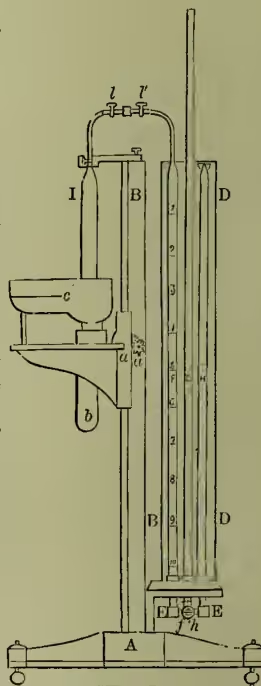
We may refer by way of illustration to the apparatus of Frankland and Ward, which is fully explained in Williams' Handbook of Chemical Manipulation, as well as in Messrs Frankland and Ward's memoir in the Quarterly Journal of the Chemical Society. We take as an example an explosion-analysis of atmospheric air. A few (three or four) cubic inches of air, freed from carbonic acid, having been introduced into the tube, I, it is transferred into F for measurement by opening the cocks, , , and placing the tube, I, in connection with the exit-pipe, ; the transference can be assisted, if necessary, by elevating the mercurial trough, C. (The part marked in the figure is merely the tubular well of the mercurial trough, C.) When the air, followed by a few drops of mercury, has passed completely into F, the cock, , is shut, and turned, so as to connect F and H with . Mercury is allowed to flow out until a vacuum of two or three inches in length is formed in H, and the metal in F is just below one of the graduated divisions; the cock, , is then reversed, and mercury very gradually admitted from G, until the highest point in F exactly corresponds with one of the divisions upon that tube; we will assume it to be the sixth division, there being ten divisions in all. This adjustment of mercury, and the subsequent readings, can be very accurately made by means of a small horizontal telescope, placed at a distance of about six feet, and sliding on a vertical rod. The height of the mercury in H must now be accurately determined; and if from the number thus read off the height of the sixth division above the zero of the scale in H is deducted (the scale on H is not marked in the figure), the remainder will express the true volume of the gas, no corrections being required for variations of temperature, atmospheric pressure, tension of aqueous vapour, &c.
Hydrogen, in the proportion of half the volume of the air used, must now be passed into I, and from thence into F, when the volume of the mixed gases must be again determined as before. An electric spark must now be passed through the mixed gases in F by means of the platinum wires at m (near the top of F). A slight explosion occurs, after which we observe a considerable contraction in the volume of the mixed gases, and one-third of this shrinkage represents the volume of oxygen.
The objection to this kind of gas-analysis is its comparative slowness. When we wish to control the process of coal-gas-making, it is necessary to collect a series of specimens during the progress of the decomposition, but the results of gas-analysis are rarely available with useful expedition. Where it is sufficient to trace up one special constituent, such as sulphuretted hydrogen in coal-gas or carbonic acid in ventilation-experiments, results of considerable value may be attained by passing known volumes of the gas through a known quantity of a test-liquid, or shaking it up with it, and measuring by titration the amount of the reagent unaffected by the particular constituent of the gas; or, more rapidly, by the gradual addition of one to the other until the mutual reaction ceases. For instance, 100 cubic cm. of crude coal-gas may have successive instalments of a dilute solution of iodine of known strength brought into contact with it; when the reaction ceases the iodine solution ceases to be decolorised by the sulphuretted hydrogen, and if starch be present a blue tint will be struck.