Gas-engine. Gas-engines are heat-engines of a type in which the fuel is combustible gas, which is burned within the engine itself. In all heat-engines there is a working substance, which is alternately heated and cooled, and does work by alternate expansion and contraction of its volume, thereby converting into mechanical form a portion of the energy which is communicated to it as heat. In most heat-engines the combustion of the fuel which supplies heat to the working substance goes on outside of the vessels within which the working substance is contained: the steam-engine is a characteristic example of this class. Gas-engines, on the other hand, belong to the internal combustion class: the working substance is made up of the fuel itself—before and after combustion—along with a certain quantity of diluting air. Internal combustion engines have the enormous advantage that there is no heating surface of metal through which the heat must pass on its way to the working substance. The existence of a heating surface in the external combustion engine imposes practically a somewhat low limit upon the highest temperature to which the working substance may be raised. In gas-engines a far higher temperature is practicable, and the result is that it becomes possible to convert a larger fraction of the heat into work. The theory of Thermodynamics (q.v.) shows that even the most efficient conceivable heat-engine can convert into work no more than a certain fraction of the heat supplied to it—a fraction which is increased by increasing the range through which the temperature of the working substance is caused to vary. This range is much greater in the gas-engine than in the steam-engine, and the ideal efficiency—that is to say, the fraction of the heat convertible into work—is consequently greater. In practice, although the gas-engine as yet falls short of its ideal efficiency to a much greater extent than does the steam-engine, it is actually the more efficient of the two. A pound of fuel converted into gas and used in a modern gas engine gives a better return in mechanical work than if it were burned in the furnace of a steam-engine of the most economical type. For small powers the gas-engine has the great practical merit, as compared with the steam-engine, of dispensing with the attendance which a boiler and furnace would require. This consideration has made it in many thousands of cases an economical motor even when the gas it uses is of the comparatively costly kind supplied for illuminating purposes.
From the year 1823 onwards a number of proposals were made by Brown, Wright, Barnett, and others for the construction of engines to work by the explosive combustion of gas. Although in some instances these inventions anticipated later successful engines, and although the details were often carefully elaborated, no practical success was attained till 1860, when an effective gas-engine was brought into public use by M. Lenoir.
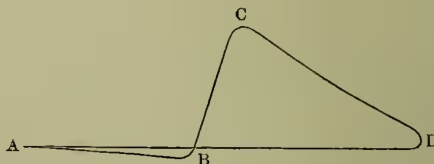
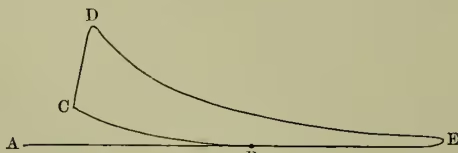
Lenoir's engine resembled in appearance a single-cylinder horizontal steam-engine. As the piston advanced it drew in an explosive mixture of gas and air. About mid-stroke this was ignited by an electric spark, and for the remainder of the stroke work was done through the pressure of the hot products of the explosion. During the back-stroke these products were expelled to the atmosphere, while on the other side of the piston a fresh explosive mixture was being taken in and exploded at mid-stroke as before. To keep the cylinder cool enough to admit of lubrication it was surrounded by an external casing within which cold water was caused to circulate. This water-jacket has continued to be a feature of nearly all modern gas-engines. An indicator-diagram from Lenoir's engine is shown in fig. 1. From A to B the gas and air are being sucked in. The rapid rise of pressure from B to C is due to the ignition of the mixture. After C the hot products of combustion go on expanding to the end of the stroke, D, and the pressure diminishes although (as recent investigations have shown) the process of combustion is to some extent continued into this stage. The back-stroke, DA, expels the burned gases at atmospheric pressure.
Lenoir's engine used about 95 cubic feet of gas per horse-power per hour, which is about five times the quantity required by the best gas-engines of the present day. Its poor economy was mainly due to the small amount of expansion which the hot gases underwent after the explosion. Another drawback was that the average pressure upon the piston was so low as to make the engine bulky in proportion to the work performed by it. These defects are remedied in modern gas-engines by compressing the mixture before it is exploded, so that a greater range of expansion is required to reduce the burned gases to the atmospheric pressure at which they are expelled. This secures greater efficiency, while at the same time the higher mean effective pressure of the working substance permits an engine of a given size to have more power. Compression of the explosive mixture had been proposed by Barnett as early as 1838, and was a feature in several later patents; but its advantages were first practically realised in the well-known and highly successful engine of Otto, which dates from 1876.
Nine years earlier (in 1867) a gas-engine had been commercially introduced by Otto in conjunction with Langen which, although now obsolete, deserves mention both on account of the success which it achieved and the peculiarity of its action. The Otto and Langen engine was of the free-piston type (originally proposed by Barranti and Matteucci in 1857). There was no compression of the explosive mixture; it was taken in during the early part of the up-stroke of a piston which rose in a vertical cylinder. Then the mixture was ignited by being brought into momentary contact with a flame through the action of a special slide-valve. Under the impulse of the explosion the piston rose with great velocity to the top of its stroke, being free to rise without doing work on the engine shaft. The burned gases then cooled, and their pressure fell below that of the atmosphere. The piston was therefore urged down by the pressure of the air, and in coming down it was automatically put into gear with the shaft, and so did work, the products of combustion being expelled during the last part of the down-stroke. The engine was excessively noisy, but it took less than half the amount of gas that had been taken by Lenoir.
Otto's invention of 1876 again halved the consumption of gas, and quickly raised the gas-engine to the position of a commercially important motor. Its success may be judged from the fact that in 1889 there were some thirty thousand engines of this type in use, of sizes which give from 100 horse-power down to a fraction of 1 horse-power. In the Otto engine the cylinder is generally horizontal and single-acting, with a trunk piston, and it takes two revolutions of the crankshaft to complete a cycle of operations. During the first forward stroke gas and air are drawn in, in the proportion proper to form an explosive mixture. During the first backward stroke the mixture is compressed into a large clearance space behind the piston. When the next forward stroke is about to begin, the compressed mixture is ignited, and work is done by the heated gases during the second forward stroke. The second backward stroke completes the cycle by causing the burned gases to be expelled into an exhaust-pipe leading to the outer air. The clearance space is, however, left full of burned gases, and this portion of the previous charge is allowed to mix with the fresh air and gas which is drawn in during the first forward stroke of the next cycle. Since only one of the four strokes which are required to complete a cycle is effective in doing work, a massive fly-wheel, running fast, is used to furnish a large magazine of energy, and in cases where exceptional uniformity of speed is important—as, for instance, in electric lighting—it is usual to have two heavy fly-wheels. A centrifugal governor controls the engine by cutting off the supply of gas when the speed exceeds a prescribed limit. The cylinder is kept moderately cool by the circulation of cold water in a water-jacket; and the usual means of igniting the charge is a slide-valve, the construction of which is described below.
The general appearance of an Otto engine, as made by Messrs Crossley Brothers, is too well known to need an extended description. It resembles a single-cylinder horizontal steam-engine, heavily built and mounted on a somewhat high bed-plate.
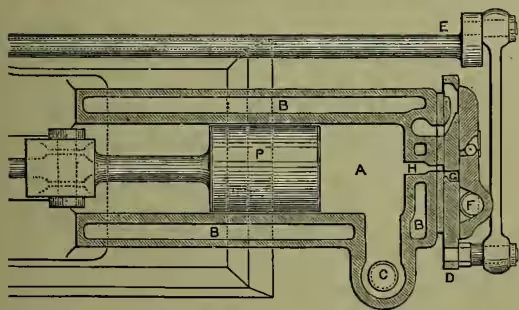
In the smallest forms a vertical arrangement of the cylinder is adopted, and for the largest powers a pair of horizontal cylinders are set side by side. Fig. 2 shows some of the principal details by a horizontal section through the cylinder. The piston, P, appears in the figure at the back end of its stroke, and the space A is the clearance. Its volume is usually from two to three fifths of the volume swept through by the piston. BBB is the water-jacket. C is the exhaust-valve, which is opened by the action of a revolving cam during the second back-stroke of the cycle. The slide-valve, D, is made to slide backwards and forwards across the back end of the cylinder by means of a connecting-rod driven by a short crank on the lay-shaft, E, which is driven by bevel or screw gear from the main shaft, so that it turns once for two revolutions of the main shaft. This valve serves to admit gas and air, and also to carry an igniting flame to the mixture after compression in the cylinder. An igniting jet is kept burning at F, behind the valve. In the valve there is a small chamber, G, supplied with gas, and as this passes the jet it ignites and continues burning until by the further movement of the valve the chamber, G, communicates with the cylinder through the opening H, by which time the back of the chamber is closed. In a number of recent Otto engines the ignition of the mixture is brought about in a different way. There is a short tube closed at one end and communicating at the other with the cylinder, through a valve. The tube is kept red-hot by a Bunsen-flame playing round it, and at the proper moment a portion of the charge within the cylinder is allowed access to the red-hot tube through the valve.
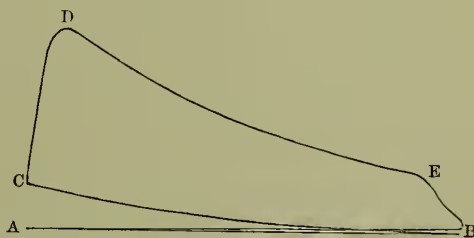
Fig. 3 is a copy of an indicator-diagram from an Otto engine. AB is the first stroke of the cycle, and corresponds to the taking in of gas and air at a pressure sensibly the same as that of the atmosphere. BC is the compression stroke. At C ignition takes place and raises the pressure quickly to D. CDEB is the effective forward stroke, and the exhaust-valve is opened for the escape of the waste gases near the end of this stroke at E. The expulsion of the gases goes on from B as the piston moves back to A, and this completes the cycle.
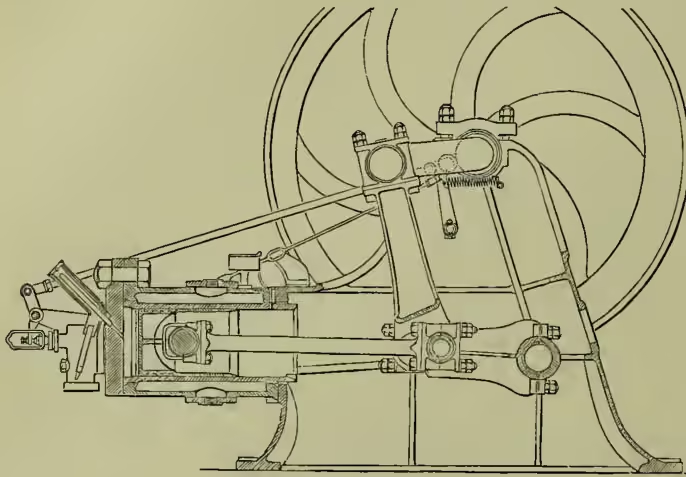
There are now a number of other successful gas-engines which more or less resemble Otto's. In Clerk's engine a similar cycle is performed, except that there is an explosion at each forward stroke. The waste gases escape through exhaust-ports near the front end of the cylinder, which are uncovered by the advance of the piston, and a displacer cylinder or pump immediately forces in a fresh mixture, which is compressed during the return stroke. In Andrew's (the Stockport) engine, and in Robson's (made by Messrs Tangye), an impulse in every revolution is secured by compressing the explosive mixture in a pump, which in some cases is supplied by using the front end of the working cylinder itself for this purpose. In the 'Griffin' engine (Messrs Dick, Kerr, & Co.) explosion occurs at both ends of the cylinder, but only at every third stroke: the cycle includes the drawing in and rejecting of a 'scavenger' charge of air, as well as the drawing in and compression of the explosive mixture and the rejection of the burned gases. A recent engine possessing much originality is Atkinson's, the distinctive features of which are shown in fig. 4. Here the piston acts on the crank-shaft not directly but through a toggle-joint, which has the effect of compelling the piston to make four single strokes for one revolution of the shaft. The four strokes are of different lengths. In the first forward stroke the piston starts from the back end of the cylinder and draws in gas and air. Returning it makes a shorter stroke, compressing the mixture into a space not swept through. Then the mixture is fired, and work is done during another and considerably longer forward stroke, and finally the cycle is completed by a return stroke, which is long enough to completely expel the burned gases. The mixture is ignited by means of a red-hot tube, but in this case there is no valve to control the time of firing; it is determined simply by the compression of the explosive mixture against a cushion of waste gas in the top of the tube. Fig. 5 is an indicator-diagram from Atkinson's engine. AB is the admission stroke. From B to C the explosive mixture is compressed; at C it is fired, and the effective working stroke, CDE, begins. Its length is more than twice that of the compression stroke. In the long return stroke, EA, the products of combustion are wholly expelled, except for a small quantity contained in the clearance space, which is no greater than the clearance necessarily left behind any piston. This complete (or, to be more exact, nearly complete) expulsion of the burned gases is a good feature in Atkinson's cycle, but the most distinctive merit is the relatively long working stroke, which secures much expansion, so that the gases do not escape until their pressure falls to a value not greatly exceeding that of the atmosphere, and at the same time makes the expansion occur quickly, giving the hot gases comparatively little time to part with their heat to the lining of the cylinder.
Messrs Crossley have lately introduced a modified form of Otto engine, with two equal cylinders, the pistons of which make their strokes simultaneously. The mixture is compressed, exploded, and expanded first behind one piston; then the products of combustion are allowed to pass to the front end of both cylinders, driving back both pistons, and undergoing further expansion. Meanwhile the other cylinder has taken in a fresh charge, which is now compressed behind its piston, and is exploded when the next forward stroke begins.
During the explosion in a gas-engine cylinder the highest value of the pressure is usually from 180 to 200 lb. per square inch, and the highest temperature is about 3000° F. The process of explosion is by no means instantaneous. After ignition the pressure and temperature rise with great rapidity, as the indicator-diagrams (figs. 3 and 5) show, but combustion is not complete when the highest point in the diagram has been reached. Only about 60 per cent. of the whole heat which the combustion of the gas should yield is developed up to that point. During the subsequent expansion a slow process of continued combustion goes on, in which a considerable part of the remaining 40 per cent. is set free; but even when the contents of the cylinder escape to the exhaust the process is generally still incomplete. The after-burning, as it is called, which occurs during expansion, after the point of highest pressure has been passed, has the effect of keeping the pressure of the expanding gas from falling so fast as it otherwise would fall. But for this the expansion curve on the indicator-diagram would fall very rapidly, owing to the cooling of the gases through their contact with the cylinder walls. During expansion the gases are parting with much heat to the walls, but the after-burning supplies nearly enough additional heat to make good this loss—sometimes, indeed, more than enough—and the result is that the form of the expansion curve does not differ very materially from that of an adiabatic line. The experiments of Mr Dugald Clerk, who has taken much pains to investigate this action, show that the time-rate of the explosion depends greatly on the richness of the explosive mixture. When the mixture is much diluted the process is so slow that the point of highest pressure is not reached until far on in the stroke.
Though the maximum temperature within the cylinder is materially reduced by this want of perfect suddenness in the combustion of the gas, it is still so high that in engines of even very moderate size a water-jacket is essential. The actual maximum temperature of the gases is in fact higher than the melting-point of cast-iron, while the temperature of the metal has to be kept low enough not to burn oil. The water-jacket involves an immense waste of heat. In the most favourable cases it absorbs 27 per cent. of the whole heat which would be produced by complete combustion of the gaseous mixture, and more generally the amount it absorbs ranges from 40 to 50 per cent. The best existing gas-engines succeed in converting into work about 22 per cent. of the whole potential energy of the fuel; of the remaining 78 per cent. a half or more generally goes to heat the water which circulates in the jacket, and the remainder is rejected in the exhaust, partly through incomplete combustion, but mainly in the form of actual heat, on account of the high temperature at which the waste gases escape. Attempts have been made to save a part of this loss by the application to gas-engines of the regenerative principle which has done so much to promote economy of heat in metallurgical operations. It was proposed by Siemens to use a separate combustion chamber, which, being distinct from the working cylinder, might be kept always hot, and to pass the outgoing gases through a regenerator, which would take up their heat and give it back to the incoming air. Much the same end was aimed at by Fleeming Jenkin, who tried to adapt the regenerative engine of Stirling (see AIR-ENGINE) to serve for the internal combustion of gas. These attempts have hitherto failed, and the gas-engine still falls far short of the limit of thermodynamic efficiency which its high range of temperature shows it to be theoretically capable of. The greatest ideal efficiency of any heat-engine is measured by the fraction , where is the highest (absolute) temperature at which it can receive heat, and is the lowest (absolute) temperature at which it can reject heat. The highest temperature in the combustion is, as we have seen, about 3000° F., and the lower limit of the range is the atmospheric temperature, or say 60° F. Substituting these values in the formula, we have 0.85 as the highest ideal efficiency; in other words, it should be, from the thermodynamic point of view, theoretically possible to convert 85 per cent. of the heat-energy of the gas into work. The greatest efficiency hitherto realised is about 0.22, or little more than one-fourth of the ideal efficiency. It must not be supposed that under any imaginable practical conditions it could be possible to reach the ideal limit, but it may be confidently expected that the gas-engine of the future will approach it much more closely than does the gas-engine of to-day. The comparison serves to show how much room there is for invention in the direction of obviating what is essentially preventable loss.
It is instructive in this connection to compare the efficiency of gas-engines with that of steam-engines. In a large steam-engine the efficiency is about 0.15; in other words, the engine converts into work only some 15 per cent. of the heat-energy supplied to the steam, and the figure would be greatly less if one stated it as a fraction of the whole heat of combustion of the fuel. In steam-engines small enough to be fairly comparable with actual gas-engines, the efficiency is rarely more, and generally a good deal less, than 0.1. Considered as a thermodynamic machine, the gas-engine, imperfect as it admittedly is, is already not far from twice as efficient as the steam-engine. It is in fact the most efficient heat-engine we possess.
Experiments show that the consumption of gas in practice in a small gas-engine (indicating 10 horse-power or more) may, in favourable cases, be less than 20 cubic feet per hour per indicated horse-power, including the gas which is consumed in maintaining the igniting flame. Of the indicated horse-power about 85 per cent. is available for doing mechanical work outside of the engine itself. The cost of the fuel is necessarily high so long as the gas supplied to the engine is the purified coal-gas used for lighting. Thus, with gas costing 3s. per 1000 cubic feet, the supply required for each indicated horse-power per hour will cost about three-farthings, whereas the coal bill of a steam-engine for each horse-power hour need not exceed a fifth of a penny, and may be even less. In such cases the advantage of the gas-engine lies in its compactness and convenience, in the saving of charges for attendance, and in the ease and economy with which it can be applied to do intermittent work. Economy in the cost of fuel may, however, be secured by supplying the engine with a cheaper kind of gas, a gas suitable for heating though not suitable for illumination. The late Sir William Siemens pointed out that a comparatively cheap gas of the kind required might be got by separating successive stages in the distillation of coal, and advised supplying of towns with such a gas for heat and power through distinct mains. Another gas for gas-engines is that produced by Mr Emerson Dowson's process of blowing a mixture of air and steam through a bed of red-hot anthracite or coke. The product contains 22½ per cent. of hydrogen and the same quantity of carbonic oxide, mixed with much nitrogen and a small quantity of carbonic acid, and is said to cost about 2½d. per 1000 cubic feet. The engine requires about four times as much of it as it would require of illuminating coal-gas. When Dowson gas is used, the fuel needed for a gas-engine is not more than 1½ lb. of coke or anthracite per horse-power per hour—as compared with the 4 or 5 lb. burned in a steam-engine of corresponding size.
Gas-engines have recently been applied with great success on the Continent to the propulsion of trancars, which carry compression-cylinders. The gas from the mains is driven by pumping-engines into a compression-reservoir: the car runs up outside the station, and the reservoir is connected with the car cylinders, which promptly become refilled under a high pressure: the stopcock is closed, the connecting-tube removed, and the car is again ready.
A notice of gas-engines would be incomplete without a reference to oil-engines using petroleum as fuel, which is vaporised and then exploded along with air. In Priestman's engine the petroleum, which is a safe oil with a flashing-point higher than 75° F., is injected in the form of spray, by a jet of compressed air, into a chamber which is heated by means of a jacket through which the hot gases of the exhaust pass. There the spray is raised to a temperature of about 300°, and is completely vaporised. From the hot chamber the vapour is drawn, along with more air, into the working cylinder, where the cycle of operations is essentially the same as in Otto's engine. In some types, only 1½ lb. of oil is burned per brake horse-power per hour. The compactness and smoothness of working of these oil-spray motors has made it possible to adapt them to vehicles, from trancars to tricycles; and innumerable types of 'auto-cars' or 'motor-cars' have been perfected, and since 1896 (see TRACTION-ENGINES) have become familiar even on the roads of remote country districts.
See works by D. Clerk (1886), W. MacGregor (1885), and Bryan Donkin (1894); Professor Perry, The Steam-Engine, and Gas and Oil Engines (1899); and numerous papers in Engineering magazines.