Gaultheria, a genus of small procumbent evergreen shrubs, of the order Ericaceæ, named by the Swedish botanist Kalm in honour of Dr Gaultier of Quebec. G. procumbens is a common plant in North America as far south as Virginia, and bears the names of Checkerberry, Partridge Berry, Deer Berry, Wintergreen, and Mountain Tea. It is about 4 or 5 inches in height, with


small whitish flowers and red 'berries,' which are eatable, but not safe in any considerable quantity, because of the pungent volatile oil which they contain. Brandy in which they have been steeped is used as a tonic. The whole plant has an agreeable aromatic odour and taste, and the volatile oil is used in medicine as a stimulant, also for flavouring syrups, and in perfume, under the name of Oil of Wintergreen. An infusion of the berries (hence called 'tea-berries') was used as tea during the war of independence. The berries are employed for flavouring beer and other drinks, as also for tooth-powders and hair-washes. The leaf is astringent, and is used in medicine.—The Shallon
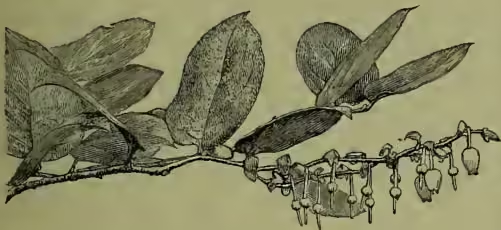
(G. shallon) is a large species (2-3 feet), with purple berries ('salal-berries'), which are largely eaten by the Indians of north-west America. It grows well in woods, and is sometimes planted in Britain to afford food for game.—G. hispida (Wax-cluster) is a native of Van Diemen's Land, bearing snow-white berries.—Other species, some fragrant, some producing edible berries, and all beautiful little shrubs, are found in mountain regions throughout the world. The Australian G. antipoda is said to be a finer fruit than G. hispida.