Gazelle is a name given to some twenty different species of antelopes, which differ from each other principally in the form of curvature of the horns, in the presence or absence of horns in the female, and in the colour. The true gazelle (Gazella Doreas) is a species about the size of a roebuck, but of lighter and more graceful form, with longer and more slender limbs, in these respects exhibiting the typical characters of the antelopes in their highest perfection. It is of a light tawny colour, the under parts white; a broad brown band along each flank; the hair short and smooth. The face is reddish fawn-colour, with white and dark stripes. The horns of the old males are 9 or 10 inches long, bending outward and then inward, like the sides of a lyre, also backward at the base and forward at the tips, tapering to a point, surrounded by thirteen or fourteen permanent rings, the rings near the base being closest together and most perfect. The horns of the female are smaller and obscurely ringed. The ears are long, narrow, and pointed; the eyes very large, soft, and black; there is a tuft of hair on each knee; the tail is short, with black hairs on its upper surface only, and at its tip. The gazelle is a native of the north of Africa, and of Syria, Arabia, and Persia. Great herds of gazelles frequent the northern borders of the Sahara; and notwithstanding their great speed, and the resist- ance which they are capable of making when compelled to stand at bay—the herd closing together with the females and young in the centre, and the males presenting their horns all around—lions and panthers destroy them in great numbers. The speed of the gazelle is such that it cannot be successfully hunted by any kind of dog, but in some parts of the East it is taken with the assistance of falcons of a small species, which fasten on its head, and by the flapping of their wings blind and confuse it, so that it soon falls a prey to the hunter.
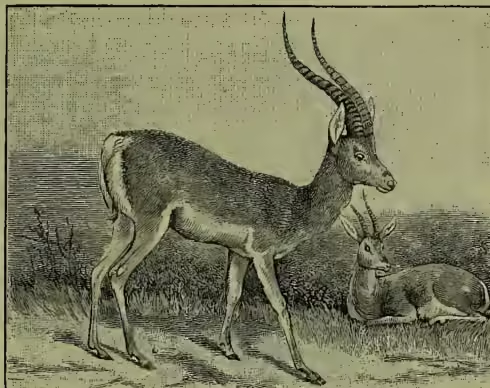
It is also captured in enclosures made near its drinking-places. Although naturally very wild and timid, it is easily domesticated, and, when taken young, becomes extremely familiar. Tame gazelles are very common in the Asiatic countries of which the species is a native; and the poetry of these countries abounds in allusions both to the beauty and the gentleness of the gazelle.—Some confusion has arisen among naturalists as to the application of the name gazelle, originally Arabic; and it has not only been given to the leucoryx of the ancients, a very different species, but even to the gemsboe of South Africa. The true gazelle was known to the ancients, and is accurately described by Ælian under the name doreas, which was also given to the roe.