General Characters.—In addition to the development of head and rasping tongue, the Gasteropods are characterised by the nature of the 'foot' or muscular ventral surface. Except in some forms adapted for free-swimming, the 'foot' is simple, median, and sole-like. It is the surface on which the animal crawls, and is often divided into anterior, median, and posterior regions. The wealth of modification included in the class is so great that no other general characters can be given.
General Survey.—(A) The simplest Gasteropods, such as the common Chiton, are symmetrical, not lop-sided like the higher forms. They have the mouth at one end of the long axis of the body, the anus at the other; the gills, kidneys, genital ducts, and circulatory organs are paired; there are two pairs (pedal and visceral) of nerve cords running parallel to one another along the body, and the ganglia are slightly developed. Of all molluscs these simplest Gasteropods are probably nearest the hypothetical worm-like ancestor. In one order (Chitons, q.v.) there are eight shells, one behind the other like segments; in the two other orders (Neomeniæ and Chæto derma) the shell is represented only by calcareous plates and spines in the skin. These three orders form the sub-class Isopleura, in contrast to all the others which are unsymmetrical—the Anisopleura.
(B) The latter are grouped first of all according to the state of the loop formed by the visceral nerves. (1) In one series the visceral nerve-loop is implicated and twisted in the torsion of the asymmetrical body, and furthermore the sexes are separate. These are known as Streptoneura ('loop-nerved'), and include limpets (Patella), ear-shells (Haliotis), pond-snail (Paludina), cowries (Cyprea), cone-shells (Conus), buckies (Buccinum), and the free-swimming Heteropods.
This division includes what are often called Prosobranchs, and the numerous genera are further arranged according to the characters of the gills, kidneys, and foot. (2) In another series the visceral loop is not twisted, and is often very short; the shell is light and often lost in the adult; and the animals are hermaphrodite. They are known as Euthyneura ('straight-nerved'), and include two sets—Opisthobranchs and Pulmonates. Among Opisthobranchs some retain the usual mantle-fold and have a delicate shell—e.g. Bulla and Aplysia, while others (known as Nudibranchs) have their mantle atrophied and no shell—e.g. Doris and Eolis. Lastly there are the Pulmonates, where gills are replaced by an air-breathing mantle-cavity, as in snails (e.g. Helix), slugs (e.g. Arion), water-snails (e.g. Lymnaeus).
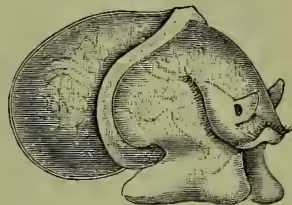
Young Pond Snail (Lymnaeus)
(from Howes).
Mode of Life.—Though the number of terrestrial Gasteropods, breathing the air directly by means of a pulmonary chamber, is very large—over 6000 living species—those living in water are greatly in the majority, including over 10,000 forms, mostly marine. Of these, some 9000 or so belong to the Prosobranchs or Streptoneura, a relatively small minority being Opisthobranchs and Nudibranchs. The Heteropods and some Opisthobranchs enjoy a free-swimming pelagic life, but most marine forms frequent the coasts either on the shores or along the bottom. Deep-sea Gasteropods are comparatively few. The locomotion effected by the contractions of the muscular 'foot' is in almost all cases very leisurely, and the average tendency is towards sluggishness. As to diet, the greatest variety obtains; most Prosobranchs with a respiratory siphon and a corresponding notch in the shell are carnivorous, and so are the active Heteropods; most of the Young Pond Snail (Lymnaeus) rest are vegetarian in diet. Numerous genera, both marine and terrestrial, are very indiscriminate in their feeding; others are as markedly specialists, keeping almost exclusively to some one vegetable or animal diet. Some marine snails partial to Echinoderms have got over the digestive difficulty presented by the calcareous character of the skins of their victims by a secretion of free sulphuric acid from the mouth. This acid changes the carbonate of lime into sulphate, which is brittle and readily pulverised by the rasping tongue. A few are parasitic—e.g. Eulima, Stylifer, and the very degenerate Entoconcha mirabilis, all occurring in or on Holothurians.
Distribution.—A few Gasteropods occur in strata as far back as the Cambrian, from which remote period they have continued with a steady increase. Almost all the Palæozoic genera are now extinct, and during these ages the siphon-possessing forms seem to have been almost, if not altogether, unrepresented. A host of new Gasteropods appeared in the Jurassic period, and many of the modern families have their origin in Cretaceous times. Numerous as the fossil forms are, the number of types wholly extinct is comparatively small; both as regards persistence of types and increase of numbers, the Gasteropods are a peculiarly successful class.
Life-history.—The eggs of Gasteropods are usually small, and are surrounded with albumen, the surface of which becomes firm, while in the common snail (Helix) and some others there is an egg-shell of lime. The eggs not unfrequently develop into embryos within the parent, but in most cases they are laid, either singly or in masses, and often within cocoons. Few objects are more familiar on the seashore than the clustered egg-cases of the whelk, which together form a ball often about the size of an orange. Inside each of the numerous egg-cases are many embryos, but only a few reach maturity, the others serving as food material, an infantile cannibalism or struggle for existence not uncommon in the class. As to the actual development and the larval forms, reference must be made
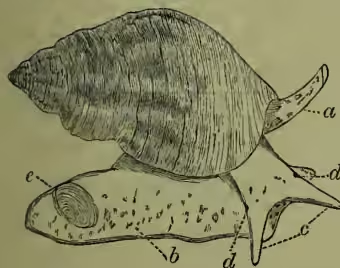
Showing respiratory siphon, a; head with
tentacles, c, and eyes, d; foot, b, with
shell-lid or operculum, e.
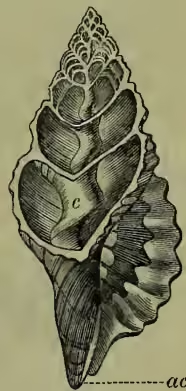
Section of Triton-shell
(after Owen):
ac, notch for siphon;
c, axis or columella.
to the articles on MOLLUSCS and on EMBRYOLOGY; but it may be noted that the ovum divides more or less unequally, according to the amount of yolk, that a gastrula-stage occurs as usual, and that this is succeeded in typical cases, first by a 'Trochosphere' and afterwards by a 'Veliger' larva (see MOLLUSCS).
General Interest.—As voracious animals, furnished with powerful rasping organs, many Gasteropods play an important part in the struggle for existence among marine organisms, while other terrestrial forms are most destructive devastators of vegetable and flowering plants. The manner in which numerous plants are saved from the ravages of snails, by their chemical and physical characters, is an interesting subject of investigation recently worked out by Professor E. Stahl. From very early times, various Gasteropods, such as whelks, have been utilised for human consumption and also as bait, while yet more frequently the shells, often so beautiful in form and colour, have been used for the decoration of the person and the dwelling, for the basis of cameos, as domestic utensils, or even as weapons, and in many other ways. From the mucous glands of the roof of the gill-cavity in the genera Purpura and Murex, there exudes the famous secretion, at first colourless, but afterwards becoming purple or violet, which furnished the ancient Tyrian dye.
See CHITON, LIMPET, MOLLUSCA, HETEROPODA, SNAIL, WHELK, and articles dealing with various Gasteropods above mentioned. Also the zoological text-books of Claus, Gegenbaur, Huxley, &c.; Hatchett Jackson's ed. of Rolleston's Forms of Animal Life (Oxford, 1888); Kefenstein's 'Mollusca,' in Bronn's Thierreich (1862-66); E. Ray Lankester, article 'Mollusca,' Ency. Brit. (vol. xvi. 1883); Woodward, Manual of Mollusca (3d ed. 1875).