Generations, ALTERNATION OF, an interesting complication in the life-history of many plants and animals, the organism producing offspring which are unlike itself, but which in turn give rise to forms like the original parents. Thus, a zoophyte buds off a swimming-bell, and the fertilised ova of the latter develop into the former. Early in the century the poet Chamisso, accompanying Kotzebue on his circumnavigation of the globe, called attention for the first time to the fact of alternation as observed in one of the locomotor tunicates (Salpa); the progress of marine zoology and the study of parasitic worms gave many natural- ists glimpses of other alternations; but Steenstrup was the first to generalise the results in his work published in 1842, entitled 'On the Alternation of Generations; or the propagation and development of animals through alternate generations, a peculiar form of fostering the young in the lower classes of animals.' From hydroids and flukes he gave illustrations of the 'natural phenomena of an animal producing an offspring which at no time resembles its parent, but which itself brings forth a progeny that returns in its form and nature to the parent,' and distinguished the interpolated generation as the Amme, or 'wet-nurse.' His essay was sternly criticised by Owen in 1849, while Leuckart attempted to treat all the alternations as cases of metamorphosis. Criticism, however, has only rendered Steenstrup's generalisation more precise, and the observations of some of the foremost naturalists have shown that the phenomena are of wider occurrence than was at first supposed, though the form of the alternation varies widely in the different cases. (a) The Rhythm between Sexual and Asexual Reproduction.—The simplest case to start with is that of many hydroids where a sessile, plant-like zoophyte—a colony of numerous nutritive 'persons'—produces in the summer months modified reproductive individuals which are set adrift as medusoids. These become sexual, and their fertilised ova develop into embryos which settle down and give rise to the sessile zoophyte from which we started. The life-history may be written in the formula:
(where M and F stand for male and female, and A for asexual generation).
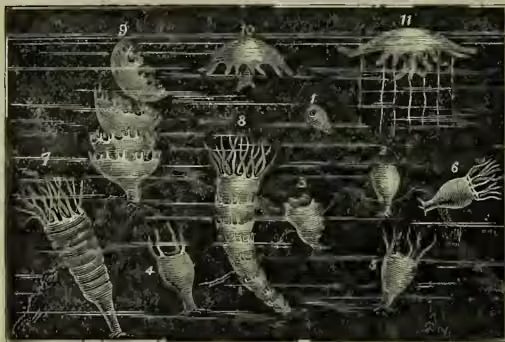
1, free-swimming embryo (planula); 2-6, the embryo fixed developing into a 'hydra-tuba,' which (7-8) divides transversely into a pile of individuals; these in turn (9) are liberated and grow (10-11) into jelly-fish. (From Haeckel.)
The life-history of the common jelly-fish (Aurelia) (fig. 1) illustrates a similar contrast. From the large free-swimming sexual jelly-fish embryos are produced which develop not into jelly-fish again, but into sessile tubular organisms or 'hydra-tubae.'
A, asexual, produces S, sexual, from fertilised ovum of which A again arises.
From these, by growth and division in an entirely asexual fashion, the jelly-fish are in turn repro- duced. Here the sexual generation is the more stable and conspicuous—the reverse of the former case, but the same formula applies, or the preceding graphic notation. In the free-swimming Tunicata (Salpa and Doliolum) the alternation is somewhat more complex, but in no essential respect different. (b) Alternation between Sexual and Degenerate Sexual Reproduction.—The life-history of the common liver-fluke, sketched in the article FLUKE, is in most cases as follows: From the fertilised ovum of the fluke an embryo develops, which produces several asexual generations, the last of which grow up to become sexual flukes. Now the asexual generations are not products of division or budding, but arise from what, though not ova, may be called precocious reproductive cells; in fact, they arise by a degenerate process of parthenogenetic reproduction in early life. The facts may be thus expressed:
where A2 and A3 represent two of the interpolated asexual generations.
This alternation between sexual reproduction by fertilised ova and reproduction by means of special cells which require no fertilisation prevails in many plants—e.g. ferns and mosses. From a fertilised egg-cell arises the ordinary fern-plant with which all are familiar. This, however, produces no male or female elements, but simply 'spores,' which are able of themselves (when they fall to the ground) to develop a new organism—the inconspicuous but sexual 'prothallus.' This bears male or female organs or both, and from the fertilised egg-cell thus produced the conspicuous vegetative, sexless fern-plant once more arises. The facts may be again expressed in notation:
A, the vegetative sexless fern-plant produces a spore (sp.) from which the sexual 'prothallus,' S, arises, giving origin to fertilised egg-cells, and thereby recommencing the cycle.
The same formula will apply to the moss. The familiar moss-plant bears male and female reproductive organs. From a fertilised egg-cell so produced a sexless spore-producing generation at once develops, and grows like a parasite on the apex of the moss-plant. The spores fall to the ground, and grow out into threads ('protonema'), from which there is finally budded the moss-plant with which we started.
Besides the above alternations there are other rhythms, some more complex, others much less frequent, into which we cannot here enter. In some cases the life-history of the liver-fluke, by the division of the embryo (sporocyst), combines the alternations (a) and (b); in some midge larvae juvenile parthenogenesis alternates with the adult sexual process; in not a few cases, as in aphides, the rhythm is between parthenogenesis and normal sexual reproduction; while finally there is an alternation of two different sexual generations in three thread-worms or nematodes.
Occurrence.—Alternation of generations is hinted at in the colonial Radiolarians, is definitely seen in the fresh-water sponge, is very characteristic of the Cœlenterates, prevails with curious complications in the flukes, is doubtful in tapeworms, occurs in one form in a few Nematodes and in certain Chætopods (Syllids), is represented by the rhythm between parthenogenesis and sexual reproduction in crustaceans and insects, and is very emphatic where it was first observed—in the locomotor tunicates.
The diagram consists of three columns labeled III, I, and II at the bottom. Each column contains three inverted triangles. In column I, the top triangle is labeled 'S', the middle 'As', and the bottom 'S'. In column II, the top triangle is 'S', the middle is 'As', and the bottom is 'S', with the 'As' triangle being smaller than the 'S' triangle. In column III, the top triangle is 'S', the middle is 'As', and the bottom is 'S', with the 'S' triangle being smaller than the 'As' triangle.
I. expresses ordinary alternation between sexual (S) and asexual (As) generations; in II. the asexual is increasingly subordinated to the sexual (as in mosses); in III. the sexual is subordinated to the asexual (as in flowering plants). emphasis the fundamental organic antithesis between nutrition and reproduction. A fixed hydroid—passive and well nourished, is preponderatingly vegetative and asexual; the reverse habit, the physiological rebound, finds expression in the actively locomotor sexual swimming-bell or medusoid. In the same way, though the alternation is less strictly between asexual and sexual, the contrast between the deeply-rooted, leafy, spore-bearing fern-plant and the inconspicuous, weakly-rooted, slightly-exposed, sexual prothallus is again fundamentally parallel. Alternation of generations is in fact an emphasised rhythm between the anabolic and katabolic tendencies so fundamental in the individual and racial life. To this, however, it will be necessary to return in the article REPRODUCTION.
See Steenstrup, 'On the Alternation of Generations' (Eng. trans. Ray Society, 1845); Owen's Parthenogenesis (1849); Haeckel's Generelle Morphologie (Berlin, 1866); Geddes and Thomson, The Evolution of Sex (Lond. 1889).