Gentian (Gentiana—so called after the Illyrian king Gentius, who is said by Pliny to have introduced G. lutea into medicine), a genus of Gentianaceæ. There are more than 100 species, natives of north temperate regions, very often growing in high mountain pastures and meadows, which they cover with their beautiful blue or yellow flowers. The roots of the Common Gentian or Yellow Gentian (G. lutea) are collected by the peasants of the Alps (along with the less valuable roots of G. pannonica, purpurea, and punctata) to furnish the gentian root (radix gentianæ) of pharmacy, which is largely employed as an excellent bitter and stomachic. The medicinal properties are essentially due to the presence of a bitter glycoside (gentiopierin); pectin (see FRUIT) and also sugar are present in quantity; hence the peasants of the Alps prepare alcoholic bitters—their Enziangeist—by the fermentation of the fresh roots. G. Catesbæi is used as gentian root in North America, and G. Kurroo in the Himalayas.
The florist recognises two main groups of these beautiful hardy plants, the first strong and easily grown in borders, of which the Willow Gentian (G. asclepiadea) and G. lutea are specially common. The former can also be grown with good effect under trees and among grass. The dwarf kinds require more careful treatment, with the exception of the Common Gentianella (G. acaulis), which readily forms edgings and carpets. The name Gentianella is sometimes also applied to the allied Cicendia filiformis, a small, slender, and graceful plant with yellow flowers. G. verna (Vernal Gentian) can be grown well in deep sandy loam, with abundant moisture and sunshine. Bavarian Gentian (G. bavarica) and Crested Gentian (G. septemfida) of the Caucasus require more moisture. Other species can be cultivated with care. Of North American species G. crinita is specially celebrated for the beauty of its flowers; the genus in fact may fairly be allowed the very first place among the floral glories alike of Alpine regions, in which they range up to the snow-level, and of the alpine garden. Several species of Gentian are popularly called Baldmoney. See ALPINE PLANTS.
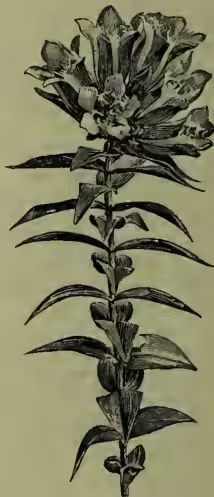
(Gentiana septemfida).
Gentianaceæ form an order of corollifloral dicotyledons. The 500 species are almost exclusively herbaceous, and are usually natives of temperate and cold latitudes and altitudes. Many have flowers of great beauty, and a general astringency pervades the order, whence many are of past or present medicinal repute. See CHIRATA, BUCKBEAN, and CENTAURY.