Geographical Distribution. There is no branch of scientific inquiry the interest and importance of which have grown more rapidly in recent years than that which forms the subject of the present article. In chief measure this is due to the totally different complexion given to the inquiry by the publication of the Darwinian views of the Origin of Species. As long as it was held that each species must have been created, as a general rule, within the geographical area which it now occupies, the most curious facts of distribution could be regarded only with 'sterile wonder.' But when the idea came to be entertained that allied species have had a common origin, it was obviously implied that they or their ancestors must have had a common birth-place; and consequently, when we find members of a group severed from their nearest kindred, we feel bound to inquire how this came about. Thus, when it is observed that all the West Indian mammals, with one exception, are allied to those of America, we at once infer that the ancestors of these animals must have been derived from that continent, and we have to determine how the passage was made from the mainland to the islands; and the problem becomes much more difficult when we find that the single exception referred to 'belongs to an order, Insectivora, entirely absent from South America, and to a family, Centetidae, all the other species of which inhabit Madagascar only' (Wallace, Geographical Distribution of Animals). Similarly, we have to explain how the tapirs are confined to the Malayan region and South America; the Camelidae to the deserts of Asia and the Andes; marsupials to the Australian region and America; how the mammals and birds of North America resemble those of Europe more than those of South America; how the flora of Japan presents greater affinities to that of the Atlantic than to that of the Pacific States of North America; and so on.
The considerations that must be taken into account in dealing with the problems of distribution are far too numerous and complex to be gone into fully within the limits of an encyclopædia article, and all that can be done under this head is to indicate the nature of the more important facts affecting the solution of these problems. One of the principal means of throwing light on this subject must obviously be to consider by what means animals and plants are able to disperse themselves across the barriers at present existing.
It is scarcely necessary to draw attention to the facilities for diffusion possessed by animals endowed with great locomotive powers, and especially, among land-animals, by those having the power of flight; and in connection with this means of dispersal the most important thing to note is that some animals, which in the adult state have only feeble powers of locomotion, are better endowed in this respect in an earlier stage of existence. Such, for example, are univalve and bivalve marine molluscs, which are all developed from free-swimming larvae.
But, besides the normal means of locomotion, there are many other modes of dispersal which it is highly important, with reference to the present inquiry, to take into account. First, there is the power of winds as a distributing agent. The carrying power of winds is known to be sufficient to bear along in the air fine dust across seas many hundreds of miles in width; and, that being the case, we have in that agency alone an adequate means of accounting for the dispersion of all plants propagated by minute spores. For that reason the distribution of most cryptogamic plants hardly forms part of the problem under consideration, and is generally left out of account by those who have devoted themselves to this investigation. What part winds may have played in carrying the seeds of phanerogamous plants across arms of the sea is a more doubtful point; but there are observations which show that even for such seeds, especially when provided with some kind of feathery appendage, winds may occasionally serve as a means of transport for very long distances. Thus, Berthelot records that after a violent hurricane he saw an annual belonging to the Compositæ (Erigeron ambiguus), widely distributed throughout the Mediterranean region, suddenly appear at various spots on the Canary Islands, where it was previously unknown, so that there could be hardly any doubt that the seeds had been blown across from Portugal or North Africa. Nevertheless, De Candolle has shown that seeds provided with a pappus are not on an average more widely distributed than those members of the Compositæ which are not so provided, so that such a case as that just mentioned must be looked upon as quite exceptional. But it is exceptional means of transport that is most important to consider with reference to the problems of distribution.
But, in the case of animals also, winds are a more important means of transport than one might at first suppose. Birds and insects are often blown immense distances out of their course; and to this cause, for instance, is due the arrival every year of American birds on the Bermudas. Insects have been caught on board of ships upwards of 300 miles from land. Further, there are well-authenticated cases of even crabs, frogs, and fishes being carried long distances by storms; and in this way it is possible to account for the transference of fish, &c. from one river-system to another. Still more frequently, in all probability, are the eggs of such creatures transported by this means.
Next, marine currents also form, beyond doubt, a highly important means of dispersal both for plants and animals, and that in various ways. First, seeds may float on the surface of the ocean, and be carried by currents for hundreds of miles, and become stranded on a distant shore still in a condition fit for germination. The well-known experiments of Darwin to determine the vitality of seeds in sea-water first enabled us to appreciate the importance of this factor in the distribution of plants. In one experiment he found that, out of 87 kinds of seeds, 64 germinated after an immersion of 28 days, and a few survived an immersion of 137 days; and in another, that, out of 94 dried plants, 18 floated for above 28 days; and, combining the results of the two experiments, he concluded that 14 plants out of every 100 in the flora of a country might be floated by currents moving at the average rate of the several Atlantic currents a distance of 924 miles, and might, on being stranded, furnish seeds capable of germinating.
But further, marine currents often carry on their surface various kinds of natural rafts, which may be the means of transport both for plants and animals. In the polar regions icebergs and ice-floes may serve this purpose; and elsewhere trunks of trees, and even fragments torn from the land. Such fragments, forming small islands with erect trees upon them, have been seen at a distance of 100 miles from the mouth of the Ganges and other rivers. Wallace points out that ocean waifs of one kind or another are almost the only means we can imagine by which land-shells can have acquired the wide distribution for which they are remarkable. These molluscs perish very readily in sea-water, but, on the other hand, are very tenacious of life in other circumstances; and this tenacity of life obviously favours their chance of being carried in chunks of floating timber, or otherwise, across the ocean.
Again, locomotive animals are very frequently the means of dispersing both plants and other animals. Seeds may be attached to the fleece or fur of mammals or the plumage of birds, or may be enclosed in clumps of earth clinging to the feet or some other part of bird or beast, even of insects. To Darwin we are again indebted for an instance showing how likely a means of transport this is. He informs us that he received from Professor Newton the leg of a red-legged partridge (Caccabis rufa) with a ball of hard earth weighing ounces adhering to it. The earth had been kept for three years; but when broken, watered, and covered by a bell-glass, as many as eighty-two plants sprang from it. Hooked fruits, such as those of agrimony, geum, &c., and fruits covered with a viscous substance, like those of some thistles, mistletoe, and others, are the most likely to be transported in this way. It seems probable that aquatic birds and water-beetles have been the means of distributing aquatic plants and fresh-water molluscs, which are remarkable for their wide diffusion; and the spawn of amphibians and fresh-water fishes may be conveyed from one body of fresh water to another by the same means.
Again, seeds with hard shells are known in many cases to be capable of passing through the digestive organs of birds uninjured; and consequently fruits enclosing such seeds, or, like the strawberry, covered with them, may be devoured by birds in one place, and deposited by them in a state fit for germination at another, hundreds of miles distant. And what is of still more importance, seeds which would be destroyed if they passed through the digestive organs of a bird are quite uninjured as long as they remain in the crop, where they may be retained for twelve or eighteen hours; and thus birds killed with food in their crop may be the means of scattering seed which has travelled 500 miles. It is obvious that the migratory habits of certain birds are of great importance with reference to both the means of transport just mentioned. Some seeds retain the power of germination even after passing through the digestive organs of ruminants. There is a well-established case of a tree belonging to the order Leguminosæ having been introduced into the West Indies through cattle brought from
South America, the cattle having been fed on the voyage with the pods belonging to the tree.
Further, the parasitic habits of certain animals enable them to be carried about from place to place, when they have themselves no power, or only a very feeble power of locomotion. And, with regard to the subject now under consideration, it makes no difference whether the animals are truly parasitic, feeding at the expense of the host to which they are attached, or merely commensalists, gaining their own food independently, like the sea-anemones so frequently attached to the shells of hermit-crabs.
Lastly, man is often unintentionally the means of conveying both plants and animals from one region to another. The foreign plants found growing on ballast-heaps are instances of this, and so also are the plants which have sprung from seed introduced with imported grain or other articles of import. Since the discovery of America the whole of the northern part of the continent is said to have been more or less overrun by European weeds; and, according to Agassiz, the roadside weeds of the New England states, to the number of 130, are all European. Wherever European sailors have gone, the European rats, both black and brown, have accompanied them; and the shrew, the death's-head moth, the Sphinx convolvuli, &c., are also known to have been introduced into various countries in ships.
In the preceding summary of the more important means of diffusion for plants and animals, some of the obstacles to diffusion have been incidentally referred to; but it will be convenient to make a general survey of these also.
For all land-plants and land-animals the most obvious and effective barrier is a wide expanse of ocean; and where the expanse is very wide it is seldom passable except with the aid of man. For land-mammals the ocean is an absolutely impassable barrier, and hence native mammals are always absent from oceanic islands (i.e. islands that have never been connected with the mainland); and this barrier is almost equally effective for serpents and amphibians, which also are nearly always wanting where there are no native mammals. Lizards are more frequently found indigenous on oceanic islands, though their means of transit from the mainland is unknown. Arms of the sea and broad rivers are likewise generally impassable for the creatures mentioned, though some of them have greater powers of swimming than is generally supposed. The jaguar, the bear, and the bison are capable of swimming the widest rivers; pigs have been known to swim ashore when carried out to sea to a distance of several miles; and even a boa constrictor, it is said, has swum to the island of St Vincent from the South American coast—a distance of 200 miles.
Mountains, and especially high mountains, are also frequently effective barriers to the migration of land plants and animals; but it must be noticed that in some cases they serve for both as a means of communication between one region and another, enabling plants and animals belonging to a cold climate, for example, to spread into latitudes where, in the plains, the climate is too hot for them. Again, deserts act as a barrier to the majority of plants and animals; forests are a barrier to the camel, liare, zebra, giraffe, &c.; treeless regions to apes, lemurs, and many monkeys; plains to wild goats and sheep. Broad rivers also act occasionally as barriers to distribution, and that, strange to say, even in the case of some species of birds.
Another important barrier is that of climate; but, with reference to this, it must be observed that the question of climate affects the problems of geographical distribution, in the proper sense of that term, only in so far as climatic conditions may shut off plants and animals from means of communication between one region and another, and not where climate merely limits the range of a species or group within a continuous area. In the case of many animals climate acts only indirectly as a barrier through limiting the food-supply required by them.
Another set of barriers may be classed under the general head of organic, inasmuch as they are all connected with the vegetable or animal life of the region where such barriers exist. Under this head may be mentioned first the fact that certain animals require for their subsistence a special kind of vegetable food. The range of insects is peculiarly liable to be limited in this way, certain insects being attached to particular species of plants, and others to genera or families; and for this reason insects, in spite of the exceptional facilities for dispersal which, as we have already seen, they enjoy, are remarkable, as a rule, rather for the restriction of their areas of distribution than for their wide diffusion. Again, the presence of enemies is sufficient in some cases absolutely to exclude certain forms from certain areas, as the well-known tse-tse fly does horses, dogs, and cattle from a well-defined area in South Africa; and another kind of fly prevents horses and cattle from running wild in Paraguay, as they do in abundance both to the north and south of that region.
But a more important, because more generally operative, organic barrier consists in the fact of a region being already fully occupied by a native flora and fauna, so that there is no room for newcomers. Hence it happens that seeds may be wafted in plenty from one country to another without a single plant growing from these seeds being able to establish itself; and there may even be, as in South America, a free communication with another region while the fauna remains strikingly distinct, simply because that portion of the American continent is already completely stocked with a fauna perfectly adapted to the physical conditions there prevailing.
The barriers to the spread of marine creatures are not so numerous as in the case of terrestrial forms. The freedom of communication between one part of the ocean and another makes it impossible to mark out any marine zoogeographical regions, though many seas and coasts are distinguished by characteristic fishes and other marine creatures. The principal barriers for fish are temperature and the intervention of land. Thus, the Isthmus of Panama is at present a complete barrier for fishes requiring warm seas.
If all the barriers to migration had existed in all past time as they are now, it would be quite impossible to explain the present distribution of plants and animals on the supposition that kindred groups have had a common birthplace. But the solution of the problems of distribution is to be found in the fact that all the barriers are liable to change. Of changes of sea and land geology supplies us with abundant evidence. Portions of the mainland now continuous were at one time severed by arms of the sea; and islands have been formed by the severance of portions of land that once belonged to the mainland. Such islands are known as continental islands, and the study of their faunas and floras is one of peculiar interest in connection with geographical distribution. These faunas and floras show, as might be expected, a greater or less degree of correspondence with those of the mainland from which the islands have been cut off; and the resemblance is the closer the more recently the land connection has been destroyed. The relative date of the disunion is usually approximately indicated by the depth of the sea which now separates island and mainland, shallow seas dividing portions of land that have only recently been disconnected, and deeper seas separating those which have been longer apart.
The most remarkable case of isolation is presented by the Australian region, the fauna and flora of which are the most peculiar in the world. In the widest sense, this region includes not only the vast island of Australia itself, but also New Guinea and all the Malayan and Pacific islands to the east of a deep channel between the islands of Bali and Lombok—a channel the significance of which, as a boundary line for plants and animals, was first pointed out by Wallace, the great authority on animal distribution, and hence known as Wallace's Line. The great feature of this region (so far as animal distribution is concerned) is 'the almost total absence of all the forms of mammalia which abound in the rest of the world, their place being taken by a great variety of marsupials.' The family just mentioned, though now restricted in the manner stated at the beginning of this article, was at one time spread over the whole world, but has in most parts become extinguished by the competition of later types; thus presenting one of the best examples of what are known as discontinuous areas of distribution, and offering an illustration of the mode in which such discontinuity is usually brought about. The early severance of the Australian region from the Asiatic continent (a severance which must be referred to some period in the Secondary Age of geologists) saved the Australian marsupials from the competition which almost extinguished the group elsewhere.
Turning now to marine distribution, we find evidence of the former absence of a land-barrier at the Isthmus of Panama in the identity of many species of fish on both sides of the isthmus.
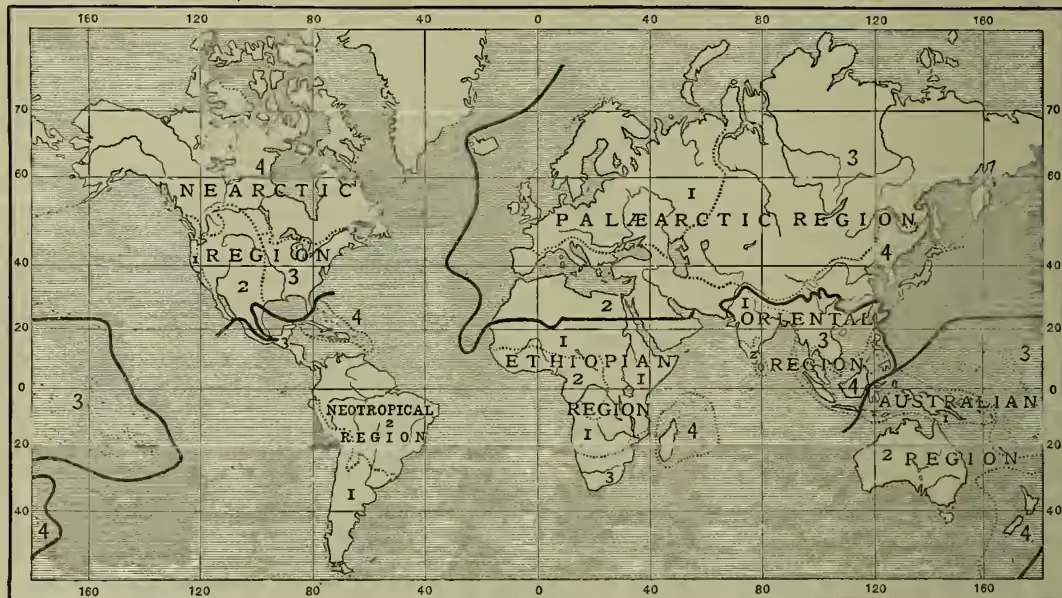
Sub-regions of Palæarctic Region—
- 1. European.
- 2. Mediterranean.
- 3. Siberian.
- 4. Manchurian.
Sub-regions of Ethiopian Region—
- 1. East African.
- 2. West "
- 3. South "
- 4. Malagasy.
Sub-regions of Oriental Region—
- 1. Indian.
- 2. Ceylonese.
- 3. Indo-Chinese.
- 4. Indo-Malayan.
Sub-regions of Australian Region—
- 1. Austro-Malayan.
- 2. Australian.
- 3. Polynesian.
- 4. New Zealand.
Sub-regions of Neotropical Region—
- 1. Chilian.
- 2. Brazilian.
- 3. Mexican.
- 4. Antillean.
Sub-regions of Nearctic Region—
- 1. Californian.
- 2. Rocky Mountain.
- 3. Alleghanian.
- 4. Canadian.
Changes in the climatic barrier have also had an important influence on geographical distribution; and it is by such changes, combined with changes in the continuity of land in the north polar regions, that the affinities between the floras of Japan and eastern North America must be explained. When these affinities were first pointed out by Asa Gray, that distinguished botanist divined the true explanation—viz. that in former geological epochs a genial climate must have prevailed even within the polar circle, so as to allow of the existence of a remarkably uniform flora, suitable to such a climate, all round the pole in very high latitudes; and that as the climate became colder in the north this flora was driven southwards, and became differentiated according to the differences of climate in the more southerly latitudes to which it advanced. Hence the eastern parts of America and Asia, as they correspond pretty much in climate, came to correspond also more closely than other tracts in the same latitude in the character of their floras. The soundness of this surmise was afterwards confirmed by the discovery of abundant plant remains of the Miocene age, indicating a warm climate in Greenland, Spitzbergen, and elsewhere. The effects on distribution of the changes of climate belonging to the period known as the Glacial Period (q.v.) or Ice Age must be alluded to here, but there is no space to do more.
As the result of all the processes of dispersal across the various barriers to migration, and of the changes in these barriers, we have the present distribution of plants and animals, which is such as to enable us to divide the terrestrial surface of the globe into more or less well-marked regions. For animals the regions adopted by Wallace are nearly the same as those first suggested by Schlater as applicable to the distribution of birds; for, in spite of the exceptional facility which birds have for crossing barriers impassable by mammals, Wallace finds that the distribution of mammals (which afford the best means of marking off zoogeographical regions) corresponds with that of birds to an extent that one would not perhaps have previously anticipated. But with regard to these regions it must be remembered (1) that it is impossible in most cases to draw any very clearly marked boundary line between one region and another; (2) that the degree of divergence between different regions is different in different cases; and (3) that, when any two regions are compared, we have not the same degree of divergence between different groups of the animal kingdom, or between animals and plants belonging to the two regions. Obviously, the degree of correspondence depends largely on the facilities for dispersal, and largely also on the geological age of different groups; and both of these are varying factors. These considerations being premised, we may now state briefly the limits of the six zoological regions adopted by Wallace, as given in his Island Life. In the space to which the present article is necessarily restricted it is impossible to give even the most fragmentary sketch of the characteristic life of the different regions, for which the reader must be referred to the works cited at the end of the article.
(1) Palearctic Region, including Europe and north temperate Asia and Africa to the northern borders of the Sahara.
(2) Ethiopian Region, consisting of all tropical and South Africa, together with Madagascar and the Mascarene Islands.
(3) Oriental Region, comprising all Asia south of the Palearctic limits, and along with this the Malay Islands as far as the Philippines, Borneo, and Java.
(4) Australian Region, as already defined and characterised. Celebes might be referred almost with equal right to this or the previous region. New Zealand is
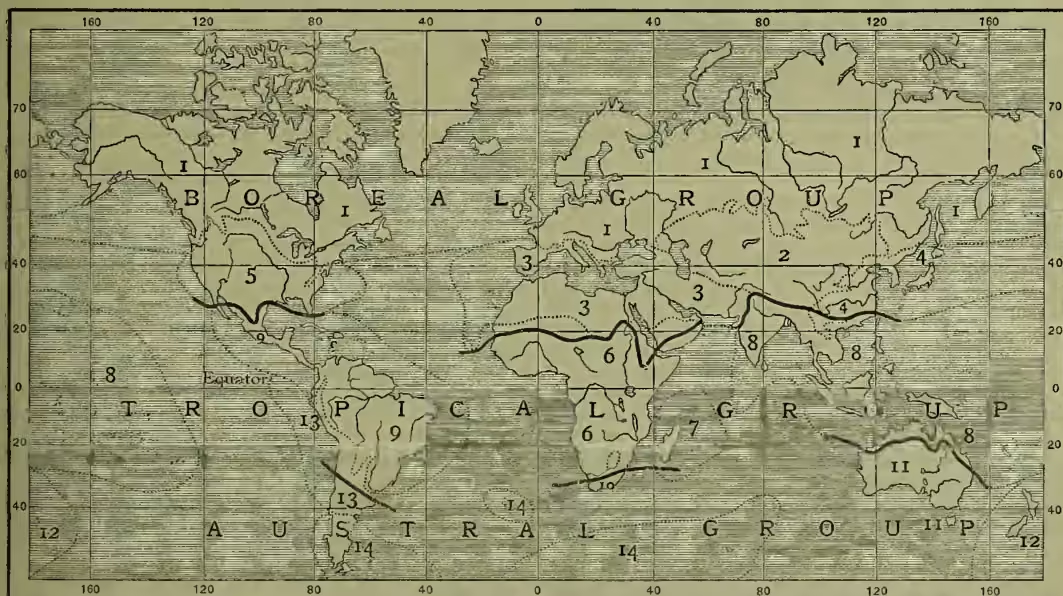
| 1. Northern. | 5. Central North American. | 9. Tropical American. | 13. Andine. |
| 2. Inner Asiatic. | 6. Tropical African. | 10. South African. | 14. Antarctic. |
| 3. Mediterranean. | 7. East African Islands. | 11. Australian. | |
| 4. Eastern Asiatic. | 8. Indian. | 12. New Zealand. |
treated by Wallace as a highly peculiar sub-region of this great region.
(5) Nearctic Region, comprising all temperate and arctic North America, including Greenland, and extending on the south to an irregular line running from the Rio Grande del Norte on the east to a point nearly opposite Cape St Lucas on the west.
(6) Neotropical Region, the American continent south of this line, together with the West Indian Islands.
Heilprin (see below) and others advocate the union of the Nearctic and Palearctic regions under the name of Holarctic, and introduce three transitional tracts (the Mediterranean, embracing southern Europe, northern Africa, and western Asia south of the Caspian and west of India, but exclusive of the southern half of Arabia; the Sonoran tract, embracing the north-west of Mexico; and the Austro-Malaysian tract, embracing Celebes and the smaller islands lying between it and New Guinea and Australia). Otherwise his major faunal divisions of the globe are similar to those of Wallace.
On plant distribution the most important recent works are those of Engler and Drude (cited at the end of the article). Engler attempts to trace the history of the vegetable kingdom since the Tertiary period, and comes to the conclusion that already in the Tertiary period four 'floral elements' (Florenelemente) could be distinguished—namely:
(1) The Arcto-tertiary element, characterised by an abundance of conifers and numerous genera of trees and shrubs now prevalent in North America, or in extra-tropical eastern Asia and in Europe.
(2) The Palearctic element, characterised by the presence of the families and sub-families dominant in the tropics of the Old World; and still more by the absence of certain families, groups, and genera found in the territory of the Arcto-tertiary element.
(3) The Neotropical or South American element, which, according to Engler, must have had in Tertiary times much the same character as that now possessed by tropical Brazil and the West Indies.
(4) The old Oceanic element, consisting of forms which possessed the power of traversing considerable stretches of ocean and developing further on islands.
The modern provinces of the vegetable kingdom are subordinated by Engler to these great divisions. Drude, in the first place, distinguishes the oceanic (marine) flora from the terrestrial forms, and the latter he divides into three great groups, and these again into fourteen floral domains (Florenreiche), the limits of which are shown on the accompanying map.
See P. L. Selater's paper on the Geographical Distribution of Birds, in the Jour. Linn. Soc. (Zool.), vol. ii., and his Address to the Biological Section of the Brit. Assoc. at Bristol, 1875; A. R. Wallace's Geographical Distribution of Animals (2 vols. Lond. 1876), and his Island Life (Lond. 1880); A. Murray's Geographical Distribution of Mammals (Lond. 1866); Angelo Heilprin, The Geographical and Geological Distribution of Animals (New York and Lond. 1887); Bentham's Presidential Address to the Linnean Society, Jour. Linn. Soc., x. (Botany, introd.); A. de Candolle's Géographie Botanique (2 vols. Paris, 1855); Sir J. Hooker's Introduction to the Flora of Tasmania, and Handbook of the Flora of New Zealand; also papers by him On Insular Floras, Brit. Assoc. 1866, and On the Distribution of Arctic Plants, Trans. Linn. Soc., xxiii.; Asa Gray's Forest Geography and Archæology, in Amer. Jour. of Science and Arts (ser. iii. vol. xvi. 1875); Grisebach's Vegetation der Erde (Leip. 1872; 2d ed. 1884; French translation with valuable additional notes by Tchihatchef, 1875-78); F. Beddard, Text-book of Zoogeography (1895); Engler's Entwicklungsgeschichte der Pflanzenwelt (1879-82); Oscar Drude, Die Florenreiche der Erde (Ergänzungsheft, No. 74, to Petermann's Mitteilungen, Gotha, 1884); and the chapters on Geographical Distribution in Darwin's Origin of Species, as well as chap. xxxviii.-xli. of Lyell's Principles of Geology.