Geometry is that branch of the science of mathematics which treats of the properties of space. When the properties investigated relate to figures described or supposed to be described on space of two dimensions, there arise such subdivisions as plane and spherical geometry, according to the surface on which the figures are drawn. If the properties relate to figures in space of three dimensions they fall under what is called solid geometry, or now more frequently, geometry of three dimensions. Again, from the mode in which the properties of figured space are investigated, arise two other subdivisions, pure and analytical geometry. The somewhat arbitrary subdivision into elementary and higher geometry arises from the fact that the geometrical books of Euclid's celebrated work, the Elements, treated only of plane figures composed of straight lines and circles, of solid figures with plane faces, and of the three round bodies, the sphere, the cylinder, and the cone.
Other subdivisions of geometry arise from the threefold classification that may be made of the properties of space. These properties may be topological, graphical, metrical. The first class of properties are independent of the magnitude or the form of the elements of a figure, and depend only on the relative situation of these elements. Perhaps the simplest example that could be given of this class of properties is that if two closed contours of any size or shape traverse one another, they must do so an even number of times. No systematic treatise on this part of geometry has ever been drawn up, and it is only in papers scattered here and there in scientific journals that contributions towards such a treatise are to be found. The principal names under which such contributions are to be looked for are Euler, Gauss, Listing, Kirkman, and Tait.
The graphical or projective properties of space, which constitute the subject of projective geometry, are those which have no reference to measurement, and which imply only the notions of a straight line and a plane. A simple example of this class of properties is the well-known theorem of Desargues: If two triangles be situated so that the straight lines joining corresponding vertices are concurrent, the points of intersection of corresponding sides are collinear, and conversely.
The metrical properties of space are those which are concerned with measurement. An example of a metrical property is the theorem of the three squares: The square on the hypotenuse of a right-angled triangle is equal to the sum of the squares on the two sides. The geometry of Euclid's Elements is metrical.
Descriptive geometry is not so much a part of science as an art. It has for its object to represent on a plane which possesses only two dimensions, length and breadth, the form and position in space of bodies which have three dimensions, length, breadth, and height. This object is attained by the method of projections.
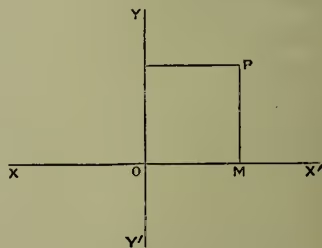
Analytical geometry is a method of representing curves and curved surfaces by means of equations. Before showing, however, how a curve can be represented by an equation, it will be necessary to explain what is meant by the coordinates of a point. If two axes, , , cutting each other perpendicularly be taken, the position of a point in the same plane as the axes is determined, if we know the distances of P from XX' and YY'—i.e. if we know MP and OM. OM is called the abscissa, MP the ordinate of the point P, and the two together are called the co-ordinates of P. It is usual to denote OM and MP by and . If the point P be supposed to move in the plane according to some law, a certain relation will exist between its co-ordinates; this relation expressed in an equation will be the equation to the curve traced out by P. To take a simple example. Let the law according to which P moves be that its distance from XX' shall always be double its distance from YY'; then the equation to the curve traced out by P will be . If it be required to draw the curve traced out by P, we may assume any values for , and from the equation determine the corresponding values for . If we assume the values 1, 2, 3, &c. for , the corresponding values of will be 2, 4, 6, &c. Determine then the points whose co-ordinates are 1 and 2, 2 and 4, 3 and 6, &c.; these will be points on the curve. It is not difficult to discover that the curve is in this instance a straight line.
If the law according to which P moves in the plane be that it shall always be at the same distance from a fixed point, we have only to specify the distance (say ), and the co-ordinates of the fixed point (say and ), and we shall find the equation which expresses this law to be
If the distance be , and the fixed point be the origin O whose co-ordinates are 0 and 0, the equation will be
These last two equations are those of a circle.
As two co-ordinates are sufficient to determine a point in a plane, so a plane curve described according to a certain law will be represented by an equation between two variables, and ; viz. . It may be mentioned that equations of the first degree represent straight lines, those of the second degree represent some form of a conic section, those of higher degrees represent curves which in general take their name from the degree of their equations. The position of a point in space is fixed when its distances from three planes, usually taken perpendicular to each other, are known; in other words, three co-ordinates determine a point in space. Hence, if a curved surface is given in form and position, and we can express algebraically one of its characteristic properties, and obtain a relation between the co-ordinates of each of its points, this equation is the equation of the surface; and every equation , whose variables are the co-ordinates of a point referred to three planes, perpendicular or oblique to each other, represents some surface, the form of which depends on the way in which the variables are combined with each other and with certain constant quantities.
The system of co-ordinates explained above is called the Cartesian, from Descartes. There are other systems, but a concise account of them would be unintelligible.
Of the history of geometry only the briefest outline can be given here, and this outline must be restricted mainly to pure geometry. Tradition ascribes (and modern research tends to confirm rather than to invalidate the ascription) the origin of geometry to the Egyptians, who were compelled to invent it in order to restore the landmarks effaced by the inundation of the Nile, but our knowledge of their attainments is meagre. From a papyrus in the British Museum written by Ahmes, possibly about 1700 B.C., we infer that the Egyptians discussed only particular numerical problems, such as the measurements of certain areas and solids, and were little acquainted with general theorems. The history of geometry, therefore, as a branch of science begins with Thales of Miletus (640–542 B.C.). The principal discovery attributed to him is the theorem that the sides of mutually equiangular triangles are proportional. After Thales came Pythagoras of Samos (born about 580 B.C.). It is difficult to separate the contributions which Pythagoras made to geometry from those of his disciples, for everything was ascribed to the master. The Pythagoreans appear to have been acquainted with most of the theorems which form Euclid's first two books, with the doctrine of proportion at least as applied to commensurable magnitudes, with the construction of the regular solids, and to have combined arithmetic with geometry. The theorem of the three squares, one of the most useful in the whole range of geometry, is known as the theorem of Pythagoras. Hippocrates of Chios, who reduced the problem of the duplication of the cube to that of finding two mean proportionals between two given straight lines; Archytas of Tarentum, who was the first to duplicate the cube; Eudoxus of Cnidus, the inventor of the method of exhaustion and the founder of the doctrine of proportion given in Euclid's fifth book; Menæchmus, the discoverer of the three conic sections; Deinostratus and Nicomedes, the inventors of the quadratrix and the conchoid; and Aristæus, are the principal predecessors of Euclid. To Euclid (about 300 B.C.) is due the form in which elementary geometry has been learnt for many centuries, and his treatise, the Elements, seems to have completely superseded all preceding writings on this subject. Those books of this treatise which are concerned with geometry are so well known that it is superfluous to refer to their contents. Archimedes of Syracuse (287–212 B.C.) is the greatest name in Greek science. Besides his important contributions to statics and hydrostatics, he wrote on the measurement of the circle, on the quadrature of the parabola, on the sphere and cylinder, on conoids and spheroids, and on semi-regular polyhedrons. Apollonius of Perga (260–200 B.C.) wrote on several geometrical subjects, but the work which procured him in his lifetime the title of 'the great geometer,' was his treatise on the conic sections. Ptolemy, author of the Almagest, Hero, and Pappus are the last important geometers belonging to the Alexandrian school.
After the destruction of Alexandria (about 640 A.D.) the study of geometry underwent a long eclipse. The Romans contributed nothing either to geometrical or indeed to any kind of mathematical discovery. The Hindus from the 6th to the 12th century A.D. cultivated arithmetic, algebra, and trigonometry, but in geometry they produced nothing of any importance. A somewhat similar statement may be made regarding the Arabs, but it ought to be remembered that they translated the works of the great Greek geometers, and it was through them that mathematical science was in the 12th century introduced into western Europe. From that time till the close of the 16th century, though editions of the Greek geometers were published and commented on, little or no advance was made in geometry comparable to what took place in other branches of pure or applied mathematics.
In the beginning of the 17th century Kepler and Desargues laid the foundations of modern pure geometry, the former by his enunciation of the principle of continuity, and by his extension of stereometry to solids of which the spheroids and conoids of Archimedes were particular cases, the latter by his introduction of the method of projection. In 1637 Descartes gave to the world his invention of analytical geometry, thus placing in the hands of mathematicians one of the most powerful instruments of research, and withdrawing their attention from pure geometry. Pascal (1623-62), whose extraordinary precocity has often been cited, wrote an essay on conic sections at the age of sixteen. He afterwards wrote a complete work, one of the properties of which is the theorem of the mystic hexagram. His last work was on the cycloid. With the mere mention of the names of Wallis, Fermat, Barrow, Huygens, we pass to Newton, whose great work, the Principia, is the glory of science. Chasles thinks Newton's best title to fame is that he has raised such a monument of his genius by the methods and with the resources of the geometry of the ancients. The names of Halley, Maclaurin, Robert Simson, and Euler bring us down to near the end of the 18th century. During the 19th century a revival of interest in pure geometry has been brought about by Monge, the inventor of descriptive geometry, by Carnot, the author of the theory of transversals, by Poncelet and Gergonne. These have been succeeded by Möbius, Steiner, Chasles, and Von Staudt.
The best works on the history of Greek Geometry are Allman's Greek Geometry from Thales to Euclid (1889); Paul Tannery's La Géométrie Grecque (1887); Bretschneider's Die Geometrie und die Geometer vor Euklides (1870). Chasles's Aperçu historique sur l'Origine et le Développement des méthodes en Géométrie (1837 or 1875) and his Rapport sur le Progrès de la Géométrie (1870) embrace the whole field of Geometry. The following more general histories may also be consulted: Cantor's Vorlesungen über Geschichte der Mathematik (1880); Hoefler's Histoire des Mathématiques (1874); Marie's Histoire des Sciences Mathématiques et Physiques (12 vols. 1883-88); Montucla's Histoire des Mathématiques (1802); Gow's Short History of Greek Mathematics (1884); and Ball's Short Account of the History of Mathematics (1888).