Geyser, or GEYSIR (Icelandic geysa, 'to burst out violently'), is the name applied to eruptive fountains of steam and hot water met with in various quarters of the globe, especially in Iceland, North America, New Zealand, Tibet, and the Azores. The water of these springs is often clear and limpid, but frequently thick, tur- bid, and heavily charged with mud; examples of the latter have been discovered in Burma. The mineral substances held in solution in geysers are numerous and varied in character, including sodium chloride, calcium sulphate, sodium sulphate, calcium carbonate, magnesium carbonate, ammonium carbonate, potassium chloride, silica, various silicates, sulphur, ferric oxide, aluminium oxide, carbonic acid, &c. Some of these substances, becoming separated from the water by evaporation, form basin-shaped cones of solid matter, from the midst of which the geyser rises, and in course of time assume proportions of considerable magnitude; the cones are principally of a calcareous or siliceous character, the latter, known as siliceous sinter or geyserite, being apparently most common. It is either a compact, dull, sometimes, but less frequently, translucent laminated substance, or shapeless, porous mass, occasionally impregnated with ferric oxide, which produces a red or pink tinge.
Geysers occur only in regions where volcanic activity has but lately become dormant, but is not yet altogether extinct, and the phenomena connected with them are connected with seismic action. Bunsen and Descloizeaux have formulated a theory explaining the phenomena, which has met with wide acceptance and is generally preferred to the views held by such authorities as Bischof, Mackenzie, Herschel, Von Nidda, and others. Shortly stated, the explanation put forward by the two former is as follows, founding upon observations made at the Great Geyser of Iceland. In the tube of this geyser, and near the surface, the water temperature is 212° F., increasing downwards until a degree of heat is reached very far above the boiling-point of water under ordinary atmospheric pressure, fluidity being maintained by the weight of the column of water above. The water in the tube or funnel of the geyser communicates with an area directly acted upon by the source of the subterranean heat, such communication being attained by means of a lateral chamber or passage. Far down in the funnel steam is generated, which, rising immediately into the cooler water above, is condensed, heating the upper water until the boiling-point is reached, and relieving the pressure upon the lower portions of the greatly heated water, which flashes into steam. This alteration passing down the funnel results in closely following explosions of steam, shooting the whole contents high into the air, and producing the well-known outward manifestations associated with geysers.
These manifestations are most frequently met with where large masses and thicknesses of rock have undergone extensive crushing, fracture, and compression—which may account not only for the subterranean heat, but also for the presence of the underground passages apparently necessary for the production of a geyser.
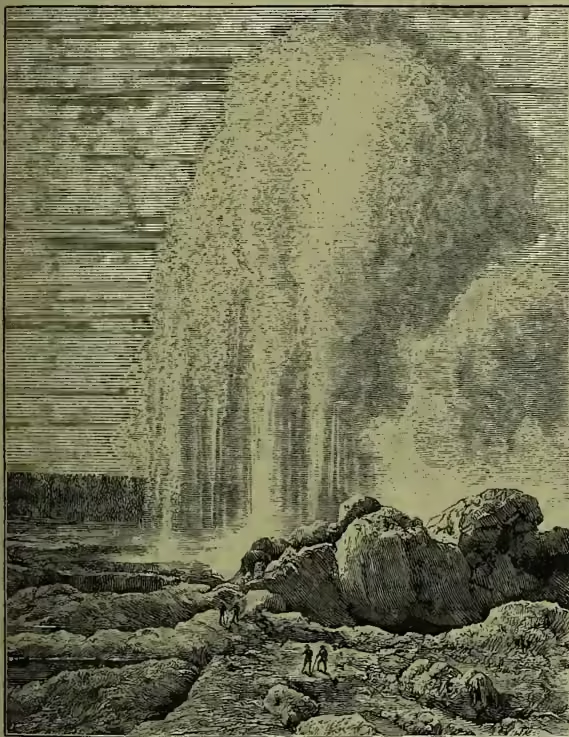
The geysers of the Yellowstone region are probably the most picturesque and wonderful in the world: on the Firehole River alone, within an area of 30 sq. m., there are probably 50 geysers, throwing columns of water to a height of from 50 to 200 feet, while smaller jets rise occasionally to 250 feet. The 'Old Faithful' geyser, in this region, throws up a column of water 6 feet in diameter to a height of 100 to 150 feet, at intervals of about an hour. Near the north entrance to the National Park, also, are the hot springs of the Gardiner River; here the 'White Mountain,' built up of terraces of white calcareous deposits, rises to a considerable height, with a diameter of 150 yards at the top. The terraces are of varying width, measuring from a few inches to many feet, and are separated one from another by small cliffs of from 6 inches to 10 or 12 feet in height. From the top of the mound water is continually trickling down over these rocks and terraces, the precipitate left behind ever slowly adding to the bulk of the cone. As the streams fall from terrace to terrace they are received into several natural basins, and, as the water gradually cools as it nears the bottom, bathers are enabled to choose almost any temperature of water, and these natural baths are largely taken advantage of. See YELLOWSTONE.
The geysers of Iceland are situated within sight of Mount Hekla, 16 miles north of Skalholt, and are the hottest springs in Europe, as well as the best known in the world. Norwegian writers of the 12th century noted their presence, but it was nearly 600 years later before native authors described or noticed them in any way. The principal geysers of this region are known as the 'Great Geyser' or 'Roarer,' and the 'Stroker' or 'Churn.' The former consists of the usual mound of siliceous incrustations, almost circular and about 40 feet in height, the top forming a basin measuring 52 feet by 60 feet, lined with a pure white siliceous coating of considerable hardness. A tube, 74 feet in length, communicates with the interior of the geyser, the upper opening being in the centre of the basin. There can be no doubt that the geyser has itself built up the tube and mound—a work, according to careful calculations and experiments undertaken on the spot in 1859 by Commander Forbes, which must have occupied over eleven centuries. Probably the best account of this geyser is that of Henderson, who visited the district in 1814. The 'Churn' has an irregular opening, not more than eight feet wide, the tube decreasing in width as it descends, permitting one to look down upon the boiling water 20 feet below without much danger to the observer. If the orifice be temporarily choked by throwing in turf the water will soon burst through, rising 60 feet into the air, carrying the obstruction along with it, and diffusing dense clouds of steam in all directions.
The geysers of New Zealand attained celebrity principally on account of the beautiful terraces associated with them, and have often been described and figured. Unfortunately, volcanic activity manifested itself throughout the region in June 1886, resulting in much loss of life and property, and in the destruction of the terraces. The basins connected with these geysers, catching the overflow of water, are, like those of the Yellowstone region, largely used by bathers, and are much resorted to by invalids. Froude and Martin may be consulted for descriptions of typical New Zealand geysers. See MINERAL WATERS.