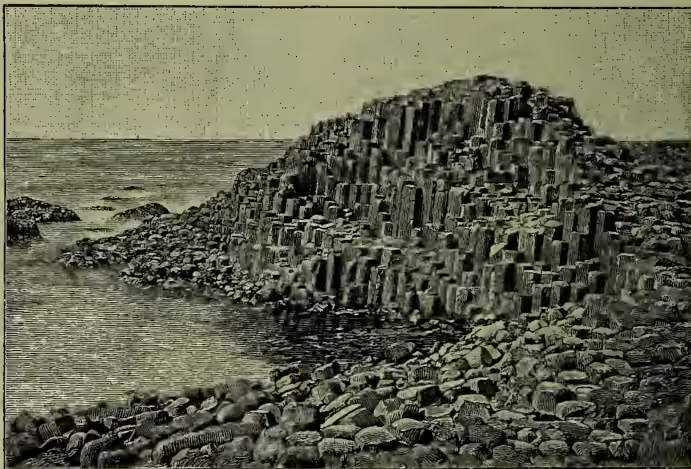
Giants' Causeway (deriving its name from a legend that it was the commencement of a road to be constructed by giants across the channel to Scotland) is a sort of natural pier or mole, of columnar basalt, projecting from the northern coast of Antrim, Ireland, into the North Channel, 7 miles NE. of Portrush by an electric tramway (1883). It is part of an overlying mass of basalt, from 300 to 500 feet in thickness, which covers almost the whole county of Antrim, and the eastern part of Londonderry. The basalt occurs in several beds, interstratified with protrusions of whin-dyke. Several of these beds are more or less columnar, but three layers are remarkably so. The first appears at the bold promontory of Fair Head; its columns exceed 200 feet in height. The other two are seen together rising above the sea-level at Bengore Head, the lower one forming the Giants' Causeway. It is exposed for 300 yards, and exhibits an unequal pavement, formed of the tops of 40,000 vertical closely-fitting polygonal columns, which in shape are chiefly hexagonal, though examples may be found with 5, 7, 8, or 9 sides. There is a single instance of a triangular prism. The diameter of the pillars varies from 15 to 20 inches. Each pillar is divided into joints of unequal length, the concave hollow at the end of one division fitting exactly into the convex projection of the other. The rock is compact and homogeneous, and is somewhat sonorous when struck with a hammer. The Grand Causeway is itself formed of three causeways, the Little, Middle or Honeycomb, and the Grand Causeway. On the Little Causeway may be seen an octagon, pentagon, hexagon, and heptagon all together; on the Middle Causeway is the famous Wishing Chair, with two arms and a back, on a platform where the columns rise to a height of about 10 feet. On the Grand Causeway are pointed out the Lady's Fan, an exact arrangement of five perfect pentagons surrounding a heptagon; the Keystone of the Causeway—a sunk octagon; and the single triangle. At the starting-point is the Giants' Loom, an imposing row of columns 30 feet high, each intersected by about thirty joints; to the left is the Giants' Well, to the right the Giants' Chair.
The best way to see the Causeway is to walk along it under the cliffs, and next over them, but he who would see the full grandeur of this wonderful strip of coast must row along it eastward as far as the Pleaskin. The 'Short Course' includes a visit to Portcoon and Runkerry Caves and the Causeway only; the 'Long Course' extends westward to the caves, and eastward to the Horseshoe Bay beyond Pleaskin and under Benbane Head. The various inlets and points along the coast, passed in order, are Portnabo, separated by the Stookan Rocks from Portganniy; next, after the Giants' Causeway proper is passed, Portnoffer, closed on the east side by the Giants' Organ, a row of imposing pillars the appearance of which at once explains their name; after Roverin Valley Head is turned, Port Reostan, opening up into the Amphitheatre, fringed with cliffs 350 feet high, and reaching its eastern horn in the Chimney Point, the lofty stacks of whose rocks are said to have been fatally mistaken for the chimneys of Dunluce Castle by a Spanish Armada ship. The next bay is Spanish Bay, with the Spanish Organ, shut in by Benanouran Head, 400 feet high, between which and Pleaskin Head are the reefs called the Giants' Eyeglass and the King and his Nobles. The Pleaskin rises to a height of 400 feet, and is the noblest of all the Causeway cliffs. The prospect is unrivalled from Hamilton's Seat near its top, so named from the Rev. Dr Hamilton of Derry, one of the first to call attention to the Causeway (1786). Beyond it is the Horseshoe Harbour and the group of rocks called the Nurse and Child. After rounding Benbane Head we come in sight of Bengore Head (367 feet), below which the coast slopes more rapidly southward past the pillars known as the Four Sisters, the Giants' Peep-hole, and the Giants' Granny to the ruins of Dunseverick Castle.