Gibraltar (Span. Gibraltarr'), an isolated mass of rock, in the SW. of Spain, rising to an altitude of 1408 feet, 3 miles in length and mile in average breadth, is situated at the extremity of a low sandy peninsula, which connects it on the north with Andalusia; its most southern headland, Point Europa, is in N. lat. and W. long. Its western side is washed by the Bay of Gibraltar, called also the Bay of Algeciras; and at the foot of the rock, on this same side, is the town of Gibraltar, which consists of two parts, the South Town, above the dockyard, and the North Town, which has narrow, mean streets, and is inhabited by a motley agglomeration of English, Genoese, Spaniards, Jews, and Moors. In 1892 Algeciras (opposite) was connected with the Spanish railway system. Pop. (1895) 26,184, including garrison of 5034. Amongst public buildings, besides barracks, &c., are the governor's residence, called the Convent—it formerly belonged to the Franciscans; the naval hospital; the Alameda Gardens, stretching between the North Town and the South Town; the signal station, crowning the central eminence of the rock, 1255 feet high; the remains of the ancient Moorish castle, founded in the 10th century; and the lighthouse, on Point Europa, erected in 1841, whose light, 150 feet above the sea, is seen for 20 miles. At the northern base of the rock is the open space called the North Front, extending as far as the British lines; here are the cemetery, the cricket-ground, the racecourse, &c. Between the British and the Spanish lines is the neutral ground, which is uninhabited. On the west side of the rock, south of the Alameda Gardens, are the naval victualling-yard and the naval dockyard. This latter dates from the 18th century, and is protected on the south by a new mole, a quarter of a mile long. The merchant-vessels that visit the town find good anchorage in the Bay of Gibraltar, 8 miles deep by 5 wide. Gibraltar has been a free port since its capture by the British. Until the introduction of steam-vessels it was one of the chief emporiums of the Mediterranean; and its trade is still important—the burden of the vessels entering and clearing is about 5000 ships of 8,500,000 tons (the vast majority British) in a year. Gibraltar ranks among the most important Coaling Stations (q.v.), and harbour improvements were sanctioned by the naval bills of 1895 and 1896. The Spaniards complain of smuggling from Gibraltar. The governor exercises all the functions of the legislative and executive; local affairs are managed by elected commissioners. Since 1842 Gibraltar has been the see of an Anglican bishop.
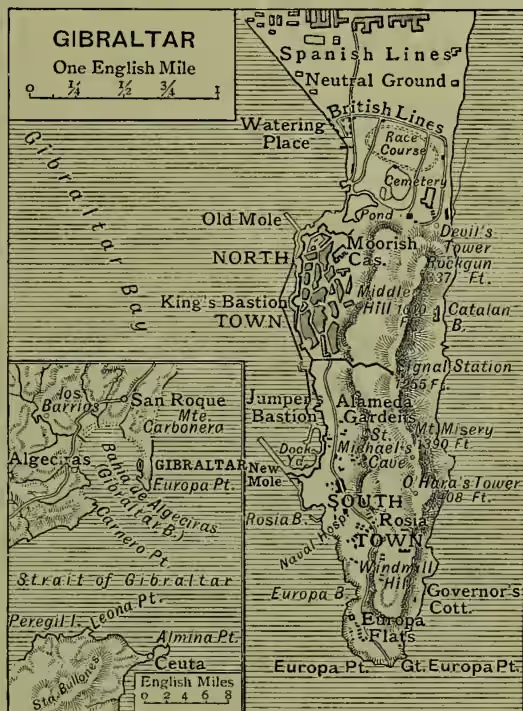
'Every spot from which a gun can be brought to bear is occupied by cannon, which oftentimes quaintly peep out of the most secluded nooks, among geraniums and flowering plants, while huge piles of shot and shell, some of enormous size, are stowed away in convenient places, screened from an enemy's fire, but all ready for use.' The approaches from the north, across the flat isthmus connecting the rock with Spain, and from the sea, the south and south-west sides, are guarded by a great number of very powerful batteries, mounted with guns of the heaviest calibre, and by fortifications so strong in themselves and in their relative bearing on each other, that the rock may fairly be regarded as impregnable so long as a sufficient garrison remains for its defence, and sufficient provision for the maintenance of the troops and any civil inhabitants suffered to reside there during hostilities. Moreover, a sea-wall, defended by a system of flanking bastions, and strengthened by a breakwater, constructed in 1846, extends along the western base of the rock from the new mole to the old. Towards the north and north-west the defences are aided by a series of fortified galleries, some 2 to 3 miles in length. These consist of an upper and a lower tier: in the former are two large halls; one, St George's, is 50 feet long by 35 wide. Port-holes are cut in these galleries for cannon at intervals of 12 yards.
The eastern side is so precipitous as to be altogether secure from assault. The annual cost to the imperial government of maintaining the garrison and fortifications averages about £330,000. In these days, however, of steam-ships and heavy long-range guns, the military importance of Gibraltar has certainly diminished.
The rock is composed of Jurassic limestone resting on a Silurian basement. The surface presents a bare and repellent aspect, principally due to the absence of trees; nevertheless, there are grassy, wooded glens in the nooks of the mountain. The rocky mass is perforated by numerous caverns, some of which penetrate for several hundred feet into the rock. The largest, called the 'Hall of St Michael,' is 220 feet long, 90 wide, and 70 high, and its floor is connected with the roof by stalactite pillars ranging up to 50 feet in height, linked by arches on the top. The entrance lies about 1100 feet above the sea. Large stalactites are found in most of the other caverns, and interesting fossils abound throughout the peninsula. Gibraltar is the only place in Europe where monkeys live wild (see BARBARY APE); but, after an epidemic of smallpox in 1894, only fifty remained.
Gibraltar has been known in history since the days of the early Phœnician navigators. The Greeks called it Calpe, and it and Abyla (now Ceuta) opposite formed the Pillars of Hercules, long held to be the western boundary of the world. We have no certain information of its natural strength being made available for defensive or aggressive purposes until the year 711 A.D., when the Saracen leader Tarik, a general of the Calif Al-Walid, crossing from Africa for the invasion of the Visigothic kingdom, fortified it, as a base of operations, and a ready point of access from the Barbary coast. From this chieftain it took the name of Gebel el-Tarik, or Hill of Tarik, of which Gibraltar is a corruption. One of the old towers of his early castle still remains. In 1302 Ferdinand II. of Castile won it from the Moors; but in 1333 it fell to the army of the king of Fez, whom a siege by the Castilian monarch failed to dislodge. In 1410 Yussuf, king of Granada, possessed himself of the fortress, which, however, was finally wrested from the Moors by the Spaniards in 1462, and by them refortified and strengthened in every way. A combined Dutch and English force, however, under Sir George Rooke and Admiral Byng, and the Prince of Hesse-Darmstadt, after a vigorous bombardment, and a landing in force, compelled the governor to capitulate in 1704.
Since 1704 Gibraltar has remained continuously in the possession of the British, in spite of many desperate efforts on the part of Spain and France to dislodge them. Before the victors had been able to add to the defences, their mettle was severely tried by two attacks in 1704-5. The most memorable of the sieges to which Gibraltar has been exposed commenced 21st June 1779, when, Britain being engaged in the struggle with its revolted colonies, and at the same time at war with France, Spain took the opportunity of joining the coalition, and made a most determined attempt to subdue the garrison of this isolated fortress. It was, however, defended with heroic valour by General Eliott (see HEATHFIELD) and 5000 men, including 1100 Hanoverians. Several times the defenders were on the point of starvation. On 26th November 1781, in a desperate midnight sally, the British succeeded in destroying the more advanced of the enemy's lines on the land side, in setting fire to many of his batteries, and in blowing up his principal depôt of ammunition. At length in July 1782 the Spaniards were reinforced by the French, the Duc de Crillon took command of the assailants, and preparations were made for the grand assault.
Additional batteries were constructed on the land side, and floating-batteries built to bombard the fortress from the sea. Covered boats destined to disembark 40,000 troops were at the same time prepared. The effective force with which General Eliott had to withstand these efforts comprised about 7000 men. The attack commenced on the 8th September by a furious bombardment simultaneously on all sides, and it was kept up without intermission until the 14th; but by means of red-hot balls and incendiary shells the otherwise invulnerable floating-batteries were all set on fire and destroyed, and the attack was completely repulsed, with a loss to the heroic garrison of only 16 killed and 68 wounded. Since then the fortress has enjoyed immunity from attack. See Drinkwater's History of the Siege of Gibraltar (1785); Gibbard's History of Gibraltar (1881); H. M. Field, Gibraltar (New York, 1889).