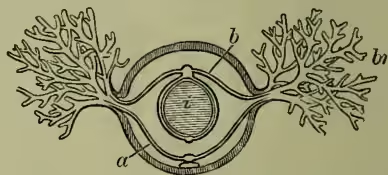
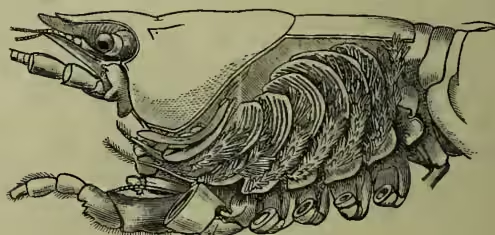
Gills, or BRANCHIÆ, organs of aquatic respiration, consisting of expansions through the thin skin of which oxygen dissolved in the water is taken into the blood, while carbonic acid passes out. It is difficult to say what animal first exhibits gills; for respiration through the general skin is common in lower Invertebrates, and the distinction between mere skin lobes and marked expansions in special connection with the vascular system is arbitrary. In starfishes thin out-pushings of the lining of the body-cavity project through pores in the skin; a modification of this simple plan is seen in some other Echinodermata; while the characteristic tube-feet are sometimes respiratory, and the Holothurians have often respiratory tentacles. In marine worms we find every transition from vague skin respiration to the increase of this by filaments or tentacles associated with legs or head, and finally to definite gills. These are usually thin expansions, filamentous, tufted, or feathery, which project into the water, have cilia on their outer surface, and blood-vessels riddling them internally. In some of the lower Crustaceans again (Branchiopoda—i.e. 'gill-footed') a number of the legs are thin enough to admit of respiration through their surfaces, while the higher forms have associated with some of their limbs special tufts of respiratory filaments, or definite feathery gills, as in the lobster. These consist of a main stem, within which are two canals, one for the impure blood from the body, the other for the return of oxygenated blood on its way to the heart; but with these canals are connected numerous hollow, thin- walled filaments, in which the real respiration is effected. In the lobster and its allies these are overlapped by the sides of the anterior shield, but water currents are kept up by the baling action of one of the anterior appendages on each side. In the King-crab (Limulus), rather an Arachnid than a Crustacean, five pairs of abdominal appendages bear flat 'gill-books,' each of which consists of an axis bearing some 150 hollow, thin-walled, blood-containing leaves. In the aquatic larvæ of some insects the air-tubes (tracheæ) are closed, but form gill-like outgrowths ('tracheal gills'), by means of which oxygen is absorbed. In bivalve molluscs (Lamellibranchs) the gills usually form ciliated plates on each side of the body. Each gill, or ctenidium, as it is often called, really consists of two rows of hollow processes of the body-wall, extending downwards on each side of the foot, but each filament at its free end usually bends up again, so that a cross section has the form of a W, the median apex of which represents the point of origin from the body-wall. Neighbouring filaments become linked to one another, and ascending and descending parts of the same filament are likewise crossed by bridges, so that finally continuous plates result, channelled by blood-containing canals. Somewhat simpler on the whole are the external gill filaments of cliton, of the limpet, of nudibranchs, &c., or the in-
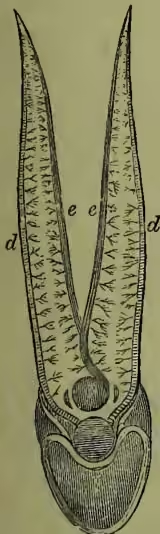
d, d, artery and branches;
e, e, vein and branches.
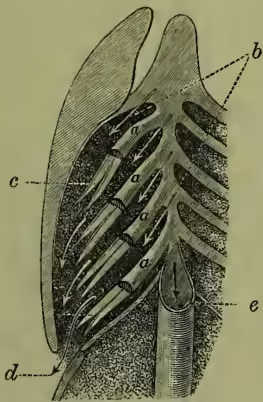
Showing by arrows, b, the course of the water; a, the gill arches; c, the gills; d, the external opening; e, the gullet.
ternal gills (covered by a folding of the mantle) in many aquatic Gasteropods; or lastly, the well-developed feather-like gills in the mantle cavity of cuttle-fishes.
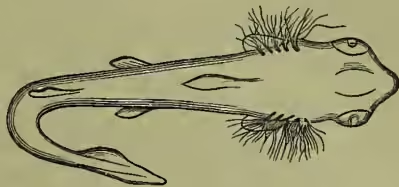
Young Dog-fish, showing transitory external gills.
Among vertebrates gills are developed only as far as the amphibians, all of which have them in their youth, though many, such as the frog, have them entirely replaced by lungs in adult life. Beyond amphibians gills never occur, though branchial or visceral clefts on the sides of the pharynx remain as traces of the ancestral condition. In tunicates and in the lancelet water entering by the mouth washes the blood spread out in vessels between slits on the walls of the pharynx, but there are no gills. In the round mouths, or Cyclostomata, the gills are enclosed in pocket-like structures, through which the water passes. In fishes we have to distinguish transitory external gills occasionally present from true internal gill-filaments borne on the branchial arches, and washed as usual by the water which entering by the mouth passes out by the gill-slits. The gill of a fish generally consists of two triangular folds of mucous membrane, supported by the branchial arch and minor cartilaginous rods, and traversed, as the diagram suggests, by vessels with impure blood from the heart, and with oxygenated blood to the body (see FISHES). For Amphibia, see the case of the tadpole described in the article FROG, and the various adult states described in the article AMPHIBIA. The student should examine especially the gills of bivalves—e.g. mussel—of fishes, and of tadpoles. See CIRCULATION, MOLLUSCA, RESPIRATION.
For the general comparative anatomy of gills, see Professor F. Jeffrey Bell's Comparative Anatomy and Physiology (Lond. 1885), and other text-books. For minute structure of gills, see especially Holman Peck, Quart. Journ. Micr. Sci. xvii. (1877), and Professor Ray Lankester's article 'Mollusca' in the Ency. Brit.