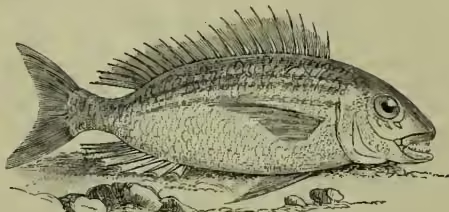
Gilthead (Chrysophrys), a genus of 'seabreams' or Sparidae, represented by about a score of species from the warmer seas, best known by the Mediterranean species (Ch. aurata), sometimes found on the southern coasts of England. Large species occur off the Cape of Good Hope, and Ch. husta is common on East Indian and Chinese coasts. The gilthead has an oblong and compressed body, a single dorsal fin with spines which can be received into a groove, scaly cheeks and gill-cover, and two kinds of teeth, sharp like canines in front, rounded like molars behind. The length is about a foot; the back is silvery gray, shaded with blue; the belly like polished steel; the sides have golden bands; and there is a half-moon-shaped spot of gold between the eyes to which the various names Chrysophrys ('golden eyebrow'), Aurata ('gilded'), Daurade, and Gilthead obviously refer. They feed chiefly on molluscs, in search of which they are said to stir up the sand with their tails. The fish is generally found near the shore in small shoals, and its presence is sometimes betrayed to fishermen by the noise which its teeth make in crushing shells. It was often kept in the vivaria by the Romans, being much valued and easily fattened.