Glasgow, the industrial metropolis of Scotland and the most populous city in Great Britain next to London, is situated on the banks of the Clyde, in the county of Lanark, the portions heretofore in Renfrew and Dumbarton shires having been transferred to Lanark under the act of 1889; at Greenock, 22 miles below, the river spreads out into a great estuary, the Firth of Clyde. Glasgow is within a nine hours railway journey of London, the distance being 405½ miles, and is about an hour's run (45 miles) from Edinburgh. The city in extent is about 3½ miles from north to south, and the extreme length is 5 miles from east to west. In reckoning area and population, however, the ring of burghs which have since the passing of the 'Lindsay' Burgh Act sprung up around and almost hemmed in Glasgow ought to be taken into consideration, as these burghs have been formed by the overflow of the population from the city proper. In 1891 the population within municipal boundaries was 565,714; within suburbs incorporated on 1st November 1891, 91,232; within suburbs not yet incorporated (Govan, Partick, &c.), 113,525—a total of 770,471 in city and suburbs. To this may be added 40,940 persons in business in Glasgow residing beyond the suburbs, and 3000 at the coast at census time, giving a grand total of 814,411. In 1881 the municipal population was 511,415, and, with the nine suburban burghs and the non-burghal suburbs, the total was 692,322; in 1801 the population was only 77,385, so that the increase has been rapid and enormous.
The origin of the name Glasgow is a subject which has been much disputed, and is still at best a mere matter of conjecture. From the position of the original settlement on the banks of the Molendinar, which stream flowed to the Clyde through a dark ravine, it has been argued that the name means 'dark glen.' A more favourite interpretation, however, is based on the fact that a village actually existed on the present site of the city prior to the settlement of Kentigern, and that it was called Clueschu, which name by a series of natural changes in time came to be written Glasghu or Glasgow. This conclusion is probably correct, and admits easily enough of the meaning deduced from it—viz. that in Celtic Glas signifies 'green,' and cu or ghu 'dear,' thus making the combination Glasgow mean the beloved green spot.
Glasgow does not occupy an important place in the early history of Scotland. As an archiepiscopal seat, and subsequently as a centre of Covenanting activity, it has a prominence in religious affairs; but as an industrial city its history can hardly be dated further back than the Union of 1707. This event opened up to the town—the most favourably situated in Scotland for the enterprise—an immense trading prospect with America, and roused in its inhabitants the extraordinary mercantile activity which has been its leading feature ever since. And yet the city of Glasgow is a very old one. It was about 560 A.D. that the half-mythical St Kentigern (q.v.) or Mungo established himself on the banks of the Molendinar, and appeared as the apostle of Christianity to the rude Celts of Strathclyde. There he built his little wooden church on the very spot where now rises the venerable cathedral. From this date for five hundred years the history of the settlement by the Clyde is a blank. The church disappeared from history, and if the village which had clustered round it and grown under the fostering care of the clergy still remained, it was a place of no importance. In the year 1115 the Prince of Cumbria, afterwards David I. of Scotland, ordered an investigation to be made into the lands and churches in the bishopric of Glasgow, and from the deed still existing of that date it is evident that a cathedral had been previously endowed. In 1116 the diocese was restored, and when David a few years after became king of Scotland he gave to the see of Glasgow the lands of Partick, besides restoring to it much of the property of which it had been despoiled. In 1124 he also gifted money for the purpose of building a church, which was dedicated in 1136, and afterwards enriched by many royal and private donations. Between 1175 and 1178 Jocelyn, Bishop of Glasgow, received authority from William the Lion to 'have and hold' a burgh in the neighbourhood of the cathedral. Alexander II. supported Glasgow in a conflict of jurisdiction with Rutherglen, and bestowed on it the rights of trade throughout the kingdom. Robert the Bruce confirmed to the bishop the various charters granted to him, and James II. prohibited Renfrew and Rutherglen from exacting toll 'by water or by land' within its territories. In 1450 the city was erected into a regality which gave the bishop the highest jurisdiction the crown could bestow on a subject-superior, and within the same year the university was constituted under a bull of Pope Nicholas V., which was confirmed three years later by a letter of privileges from the king and a charter from the bishop and chapter.
In 1454 reference is made to one John Stewart as the first provost that was in the city of Glasgow. After that date the magistrates are described as provost and bailies; and, though it is not recorded how they were elected at that time, in 1476 James III. authorised the ruling bishop in Glasgow to elect so many bailies, sergeants, and other officers as were needed within the city, and to appoint a provost, all to hold office during his pleasure. This unsatisfactory mode of procedure continued in force till 1587, when the whole of the church lands were annexed to the crown, and several months later granted to Walter, Commendator of Blantyre, in feu for payment to the crown of £500 Scots annually. Along with other privileges, Blantyre and the Duke of Lennox both claimed the right of choosing the provost and bailies of the burgh, which privilege had been taken from the church. James VI. in 1600 conveyed to Lennox that right; but five years later the city itself was authorised to have the freedom of election of its own magistrates, and in 1611 this authority was confirmed by act of parliament—not, however, without the stipulation that both the church and Lennox should reserve the right to influence the election. Glasgow therefore did not fully receive the position of a royal burgh till 1636, when it was incorporated into one free royal burgh, with the freedom of the Clyde from the bridge of Glasgow to the Clochstane in the Firth of Clyde. At the time of the Commonwealth the Glasgow citizens made a strenuous effort to effect the union of England and Scotland; but the death of Cromwell and subsequent restoration of Charles II. delayed it, and materially hindered the active trade between the two countries which the policy of the Protector had inaugurated. The city in 1656 is described as a 'very neate burghie toun—one of the most considerable burghs in Scotland, as well for the structure as trade of it;' and the same writer commends the 'mercantile genius of the people.'
As early as 1516 trades in Glasgow were forming into guilds, but it was not till 1672 that the letter of guildry, adjusted in 1605, was confirmed by parliament, which put an end to the perpetual disputes between the merchants' and the trades' guilds. These two classes still exist, the former being represented by the Merchants' House, and the latter by the Trades' House, the heads of which, the dean of guild and the deacon-convener respectively, have been since 1711 constituent members of the town-council. In 1833 all the complicated arrangements in connection with municipal elections were set aside by the Burgh Reform Act, and the number of councillors in Glasgow was fixed at thirty, over and above the dean of guild and the deacon-convener. Since then the number of magistrates and councillors has increased with the increase of the city boundaries. As constituted in 1890, the town-council has forty-eight members elected by the citizens—three for each of the sixteen wards of the city—with the addition of the dean of guild and the deacon-convener of trades. The council elects the Lord Provost, ten bailies, a bailie of the River and Firth of Clyde, and other officers. The city is represented in parliament by seven members for as many different electoral divisions; and the suburban divisions, Govan and Partick, also each return a member.
The corporation of Glasgow, since it became a popularly elected one, has carried through great operations for the improvement of the city. By its various departments, each controlled by committees from the general council, the lighting, cleansing, water-supply, &c. are administered. In connection with the water-supply, the corporation in 1854–59 constructed immense works for a supply of water unequalled in the kingdom, bringing it from Loch Katrine, a distance of 34 miles. The water is conveyed by aqueduct and piping to a reservoir, 70 acres in area, about 7 miles from Glasgow, where it is filtered and distributed by pipes over the city. The average daily distribution now exceeds 40 million gallons. The cost of the construction of these works, including the price paid to the previously existing water companies, has been £2,350,000; and in 1889–96 extensive works were completed at a further expenditure of £1,000,000, for raising the supply of the city to 100 million gallons daily. The valuation of the city in 1855, the first year of the Lands Valuation Act, was £1,362,168; in 1870 it was £2,126,324; and in 1894–95 it reached £4,208,000.
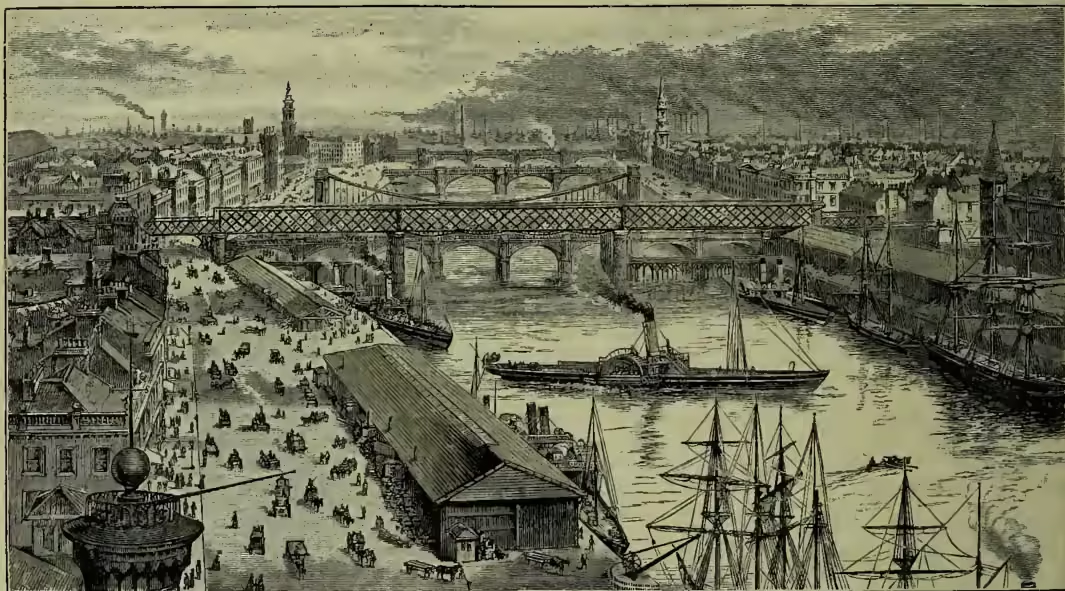
The lighting of the city also forms one of the municipal departments, the corporation having acquired powers to purchase the properties of the two gas companies which formerly supplied Glasgow and its suburbs. At the present time over 2300 million cubic feet of gas per annum is supplied to the public: the capital expenditure on the various works amounted in 1889 to £610,000, and the annual revenue is £390,000. Between 1866 and 1890 the town-council as the City Improvement Trust spent two millions sterling on objects such as are indicated by its title, and at present that body holds property valued at over half a million of money. Of thoroughfares in Glasgow there are about 200 miles, and the Clyde is within the burgh spanned by ten bridges, of which three are railway viaducts and two suspension bridges for foot-passengers. Parliamentary sanction was obtained in 1889 for constructing a tunnel for foot and vehicular traffic under the river at the harbour.
Throughout the city there are upwards of 100 miles of main-sewers, the largest—in brick—being 6 feet in diameter, and the smallest 2 feet.
Of buildings possessing historical interest Glasgow is conspicuously destitute, with the very notable exception of the cathedral, which is a fine example of the Early English Gothic style of architecture. It was begun by Bishop Jocelyn about 1197, to replace the church built in 1136 by Bishop John Achain, which had been destroyed by fire. The structure was largely added to by Bishops Bondington and Lauder, and was practically brought to its present form by Bishop Cameron in 1446. It was saved from injury in the fit of iconoclastic zeal which followed the Reformation by the activity of the Glasgow craftsmen, and afterwards, from time to time, was carefully repaired by the Protestant archbishops who governed the see until the Revolution. The cathedral is in length from east to west 319 feet, and in width 63 feet. It was designed to be in the form of a cross, but the transepts were never erected. From the centre rises a tower, surmounted by a graceful spire, 225 feet in height. The most famous part of the building is the so-called crypt under the choir, which for elaborate designing, and richness of ornamentation on pillars, groining, and doors, stands unrivalled amongst similar structures in Britain. Properly speaking, however, it is not a crypt, but a lower church formed to take advantage of the ground sloping eastward towards the bed of the Molendinar. About 1854, under the direction of the government, the building was repaired and renewed, its general character being scrupulously maintained. At the same time the ancient tower and consistory house on the west face of the cathedral were removed. Since then a series of stained-glass windows has been provided, mostly by Munich artists.
The city chambers opened in 1889, built at a cost of £530,000, form an architectural feature of great importance, and occupy a prominent position, filling the east side of George Square. The Royal Exchange, a handsome building ornamented with colonnades of Corinthian pillars, contains a newsroom 122 feet in length by 60 feet broad. In the building of churches Glasgow has made great strides during the last thirty years, so that probably no other town in the United Kingdom has done more in this respect, and the ecclesiastical buildings of all denominations vie with each other in the elegance of their adornment. The architecture of many of the banks and other public buildings is varied in style and rich in detail, and the post-office buildings, of which the foundation-stone was laid by the Prince of Wales in 1876, though severely plain and massive, deserve mention for their great size and perfect planning. Not without reason, indeed, Glasgow has been called one of the best-built cities of the empire: its streets are well laid out and spacious, and the houses which line them are substantially built of excellent stone which is quarried in abundance around the city.
Glasgow is especially well provided with public parks, having three beautifully planned pleasure-grounds in different districts of the city, besides the Glasgow Green—a wide expanse along the north bank of the river—all of which are maintained by the town-council as a Parks and Galleries Trust. The statues in Glasgow are not numerous, though some of them are very fine. The equestrian statue of Wellington stands opposite the Royal Exchange, and that of William III. at the east end of Argyle Street, near the site of the old cross. The greatest number of monumental statues are in George Square, where in addition to the equestrian statues of the Queen and the late Prince Consort are to be found figures of James Watt, Sir Walter Scott,
Robert Burns, David Livingstone, Sir John Moore, Thomas Campbell, Lord Clyde (the last three natives of the city), and others.
The Glasgow and West of Scotland Technical College was formed in 1886 by the amalgamation of several institutions (including the arts department of Anderson's College, q.v.) under a scheme formulated by the Educational Endowments Commission. It has over 2000 students attending its day and evening classes. It provides suitable education for those who wish to qualify themselves for following any industrial pursuit, and trains teachers for technical schools. St Mungo's College, dating from 1889, has faculties in medicine and law; and the medical department of Anderson's College is a separate school. St Margaret's College is for women. The Free Church College possesses conspicuous buildings; and mention should also be made of the Normal Schools, and of the School of Arts and Haldane's Academy. Of the secondary schools in Glasgow the principal is the High School—a survival of the ancient grammar-school of the city—which is under the manage- ment of the school-board. Other schools of a like standing are the Glasgow and the Kelvinside academies, both large and efficiently managed; while, richly endowed from the Hutcheson Trust, two schools for boys and girls provide at a very low rate a thoroughly good secondary education. Scattered throughout all the districts of the town are the seventy elementary schools of the Board. Amongst educative agencies may be reckoned the Glasgow Art Gallery and Museum in the Kelvinside Park, being built in 1900 beside the more temporary buildings for the Exhibition in 1901.
Unfortunately, the city is entirely destitute of fine buildings wholly devoted to library purposes. There is no free lending library in the town, but there are several great collections which may be used free of charge as consulting libraries. Of these the Mitchell Library, which is under corporation management, contains over 75,000 volumes; and the Stirling's and Glasgow Public Library contains about 45,000 volumes. Baillie's Library is under the same roof. The university has a library of 175,000 volumes, among which number are many notable examples of Caxton's and Pynson's and other 15th-century printing; but the library is only available to alumni of the university. The Athenæum includes a newsroom, magazine-room, and a library of 12,000 volumes. Of subscription lending libraries there is an abundance in the city, and private libraries are to be found in such large numbers as to form a distinctive feature. The publishing of books and newspapers has of late been more largely developed. Glasgow has two daily morning newspapers, three evening, and about a dozen weekly newspapers and periodicals, and one or two monthlies. An industrial museum has been instituted in the city in which a considerable collection, especially in the natural history department, is now displayed. It is supported under the Parks and Galleries Trust, as are also the Corporation Galleries of Art, a collection of pictures and statuary acquired partly by purchase, but more largely by donation and bequest. The galleries contain a very valuable series of old Dutch masters, and there is a noble statue of Pitt by Flaxman.
With benevolent and charitable institutions the city is richly endowed. In addition to numerous hospitals and dispensaries for special diseases, there are three general infirmaries, which among them accommodate upwards of one thousand patients. These are the Royal Infirmary in the north-east district, the Western Infirmary adjoining the University, and the Victoria Infirmary in the Queen's Park, South Side. They are all maintained by voluntary contributions and bequests.
Three magnificent terminal railway stations bring traffic to the heart of the town, respectively forming the headquarters of the three great Scotch lines—the Caledonian, the Glasgow and South-Western, and the North British. St Enoch's Station, the terminus of the Glasgow and South-Western, is modelled on the plan of St Pancras; the Central Station is the headquarters of the Caledonian, The Underground Railway (1886), in connection with the North British system, and the City Union line afford every facility for rapid travelling into nearly every quarter of the town; and in 1889-95 there was constructed an underground system connected with the Caledonian Railway, passing through the busiest and most populous districts. There is also a circular cable-car subway miles long, with fifteen stations, on both sides of the river. Originating with the corporation authorities, the running of tram-cars—now the property of the town and driven largely by electricity—in Glasgow has proved a great success. Another means of transit is found in the magnificent fleet of river-steamers, which are noted for speed, comfort, and elegance of appointment, and afford a rapid and easy means of access to all the Western Highlands and Islands, thus making Glasgow the metropolis of the West. Two of the foremost of these 'floating palaces' are the Columbia and the Lord of the Isles, the former of which attains a speed of 22 miles an hour, and can accommodate 2000 passengers on its daily journey of 160 miles.
The river Clyde (q.v.) has been a chief source of the great prosperity of Glasgow, and it is to the credit of Glasgow citizens that through their enterprise its utility has almost been created by the gigantic works of narrowing the channel and dredging, so that what within the memory of persons still alive was a stream over which one could wade has now become a channel capable of allowing ships which draw 24 feet of water to ride at anchor. The quayage of the harbour and docks from the Broomielaw extends to over 11,000 lineal yards, and the water space covers acres, while since 1875 two graving-docks have been provided capable of accommodating the largest mercantile steamers afloat. On the river and harbour the Clyde Navigation Trust has spent about eleven millions sterling, and the annual revenue usually exceeds £300,000; while the customs revenue of the port amounts to more than £1,500,000. The principal feature of the Clyde beyond the harbour is the great shipbuilding and marine engineering yards which line its sides, and which have flourished since the second quarter of this century. The pioneers of these industries—the Napiers, Charles Randolph, John Elder, &c.—have a world-wide fame. They launched from their yards the most perfect examples of naval architecture and engineering skill of their day, and their successors at the present day amply uphold that reputation by marvels of naval architecture, such as the City of New York, City of Paris, Lucania, and Campania (see SHIPBUILDING). The greatest tonnage launched in any year on the Clyde was 419,600 in 1883: the normal output is from 200,000 to 300,000 tons; in 1889-95 the yearly tonnage built was upwards of 300,000 tons. To the success of the little Comet, the earliest trading steamship in the Old World, which began to ply between Glasgow and Greenock in 1812, may be traced the great development of shipbuilding and shipping on the Clyde.
But another factor in the industrial prosperity of the city is the fact that it is built over a coalfield rich in seams of ironstone. Glasgow is exceptional in having blast-furnaces actually within its municipal bounds. It was in the neighbourhood of the city that the first experiments with Neilson's hot-blast in iron-furnaces, patented in 1828, were made, and the economy thereby effected developed the iron industry so rapidly in Glasgow as to distance for a long period all competition. Great forges, with powerful steam-hammers and other appliances, the making of steam-tubes, boiler-making, locomotive-engine building, sugar machinery, and general engineering are among the most important industrial features of the city.
Bleaching and calico-printing were established in Glasgow in 1738, nearly thirty years earlier than in Lancashire. The dyeing of Turkey-red was inaugurated in 1785 as a British industry by two Glasgow citizens, David Dale and George
Macintosh—the colour being known for a long time as Dale's red; and this branch of trade has developed in Glasgow and the neighbourhood to an extent unequalled in any other manufacturing centre. In Glasgow, also, bleaching-powder (chloride of lime) was discovered in 1798 by Mr Charles Tennant, who thereby laid the foundation of the gigantic St Rollox chemical works, and gave the first impetus to chemical works generally. These, along with the spinning and weaving industries which have been centred in the great city factories since the inventions of Arkwright, Cartwright, and others superseded hand-loom weaving, have for the past century afforded employment for a great proportion of the population of the town.
THE UNIVERSITY OF GLASGOW was founded on 7th January 1450-51 by Bishop Turnbull, who procured a bull of ratification from Pope Nicholas V. In 1460 James, first Lord Hamilton, endowed a college on the site—in the densest part of the High Street—of the late buildings, the older portions of which were erected between 1632 and 1656. Queen Mary bestowed on the university 13 acres of adjacent ground. In 1577 James VI. granted increased funds in a new charter. In 1864 the university buildings and adjacent lands were sold for £100,000, and handsome new buildings, designed by Sir G. Gilbert Scott, were erected at Gilmorehill, overlooking the West End Park, and opened in 1870. The total cost was about £470,000, of which £120,000 was granted by parliament, and above £250,000 subscribed and otherwise obtained, chiefly in Glasgow. For the erection of a common hall the Marquis of Bute gave £40,000; and a bequest of £70,000 by Charles Randolph was utilised in completing the buildings. More recent bequests have been employed largely for laboratories and other adjuncts of scientific teaching and research.
Chairs, Office-bearers, Degrees.—The office-bearers of the university consist of a Chancellor, Rector, Principal, and Dean of Faculties. The Chancellor holds his office for life, and was formerly elected by the senate, but since 1875 he is elected by the general council; the Rector is elected triennially by the matriculated students, who are divided, according to their place of birth, into four nations—Glottiana (Lanarkshire), Transforthana (Scotland north of the Forth), Rothsciana (Buteshire, Renfrewshire, and Ayrshire), Loudoniana (all other places). In the university there are now (through the recent separation of the faculty of science from that of arts) five faculties: Arts, Science, Divinity, Law, and Medicine; thirty-one professorships (eighteen founded during the nineteenth century), and upwards of thirty lectureships (all of recent foundation). The degrees granted are Master of Arts (M.A.), Bachelor of Science (B.Sc.), Doctor of Science (D.Sc.), Doctor of Medicine (M.D.), Master of Surgery (C.M.), Bachelor of Divinity (B.D.), Bachelor of Law (B.L.), Bachelor of Laws (LL.B.), Doctor of Divinity (D.D.), and Doctor of Laws (LL.D.), the last two being honorary. The university also grants certificates as Literates in Arts (L.A.) to candidates who have attended two sessions, and certificates of various grades to women and students not attending university classes, on the results of local examinations; besides which it has instituted a diploma for teachers. The number of matriculated students in 1870-75 was about 1300; of late years the average number is a little under or a little over 2000, nearly half being in the Faculty of Arts. The students reside outside the college walls; and those in certain classes of the Faculty of Arts wear scarlet gowns. The university, conjointly with that of Aberdeen, returns one member to parliament.
Bursaries and Exhibitions.—There are upwards of 300 bursaries for students still attending lectures, ranging in value from £6 to £80; and with exhibitions, fellowships, and scholarships (besides 9 common to Glasgow with the other Scottish universities), the amount distributed yearly exceeds £8000. Of the latter the most valuable are the four Clark scholarships, founded in 1872, and each worth £200 a year. The oldest are the Snell exhibitions, founded by John Snell, a native of Ayrshire, who in 1677 presented to the university a landed estate, for the purpose of supporting at Balliol College, Oxford, ten students who had previously studied at Glasgow. Owing to the rise in the value of land, the foundation was made to maintain 14 exhibitioners, who were each to receive £110 a year for five years; but at present the yearly stipend is only £80, with an arrangement that the total sum, £400, may be paid within three years. Several men who have risen to great eminence went to Oxford on Snell exhibitions; among whom may be named Adam Smith, Sir William Hamilton, Archbishop Tait, Principal Shairp, and Lord President Inglis.
Libraries, Museums, &c.—The library was founded prior to the Reformation, and now contains about 175,000 volumes. It is supported by an annual grant of £707 from the Treasury, graduation fees, the contributions of students, &c. Subsidiary libraries are attached to several of the classes, the books being selected with a view to the subjects treated of in each class. In July 1781 the celebrated Dr William Hunter of London framed a will, leaving to the principal and professors of the university his splendid collection of books, coins, medals, and anatomical preparations; and for the accommodation and conservation of these a building was erected in 1804; but they are now located in the new university. The university also possesses an observatory.
Among the men of eminence who have taught or studied in the university are Bishop Elphinstone, John Major, John Spottiswoode, Andrew Melville, James Melville, Boyd of Trochrig, John Cameron, Zachary Boyd, Robert Baillie, Lord Stair, Bishop Burnet, Robert Simson, Hutcheson, William Hunter, Tobias Smollett, Dr John Moore, Adam Smith, Thomas Reid, William Cullen, Joseph Black, Matthew Baillie, Thomas Campbell, Francis Jeffrey, J. G. Lockhart, Sir William Hamilton, Sir Daniel Sandford, Archbishop Tait, Professor Jebb, the two Cairds, and Lord Kelvin.
See John M'Ure, A View of the City of Glasgow (1736); John Gibson, The History of Glasgow (1779); Andrew Brown, History of Glasgow (1795-97); Cleland, Annals of Glasgow (1829); Dr Gordon, Glasghu Facies (1872); Macgeorge, Old Glasgow (1880; 3d ed. 1888); George MacGregor, The History of Glasgow (1881); A. Wallace, Sketch of the History of Glasgow; Glasgow Past and Present, by 'Senex' and others (1882; new ed. 1884); and Glasgow: its Municipal Organisation and Administration, by Sir J. Bell and the present writer (1896).—For the recent anti-academic and original school of painting in landscape and portraiture that has attracted notice at Paris, Munich, and Venice, see The History of the Glasgow School of Painting, by David Martin, with introduction by F. H. Newbery (1897); Guthrie and Lavery are conspicuous representatives.