Glastonbury, an ancient municipal borough of Somersetshire, lies, engirt by the river Brue, amid orchards and level pastures—once fen-land—at the foot of the conical tower-crowned Tor (500 feet), 6 miles by rail SSW. of Wells, and 36 S. of Bristol. The Celtic Ynysvitrin, the Avalon of Arthurian legend, and the Glaestingaburh or Glæstings' borough of the West Saxons, it was hither, says William of Malmesbury, that Joseph of Arimathæa came bearing the Holy Grail, here that he founded the first Christian church in Britain. On Weary-all Hill he planted his pilgrim's staff; it took root, and grew into the Holy Thorn, which blossomed miraculously every Old Christmas-eve until it was cut down by a Puritan. [Grafts from it flourish still; one at Sutton Poyntz, near Weymouth, duly blossomed on the night of the 5th January 1884 in presence of 250 persons. It is the Crataegus præcox of botanists.] Certain at least it is that, unlike Canterbury or York or London, 'Glastonbury was the one church of the first rank in England which stood as a memorial of British days, the only one which had lived unscathed through the storm of English conquest.' For the wattled basilica, which contained the grave of a St Patrick and of Gildas, was in 630 encased by Paulinus of York in boards and lead; and to the east of it in 719 King Ine reared the great church of SS. Peter and Paul.
This, spoiled by the Danes, was the abbey refounded by St Dunstan (q.v.) about 946, and became the sepulchre of Kings Edmund, Edgar, and Edmund Ironside, if not indeed of Dunstan himself, of Joseph of Arimathæa, or of Arthur and Guinevere. It had just been rebuilt when in 1184 the whole pile was consumed by fire; and the splendid minster, 528 feet long, then undertaken by Henry II., was not dedicated till 1303. In 1539
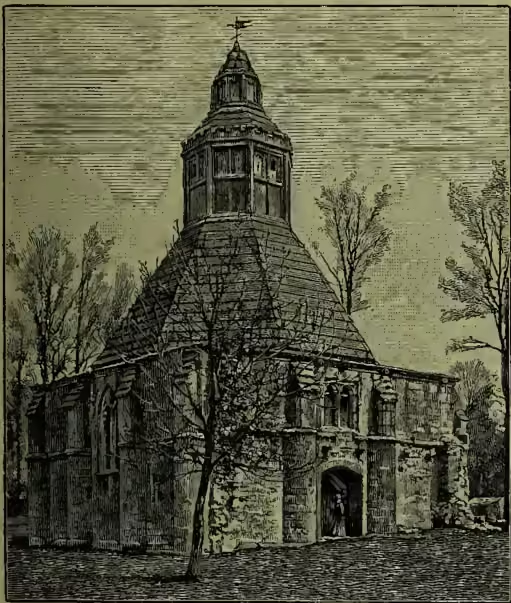
Richard Whiting, the last of its mitred abbots, was hanged on the Tor by Henry VIII.; and the ruins of this great Benedictine house, which had covered 60 acres, are now comparatively scanty, having long been the quarry of the district. Yet still on the site of the 'Vetusta Ecclesia' stands the roofless chapel of Our Lady or St Joseph, a fine example of Transition Norman, with its 15th-century crypt; still there is the massive stone Abbot's Kitchen (14th century), 33½ feet square, and 72 high, with its four huge fireplaces and pyramidal roof. Apart from its abbey and its two parish churches, one of which has a noble tower 140 feet high, Glastonbury is a quaint, old-world place, a very store of domestic antiquities, with the 15th-century Pilgrims' Inn (now the 'George'), the Tribunal, and the Abbot's Barn. Sharpham, 2 miles south-west, was Fielding's birthplace. Sheepskins, mats, rugs, gloves, and pottery are manufactured. Pop. (1851) 3325; (1891) 4119. A lake-dwelling was uncovered here in 1895. See GRAIL, ARTHUR; the Rev. R. Willis's Architectural History of Glastonbury Abbey (1866); Freeman's English Towns and Districts (1883); Gasquet, The Last Abbot of Glastonbury (1895).