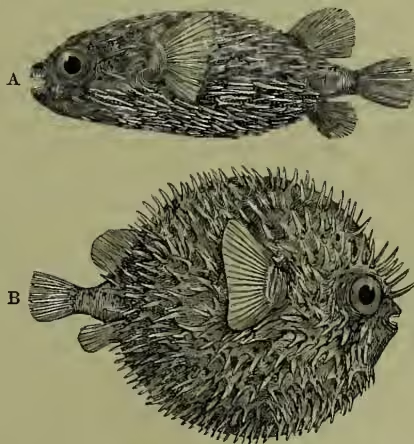
Globe-fish, a name given to a number of peculiar Teleostean fishes forming a sub-family (Tetrodontina) of the order Plectognathi. The best-known genera are Tetrodon and Diodon, which may be readily distinguished from one another by the structure of the jaws, which are cleft in the former, undivided in the latter, thus producing the appearance (which the names emphasise) of four and two teeth respectively. Both are represented by numerous species in tropical seas. One species of Tetrodon (T. lagocephalus) has been found on British coasts. The globe-fishes are so named from their curious power of filling their bodies with air, and thus distending them till they are nearly globular. The distension takes place chiefly in the œsophagus, and the fish, therefore, when inflated, turns over and floats on its back at the surface of the water. In this position it can not only move forward, but can turn to either side by the aid of its pectoral fins. The globe-fishes have short, thick bodies, sharp, hard beaks, and well-developed fins. The smallest are only a few inches in length, while the Sea-hedgehog (Diodon hystrix) measures two feet. The skin is scaleless, but in it are embedded spines which vary greatly in size and number in the different species. In some they are movable, and are erected with the distension of the body. Darwin, in an account of one species (D. antennatus), says that it can secrete from the skin of its belly, when handled, a most beautiful carmine-red substance, which stains ivory or paper permanently. He also states that a Diodon has frequently been found floating, alive and distended, inside the stomach of a shark, and that one has even been known to eat its way through the sides of the monster, thus causing its death. Many of the globe-fishes are highly poisonous, the poison varying in intensity in different individuals, in different localities, and at different times of the year. The food of these fishes consists of corals, molluscs, and crustaceans, for breaking which their hard beaks are well adapted. Nearly related to the Tetrodontina are the Triodonts (to which the name globe-fish might also be extended) and the pelagic Sun-fishes (q.v.). All are included in the family Gymnodontes. See Günther, Study of Fishes (Edin. 1880).