Glow-worm, a name applied to numerous 'phosphorescent' beetles in the sub-family Lampyrides (fam. Telephoridae) already distinguished from the Fire-flies (q.v.). They are nocturnal in habit, and represented by about 500 species, widely distributed, especially in warm countries. The phosphorescent structures are situated on the abdomen, and are present in the larva as well as in the adult forms. The larvæ are elongated, but flattened, of a velvety black colour, and feed especially on living snails. The adult females tend to retain a larval appearance, and are often destitute of wings.
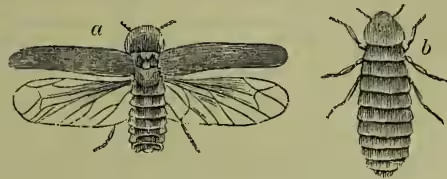
a, male; b, female.
The commonest European glow-worms are Lampyris noctiluca and L. splendida—the Johanniswürmchen of the Germans—in both of which the females are slightly larger and wingless. The male of the former is also comparatively sluggish and keeps among the grass, while that of the latter flies actively about in the evenings. The general life-history of such Lampyrides is as follows: The yellowish phosphorescent eggs are laid in early spring; the voracious larvæ are vigorously crawling about by April; in summer, however, they fall into a pupa slumber, and may so remain till the next spring, when adult life is attained. In Lampyris noctiluca (which is the British species) the females give the more brilliant light, but in other cases the reverse is often true, while in one of the American species (Photinus dimissus) only the male is luminous.
Gosse has described a number of West Indian forms, such as Photuris versicolor and the yet more gorgeous Pygolampis xanthophotis, which with green and orange lights respectively sometimes light up the foliage with bewitching brilliancy. America is very rich in 'lightning-bugs,' such as Photuris pennsylvanicus, and species of Pyrautomena and Photinus. Pyrocœlia, Luciola, and Lamprocera are other important genera widely distributed.
The luminous organs consist, like those of the Fire-flies (q.v.), of fatty-looking cells round which there is a plentiful supply of tracheæ, affording the necessary oxygen for the rapid vital combustion of phosphorescence. In regard to their utility it has at least been settled by the experiments of Emery and others that they serve as love-signals between the sexes, while it is probable that the flashes also illumine the beetles' paths and frighten designing foes. For what is known of the real physiology of luminosity, see PHOSPHORESCENCE. Professor Emery gives a most entertaining account of his observations on the love-lights of Luciola italica, which he studied in the meadows round Bologna. By catching females and imprisoning them in glass tubes in the meadows he satisfied himself that sight, not smell, was all important. When the females caught sight of the flashes of an approaching male, in spite of their tantalising situation, they allowed their splendour to shine forth. In the two sexes the colour of the light is identical; the intensity also appears much the same, though that of the female is more restricted. The most noteworthy difference is that the luminous rhythm of the male is more rapid and the flashes briefer, while that of the female is more prolonged, at longer intervals, and more tremulous. The attracted males dance round about the female, who after having captivated one suitor, proceeds to signal other rivals, till she is finally surrounded by a circle of devotees. See articles by Professor C. Emery, Bull. Soc. Entomol. Ital., 1885-87; and C. F. Holder's Living Lights (1887).