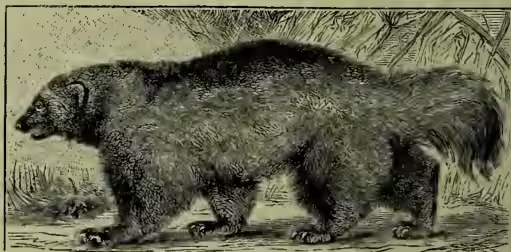
Glutton (Gulo), a carnivorous quadruped belonging to the weasel family (Mustelidæ). There are three false molars in the upper, and four in the lower jaw, anterior to the carnassial tooth, which is large and sharp. The body is long—about 2 feet 6 inches—the legs are short, the feet have each five deeply-divided toes, terminated by long curved claws. The tail is rather short—about 7 or 8 inches; a fold beneath the tail supplies the place of the glandular pouch of the badgers; but when hard pressed by enemies the gluttons emit a peculiar fluid of a strong musky odour. Their habits are nocturnal. Both body and tail are covered with long hair, under which the body is covered with a rich thick fur. The general colour of the long hair is brown, sometimes approaching to black, lighter bands passing from the neck along the flanks, and meeting at the tail. The short fur is chestnut brown. The muzzle is black. A light-brown band runs across the forehead from ear to ear. The fur of the glutton is sometimes of considerable value, and is used for muffs, cloaks, &c., but varies not a little in glossiness and other qualities (see FURS, Wolverine). There is only one species, commonly called Glutton, and also Wolverine (G. luscus), a native of the northern parts of Europe, Asia, and America. It is more common in the arctic regions than towards the southern limits of its distribution, which are about the forests of Courland, in Europe, and northern California, in America. The most extraordinary stories were at one time credited concerning the ferocity, voracity, and cunning of this animal, though in captivity it has been known to overcome and kill a large polar bear (1897); it is very capable of domestication, and even in a wild state exhibits no remarkable ferocity; nor is there any reason to believe that it leaps from trees on deer, or pursues any of those artful methods of procuring food which were once ascribed to it. It often preys on animals which it has not itself killed. The smaller quadrupeds are its principal food, and it devours young foxes in great numbers. Its speed is not great, but it excels in strength and perseverance. The traps set for the smaller kinds of animals—e.g. martens—in the fur countries of North America are very often robbed by the wolverine, and it has been known to remove a great pile of wood in order to get at provisions which had been hidden under it.—Closely allied to the glutton are the grison, the badger, the otter, and the ratel. Bone-caves and some of the newest deposits exhibit remains of more than one species of glutton.