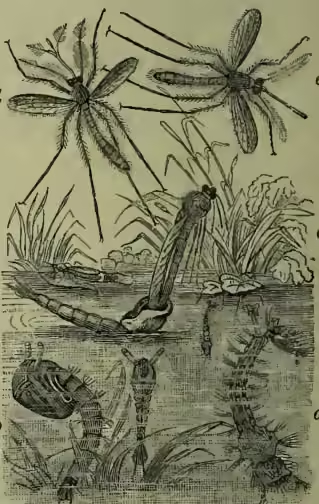
Gnat (Culex), a genus of dipterous insects represented by numerous widely distributed species, and specially abundant in marshy districts. There are nine British species, of which the Common Gnat (Culex pipiens) may be taken as typical. The colour of the middle portion of the body on the upper surface is yellowish-brown, marked with darker longitudinal lines; the posterior part is light gray. The abdomen is long, slender, and slightly flattened; the legs, very long and thin; and the delicate glassy wings bear numerous hairs on the veins and along their posterior margins. When the insect is at rest the wings are laid flat back upon the body. The antennæ consist of fourteen joints, and bear circlets of hair, which, in the male, may be so long and thick as to give a feathery appearance. The female is furnished with mandibles which are absent in the male. The male gnat sips nectar from the flowers and passes his days in joyous dancing in the sunlight; the female spends, not her days only, but her nights, in pursuit of men and cattle into whom she may drive her sharp lancets, to suck from their blood her more nutritious, if less delicate diet. The proboscis, whose double function of piercing and sucking was noticed even by Pliny, is an extremely complex structure composed of representatives of the three usual mouth appendages. The humming sound produced by the female in flying, the deeper notes of which are due to the rapid vibration of the wings (computed at 3000 per minute), the higher to membranes on the thoracic openings of the air-tubes, serves in part, doubtless, to attract the males. Darwin quotes Mayer to the following effect: 'The hairs on the antennæ of the male gnat vibrate in unison with the notes of a tuning-fork, within the range of the sounds emitted by the female. The longer hairs vibrate sympathetically with the graver notes, and the shorter hairs with the higher ones.' Landois also says that he has repeatedly brought down a whole swarm of gnats by uttering a particular note. After fertilisation, the female lays her eggs—300 at a time, it may be—in a pool or ditch of stagnant water, mooring them by a glutinous substance to a floating leaf or twig. The larvæ, which in favourable circumstances are hatched in a few days, are about half an inch long, of a black colour, intensely active, with bristle-fringed mandibles which vibrate continually, making a little eddy which conveys food-particles to their mouths. When at rest, they suspend themselves head downwards from the surface of the water, and take in air through a curious tube projecting from the eighth segment of the abdomen. They remain in the larval state about three weeks, during which period they moult three times. The pupa is smaller and lighter in colour; it also is active, though, of course, it takes no nourishment. Its external air-tubes are situated on the sides of the thorax, and project beyond its head. When mature, the pupa comes to the surface, the skin splits longitudinally, and the perfect gnat slowly emerges. Many, however, never taste the delight of flying, for their weak wings being drenched cannot be spread, and the insects are drowned without fully escaping from their pupa-skin. Several generations of gnats follow one another in a season. In the Fen district they are sometimes so abundant that the inhabitants are forced to use curtains and such means of protection against them as are used in hotter countries against their allies the Mosquitoes (q.v.). Gnats occasionally swarm together in such numbers that they present the appearance of dense clouds of smoke; and it is recorded that, in the year 1736, an alarm of fire was raised in Salisbury because of the vast columns of gnats swarming round the cathedral spire.