Goatsucker, or NIGHT-JAR, a name applicable to any member of the family Caprimulgidae, allied to the swifts, included among the Passerine birds. They are almost cosmopolitan, nocturnal, superficially owl-like birds, with soft, mottled, predominantly brown and gray plumage, feeding usually on insects which they catch on their swift, silent flight, and notable for their eerie, often almost human-like cries, which have awakened superstitious dread in the natives of all countries. The bill is short, with the upper part curved at the point, but the gape is extremely wide, and enclosed by a fringe of strong bristles borne along the margins of the beak. The eyes are very large and full; the hind toe can be directed forwards; in the great majority (Caprimulginae) the middle claw is a curious comb; the second pectoral muscle is long; the oil-gland is small; there are after-shafts to the feathers.
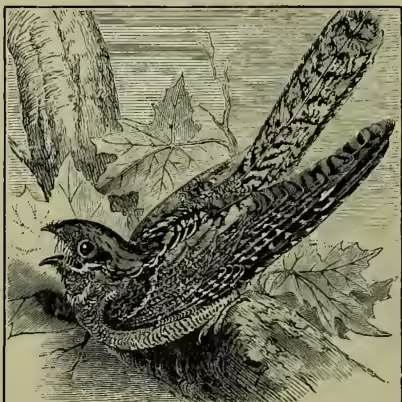
The only constant British species is the night-jar, night-hawk, fern owl, churn owl, or night-churr (Caprimulgus europæus), which stays from May to September, frequenting uncultivated, fern-covered ground or bushy places throughout the country. With twisting flight and 'whirring' wings it hawks for insects in twilight or darkness, but will also bask in the sun. On a branch it sits lengthways, with the head low down, and when stationary the male utters his well-known 'ehurr.'
With the comb-like middle claw a night-jar in captivity has been seen to scratch the ground, but what it usually does with this instrument is uncertain. The plumage is gray, brown, and buff; the length about 10 inches. The eggs (two) are laid on the ground without a nest, and are 'creamy white, marbled and veined in endless variety with brownish-black and purplish-gray.' The bird is widely distributed in Europe, North Africa, and as far east as North-west India. 'One of its lines of migration from Africa crosses Malta, where large numbers are shot for the table in spring.' Two other species of night-jar (C. ruficollis and C. ægyptius) are noted by Howard Saunders as having occurred in Britain. See his Manual of British Birds.
Among the interesting members of the family, which includes about seventeen genera and ninety species, may be noted the Pennant-winged Night-jar (Cosmetornis vezillarius) and the Lyre-tailed Goatsucker (Macropsalis lyra), with elongated feathers on wings and tail respectively (see also WHIP-POOR-WILL). The South American genus Nyctibius differs from the ordinary goatsuckers in several particulars—e.g. in having a smooth middle claw. It seems to connect them with the family of Podargidae, the members of which—e.g. the 'frog-mouths' (Batrachostomus)—have a gape even wider than that of goatsuckers. Allied also is the peculiar South American Oil-bird or Steatorniths (see GUACHARO). The family of Rollers (q.v., Coraciadæ) is also nearly related.
The weird and often almost articulate cries of the goatsuckers—'who are you,' 'work away,' 'willy-come-go,' 'whip-poor-will,' &c.—have earned for the birds the reputation of auguring evil, while a more curious, and yet quite explicable popular notion is expressed in the modern title 'goatsucker,' or in Pliny's name Caprimulgus, or in Aristotle's Aigothelas. The notion suggested by these words is that the birds suck the milk of goats, as Pliny definitely states. The truth and the origin of the mistake may be best expressed in Waterton's words: 'These innocent little birds never suck the herds; for when they approach them, and jump up at their udders, it is to catch the flies and insects there.' The animals are sensible of the birds' good offices, for they stand quietly and 'do not try to drive them off as uncivil intruders.' See Waterton's Wanderings in South America.