Goldfinch (Carduelis elegans), the most beautiful of British finches (Fringillidae). It is about five inches in length; has a thick, conical, sharp-pointed bill; and is noteworthy among British birds for its handsome plumage, in which black, crimson-red, yellow, and white are, in the adult male, exquisitely mingled. The female has less crimson on the throat and no yellow on the breast, and the 'gray-pate' or 'bald-pate' young are also of course much less gaily adorned than the full-grown males.
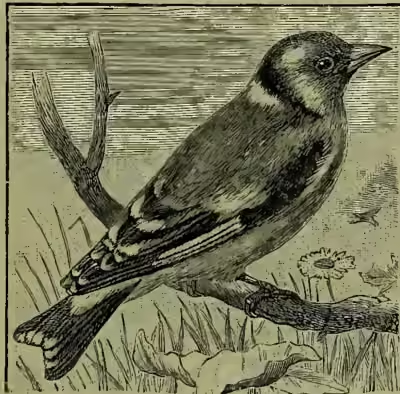
Goldfinches occur in small flocks on open uncultivated ground, feeding on thistles and other composites, or are found breeding in gardens and orchards. The nest, usually in a fruit-tree, is even nearer than that of the chaffinch, lined with the finest down, but without lichens; the eggs (4 or 5) are grayish-white, with purplish-brown streaks and spots; there are two broods in the year; the young are fed on insects. The goldfinch is still a common summer bird in Britain, especially in the south; most migrate southwards in October. It breeds throughout Europe, especially in the south, and ranges from the Canaries, through North Africa, to Persia. Its soft pleasing song, intelligence, docility, liveliness, and lovingness make it, to its cost, a favourite cage-bird. See Howard Saunders, Manual of British Birds.
(a garden variety).