Golf, a Scottish pastime (also goff or gorf—the latter the vernacular pronunciation; the name being usually connected with the Dutch kolf, 'club'), is certainly of great antiquity, and frequent references are made to it in old Scottish records. In 1457 the Scottish parliament passed an act enjoining that 'Fute ball and Golfe be utterly cryit downe, and nocht usit, and that the bowe merkis be maid at ilka parochie kirke a paire of buttis, and schutting be usit ilk Sunday.' A similar act was passed in May 1491. It thus appears that the game was at one time so popular in Scotland that the more important practice of archery, for the defence of the country, stood in danger of being neglected. In 1592 the magistrates of Edinburgh issued a proclamation against playing the game on Sunday.
Reference is made to golf on Leith Links in A Diurnal of Occurrences within Scotland, 1516-75 (Maitland Club, 1832), and it appears to have been practised by all classes in the reign of King James VI. Charles I. was much attached to the game, and on his visit to Scotland in 1641 was engaged in it on Leith Links when intimation was given him of the rebellion in Ireland, whereupon he threw down his club, and returned in great agitation to Holyrood House. The Duke of York, afterwards James II., also delighted in the game.
Until late years golf was entirely confined to Scotland, though the oldest existing golf club was founded by James I. at Blackheath in 1608; but now it is firmly established south of the Tweed, and clubs have been formed in almost every locality in England where the ground is at all suitable for the game. Golf is played at several stations in India, as well as in Canada and Cape Colony; and clubs were formed at Cairo in 1888 and at San Francisco in 1889. Ladies' golf clubs exist in a flourishing condition at St Andrews, North Berwick, Westward Ho, &c. The game is played on what are called in Scotland links (Eng. downs)—i.e. tracts of sandy soil covered with short grass, which occur frequently along the east coast of Scotland. The best Scotch golfing links are St Andrews and Leven in Fife, Prestwick in Ayrshire, Machrihanish in Argyllshire, North Berwick and Gullane in East Lothian, Carnoustie and Montrose in Forfarshire, and Dornoch in Sutherland. In England the most important centres are Hoylake near Liverpool, Westward Ho in Devonshire, Wimbledon near London, and Sandwich in Kent. All of these are examples of admirably suited links, as the ground is diversified by knolls, sand-pits, and other hazards (as they are termed in golfing phraseology), the avoiding of which is one of the most important points of the game.
A series of small round holes, about four inches in diameter, and several inches in depth, are cut in the turf, at distances of from one to five or six hundred yards from each other, according to the nature of the ground, so as to form a circuit or round. The round generally consists of either nine or eighteen holes as the length or nature of the course may allow. The links of St Andrews contain eighteen holes, and two hours are occupied in completing the round. The rival players are either two in number, which is the simplest arrangement, or four (two against two), in which case the two partners strike the ball on their side alternately. The balls, weighing somewhat under two ounces, are made of gutta-percha, and painted white so as to be readily seen.
An ordinary golf-club consists of two parts spliced together—viz. the shaft and head: the shaft is usually made of hickory or lancewood; the handle covered with leather; the head (heavily weighted with lead behind, and with a slip of horn along the front of the sole) of well-seasoned apple-tree or beech. Every player has a set of clubs, differing in length and shape to suit the distance to be driven and the position of the ball; for (except in striking off from a hole, when the ball may be tee'd—i.e. placed advantageously on a little heap of sand, called a tee) it is a rule that the ball must be struck as it happens to lie. Some positions of the ball require a club with an iron head. The usual complement of clubs is about seven; but those who refine on the gradation of implements use as many as ten, or even twelve, which are technically distinguished as the driver, long-spoon, mid-spoon, short-spoon, brassey, putter, iron, lofting-iron, mashie, iron-putter, cleek, and niblick—the last six have iron heads, the others are of wood. Every player is usually provided with an attendant, called a caddy, who carries his clubs and 'tees' his balls. Since the game has become so generally popular, many modifications and inventions in clubs have been introduced. The earliest and most permanent of these is the 'bulger' form of wooden club heads. The bulger-head is shorter and rounder than the old form, and from its general acceptance would seem to have answered its purpose of giving greater power in driving. The others are mostly in the way of iron clubs, and except the 'mashie,' a useful short-headed pitching iron, are too numerous (and in many cases fantastic) to specify.
Commencing at a spot a few yards in front of the home hole—the teeing ground—each player drives off his ball in the direction of the first hole, into which he does his best to put the ball in fewer strokes than his antagonist. If the players put their balls in in an equal number of strokes, the hole is said to be halved, and scores to neither; but if one, by superior play, holes his ball in fewer strokes than the other, he gains that hole, and so takes precedence (the honour) in striking off towards the next. In this manner they proceed till the entire round is finished, the match being gained by the player who has achieved the greater number of holes. Sometimes the interest of a match is maintained till the very last, by a succession of evenly-played holes, or by each having gained an equal number during the round. 'All even on the day's play' may also be declared where each party has won the same number of rounds as his antagonist, or antagonists. A match may also consist of a certain number of holes independently of rounds, when it of course accernes to the winner of the greater number of holes. In contests between professional players the match usually consists of a certain number of holes to be contested on more links than one.
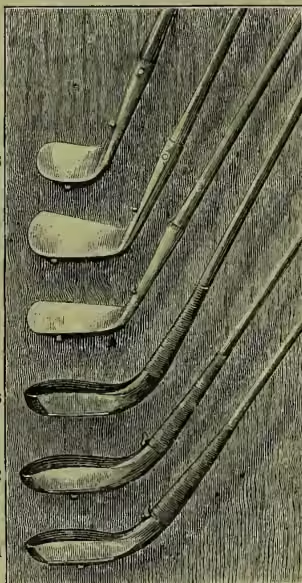
1, driver; 2, mid-spoon; 3, putter;
4, cleek; 5, iron; 6, niblick.
Throughout the entire game, he whose ball lies farthest from the hole which he is approaching invariably plays before his more advanced companion. We have already said that the player who 'holes' his ball in fewer strokes than his rival wins that hole. Now, if it is agreed that the match shall fall to the player who holes the entire round in fewest strokes, as in playing for medals or other prizes, each stroke is scrupulously recorded, and scored on a card; but if the match is to be yielded to the winner of the greatest number of holes in a round, the number of actual strokes need not necessarily be reckoned. Golf, like all other games, has its especial phraseology.
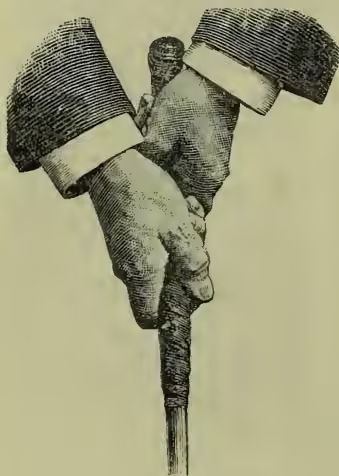
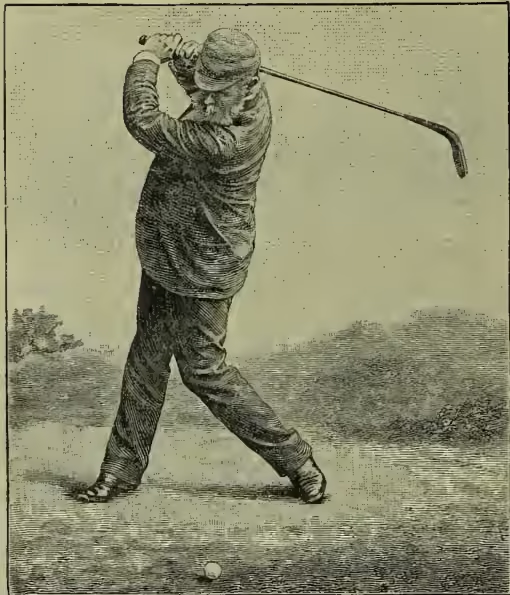
Thus, he who is about to play the same number of strokes as his antagonist has already played, plays the like; if he is about to play one stroke more than his rival has already played, he plays the odds; if one stroke less, he plays one off two; if two strokes more, two more, and so on. This method of reckoning, though somewhat confusing at first, is after a little time easily acquired; and, from its be- ing universally adopted on golfing courses, should receive especial attention. In the accompanying illustrations the method of holding the club when driving, and the swing, are shown.
To play the game of golf well requires long practice, and very few attain to great excellence who have not played from their youth. But any one may in a year or two learn to play tolerably, so as to take great pleasure in the game; and for all who have once entered upon it it possesses no ordinary fascination. It has this advantage over many other outdoor games, that it is suited for both old and young. The strong and energetic find scope for their energy in driving long balls (crack players will drive a ball above 200 yards); but the more important points of the game—an exact eye, a steady and measured stroke for the short distances, and skill in avoiding hazards—are called forth in all cases. Along with the muscular exercise required by the actual play, there is a mixture of walking which particularly suits those whose pursuits are sedentary—walking, too, on a breezy common, and under circumstances which make it far more beneficial than an ordinary 'constitutional.'
Golf associations are numerous in Scotland, and in most cases are governed by the rules laid down by the Royal and Ancient Golf Club of St Andrews (1754), which is the chief, and one of the oldest clubs in the country. These rules have been very generally adopted all over England. English golfers are at the same time much indebted to the exertions of the late Mr George Glennie, sometime captain of the Royal Blackheath Golf Club, for keeping the game alive at Blackheath while for many years it was unknown elsewhere in the south; and it was mainly his fostering influence which promoted its growth on other southern greens. Many professional players make their livelihood by golf, and are always ready to instruct beginners in the art, or to play matches with amateurs. Among the most famous professional golfers were Allan Robertson (died 1859), and latterly young Tom Morris (died 1875). 'Amateur' and 'open' championship meetings are held annually on different greens in Scotland and England. The first championships were held alternately by old Tom Morris and Willie Park, sen., for many years. 'Young' Tom Morris was the only player who, winning the trophy three years consecutively, became its permanent possessor.
For information concerning the rules of golf and the history of the game from the earliest records, see Golf: a Royal and Ancient Game, by Robert Clark (Edin. 1876; new ed. 1894); Golfing (W. & R. Chambers: Edin. 1887); The Art of Golf, by Sir W. Simpson (Edin. 1888); Golf in the 'Badminton Library', by H. Hutchinson, A. J. Balfour, A. Lang, Sir W. Simpson, and others.