Gorilla (Troglodytes Gorilla), a great African ape, generally referred by naturalists to the same genus with the chimpanzee, although Professor Isidore Geoffroy St-Hilaire has attempted to establish for it a separate genus. It has received the name by which it is now known in consequence of its being supposed to be the same animal which is mentioned in the Periplus of Hanno the Carthaginian navigator, who visited the tropical parts of the west coast of Africa about the year 350 B.C., although it is by no means certain that the gorilla of Hanno is not the chimpanzee, or perhaps a species of baboon. Vague accounts of apes of great size, of which very wonderful stories were told, were from time to time brought from Western Africa; but it was not till 1847 that the gorilla became really known to naturalists, when a skull was sent to Professor Wyman of Boston by Dr Wilson, an American missionary on the Gaboon River. Since that time not only have skeletons and skins been obtained in sufficient number for scientific examination, but information has also been procured concerning the habits of the animal in his native haunts. The accounts of the gorilla given in Du Chaillu's Explorations and Adventures in Equatorial Africa (Lond. 1861) soon came to be regarded by the highest scientific authorities, and particularly by Owen, as in the main trustworthy, notwithstanding all the doubt that was cast over that traveller's narrative of his adventures; and they are in accordance with all that has been learnt from other sources, and with the inferences to be deduced from the dentition and osteology of the animal.
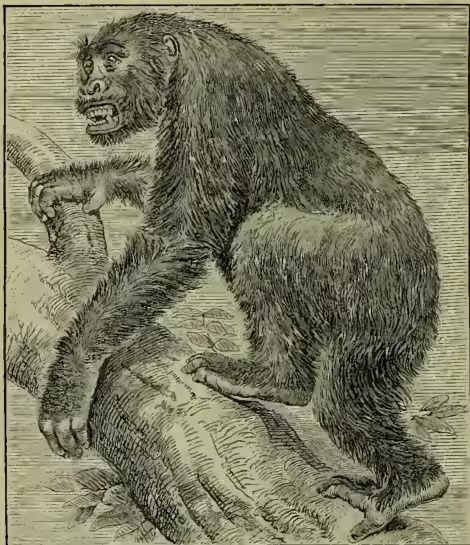
The gorilla differs from the chimpanzee in its greater size; the height of an adult male in an erect posture being commonly about 5 feet 6 inches or 5 feet 8 inches, although there is reason to think that it sometimes exceeds 6 feet. The general aspect of the creature may be gathered from the accompanying figure. The skin is very black; the hairy covering of the back is thicker than on the belly; its colour varies in individuals and on different parts of the body from reddish-brown to black.
The skeleton is very powerful and massive, and differs from the human skeleton in the following (among other) points. The skull is extremely prognathous, the supra-orbital ridges are enormously developed; there is a great crest between the frontals and parietal bones which joins the occiput crest. The canine teeth are very large, particularly in the male. The cervical vertebrae have very long spinous processes. The ribs increase progressively in their span, the chest cavity being thus more or less conical in form. The arm bones are much longer than in man, while the leg bones are shorter.
The muscular anatomy shows also certain marked differences from man, as does also the brain. The gorilla cannot be regarded as nearer to man than the chimpanzee and orang. There are a number of varieties of the gorilla, but apparently only one species, which is confined to the forests of West Africa between 2° N. and 5° S. lat., and 6° and 16° E. long. It is principally a vegetable feeder, though like most apes it also preys upon small mammals, birds, and their eggs.
The gorilla wanders about in families, consisting of one male and female and their young; most of the time is spent upon the ground, though the animal is a skilful climber. It is not so ferocious a creature as has been supposed, and when molested generally avoids an encounter; but if driven into a corner it will defend itself, and its enormous strength renders it a dangerous enemy. On such occasions it will advance to the attack, beating its breast with its fists and giving forth a furious roar. The gorilla has not been hitherto tamed, and, in an adult state at least, seems very incapable of it. In 1876 a live gorilla was brought to Berlin, the first authentic instance of the introduction of the animal into Europe; and in 1887 a young gorilla was exhibited at the Zoological Gardens in the Regent's Park. The name given to this animal in its native country is N'gina, or Ingeena. On the Loango coast it is called N'punga. For the skeleton, see ANTHROPOID APES, and the books there cited.