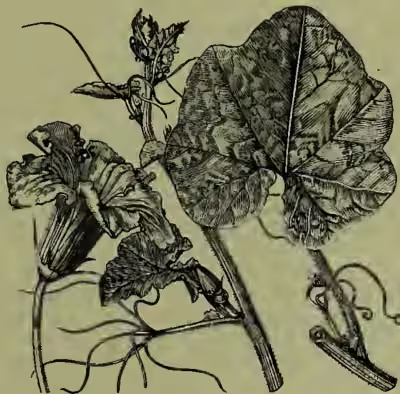
Branch with flower.
Gourd (Cucurbita), a genus of plants of the natural order Cucurbitaceæ, nearly allied to the cucumber, having male and female flowers on the same plant, the flowers large and yellow. The species are annual plants of very rapid growth, their leaves and stems rough, their leaves broad and lobed, their stems often very long and trailing; they are natives of warm climates, although the native region of the kinds chiefly cultivated is very uncertain, and they have probably been greatly modified by long cultivation, so that perhaps all of them may be forms of one original species, a native of some of the warmer parts of Asia. The Common Gourd or Pumpkin, Citriville of the French (C. pepo), with smooth globose or pear-shaped fruit, varying from the size of a large apple to 50 or 100 lb. in weight, is much cultivated both in gardens and fields in almost all parts of the world of which the climate is warm enough for it; and the fruit is not only a very important article of human food, but is also used along with the superabundant shoots for feeding cattle. In many countries pumpkins are a principal part of the ordinary food of the poorer classes, and are much used even by the wealthy; they are not eaten raw, but dressed in a great variety of ways—as in pies, with sugar, spice, &c., or sliced and fried with oil or butter, or made into soups, &c. Pumpkins are much cultivated in North America. In England they are also cultivated, but not to a great extent, and never as food for cattle.—The Vegetable Marrow (C. ovifera or C. succedala) appears to be a mere variety of the pumpkin. It is now more generally cultivated in Britain than any other kind of gourd, being one of the most hardy, and its fruit of excellent quality and useful for culinary purposes at almost every stage of its growth. When full grown the fruit is elliptic, very smooth, generally about 9 inches long and 4 inches in diameter; but there are many varieties distinguished by the form of the fruit and by the delicacy of the texture and flavour of the flesh.—One of the most valuable gourds for culinary purposes is the Great Gourd (C. maxima), of which the Spanish Gourd is a green-fruited variety; and the Great Yellow Gourd, the largest of all, has yellow fruit, with firm flesh of a deep yellow colour. It is sometimes fully 200 lb. in weight and 8 feet in circumference. The form of the fruit is a somewhat flattened globe; when boiled it is a very pleasant and wholesome article of food. It is much cultivated in the south of
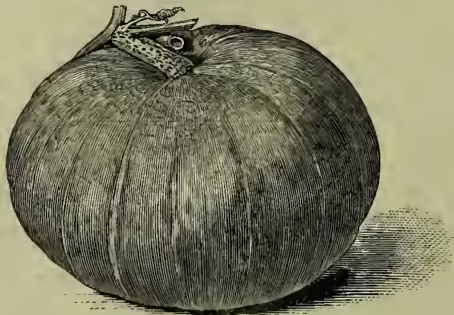
Europe. The French call it Potiron, and use it largely in soups.—The Squash (C. melopepo) differs from all these in generally forming a bush, instead of sending out long trailing shoots; also in the extremely flattened fruit, the outline of which is generally irregular, and its whole form often so like some kinds of cap that in Germany one variety is commonly known as the Elector's Hat, and the name Turk's Cap is bestowed on another. The Squash is regarded as one of the best gourds, and is much cultivated in some parts of Europe and in North America.—The Warted Gourd (C. verrucosa), which has a very hard-skinned fruit covered with large warts, and the Musk Gourd (C. moschata), distinguished by its musky smell, are less hardy than the kinds already named; as is also the Orange Gourd (C. aurantia), sometimes cultivated on account of its beautiful orange-like fruit, which, however, although sometimes edible and wholesome, is not unfrequently very unfit for use, on account of colicynth developed in it. This is apt to be the case in some degree with other gourds also, but the bitter taste at once reveals the danger. The same remark is applicable to the young shoots and leaves, which, when perfectly free from bitterness, are an excellent substitute for spinach. In Scotland even the most hardy gourds are generally reared on a hotbed and planted out. In England it has been suggested that railway-banks might be made productive of a great quantity of human food by planting them with gourds. Ripe gourds may be kept for a long time in a cool well-ventilated place, nor are they injured by cutting off portions for use as required. The name gourd is often extended to many other Cucurbitaceæ. See CUCURBITACEÆ, CUCUMBER, &c.; also BOTTLE-GOURD.