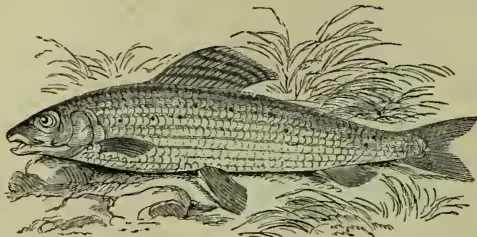
Grayling (Thymallus), a genus of fresh-water fishes in the salmon family, distinguished from trout, &c. by the smaller mouth and teeth, and by the long many-rayed dorsal fin. The genus is represented by five species, inhabiting clear streams in north Europe, Asia, and North America. The British Grayling (Th. vulgaris) has a wide but local distribution; it prefers rivers with rocky or gravelly bottom and an alternation of stream and pool. The back and sides are silvery gray, with longitudinal dusky streaks; the dorsal fin is crossed by rows of spots. The fish, which may attain a weight of 4 to 5 lb., is esteemed for the table, but should be cooked when newly caught, when it has an odour compared to that of wild thyme. It spawns in April or May, and is in best condition when trout are out of season, in October and November. Another well-known species is Th. signifer, a beautiful fish from the clear affluents of the Mackenzie River, called 'Hewlukpowak,' or 'fish with the winglike fin,' by the Eskimos, and 'poisson bleu' by the Canadian voyagers. See Pritt, The Book of the Grayling (1888); Walham, Grayling, and how to catch them (1895).