Gregarinida, or Sporozoa, a class of parasitic single-celled animals or Protozoa. As adults they are entirely destitute of cilia or other locomotor structures, and emphasise in their history the encysted phase of cell-life. They are found in almost all kinds of animals, inside the cells, or loose in the alimentary canal, body-cavity, and other spaces. The food consists of the diffusible albuminoids of the host, absorbed by the general surface of the 'mouthless' unit. The Gregarine is wholly surrounded by a rind, and sometimes shows fibril-like, probably contractile, structures; there is a large spherical nucleus, but no contractile vesicle. They vary greatly in size, from minute forms which live within blood corpuscles to others visible to the unaided eye, and measuring sometimes th of an inch. A typical life-history is indicated in the diagram, the important points being as follows: in early life the Gregarine usually lives inside a cell, whether it keep this habitat or not; the young forms not unfrequently divide; Gregarines are fond of associating in couples (or even in trios), but this union does not seem to be usually followed by fusion; at a certain stage the unit, or sometimes the pair, becomes encysted and divides into numerous clothed spores; each of these, when liberated by the bursting of the cyst, gives origin to a young Gregarine, or usually to several; these are at first flagellate or amoeboid, or at least more active than the adults, but with nutrition and growth the juvenile activity is soon lost.
Among the most important Sporozoa are the following: Monocystis, represented by at least two species in the male organs of the earthworm;
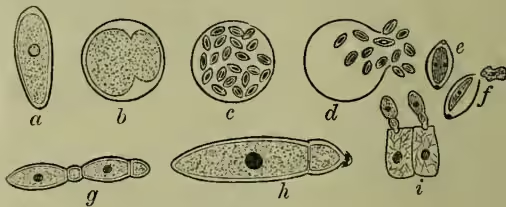
Gregarina, a type of those with the body divided by a partition, and furnished with a curious, anterior, proboscis-like appendage, found in the alimentary canal of crustaceans and insects—e.g. lobster and cockroach; Klossia, in molluscs, especially cuttle-fish; Drepanidium, in frog's blood, a type of many with a similar habitat in birds and reptiles. Very imperfectly known are the Myxosporidia found in fishes—apparently very primitive forms—and the Sarcosporidia in the muscle-fibres of mammals, of which Sarcocystis ('Miescher's vesicles' or 'Rainey's corpuscles') is common, but apparently harmless in butcher-meat. Coccidium oviforme is definitely known as a Gregarine parasitic in man.
See CELL, PARASITISM, PROTOZOA; also Bütschli, 'Protozoa' in Bronn's Thierreich; Balbiani, Leçons sur les Sporozoaires (Paris, 1884); Leuckart, Parasites of Man (Edin. 1886); Lankester, art. 'Protozoa,' Encycl. Brit.; Schneider, Tablettes Zoologiques (1886, &c.); Hatchett Jackson's ed. of Rolleston's Forms of Animal Life (Oxford, 1888).