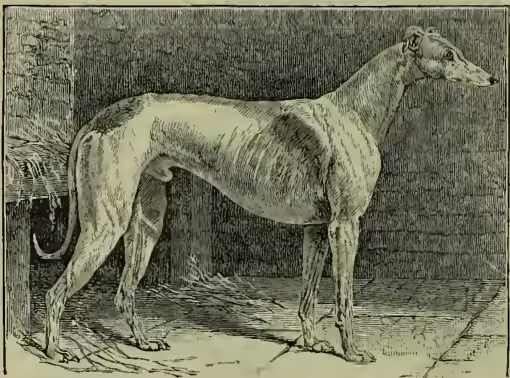
Greyhound. a breed of great antiquity, the only breed of dog which has retained its original shape; many Egyptian monuments are decorated with figures of dogs closely resembling the smooth English greyhound. The greyhound has been known in England since the time of King Canute, who confined its use to the nobility by statute. Until comparatively modern times only land-owners were permitted to use the greyhound. When the game-laws were relaxed, coursing became open to all, until now upwards of five thousand greyhounds are kept for public Coursing (q.v.). Clubs were formed for the encouragement of the sport, and a scale of points by which competing greyhounds could be tested was arranged. When it is desired to test two rival greyhounds, they are placed in the hands of the 'slipper,' towards whom the hares are driven. After getting the dogs in a straight line behind the hare, he liberates them by means of a mechanical contrivance, allowing the hare from 50 to 80 yards start. The 'judge,' who follows on horseback, then notes the points scored by either greyhound, giving his decision, from which there is no appeal, at the end of each course. The scale of points adopted is as follows: 'the run-up,' first reaching the hare, one to three points, according to lead gained; 'the turn,' causing the hare to turn at an acute angle, two points; 'the wrench,' turning at an obtuse angle, one point; 'the go-by,' starting behind a competitor and passing him, two points; 'the trip,' knocking the hare over but not killing, one point; 'the kill,' not more than two points, sometimes none, according to merit. Many greyhounds, after they have been repeatedly coured, 'run cunning' or 'lurch'—i.e. allow their opponent to do all the work, only waiting for an opportunity to kill; this vice is hereditary, and must be guarded against in breeding. The greyhound is a large and graceful dog, conveying an impression of great speed. His head should be long and narrow, with powerful jaws; shoulders, sloping back, allowing free play for the fore-legs; fore-legs, strong and muscular; chest, deep and narrow; hind-legs, very long from hip to hock, and 'well-bent.' The points of the greyhound are neatly summed up in the 15th-century rhyme:
The head of a snake,
The neck of a drake,
A back like a beam,
A side like a bream,
The foot of a rat,
And the tail of a rat, which is still a fairly accurate description. The greyhound is rarely kept as a companion, its intelligence not being of a high order. The Russian and Circassian greyhounds are identical in shape with the English greyhound, but much rougher in coat, and slower. The Italian and Turkish grey- hounds are shaped very much the same way, but on a very reduced scale; they are used entirely as pets, being too delicate for any active work. See H. Dalziel, The Greyhound: its History, Points, and Breeding (1886).