Grouse. a name applied to many game-birds in the family Tetraonidae, which also includes quails and partridges. From these the grouse (forming a sub-family Tetraoninae) may be distinguished by the more or less complete feathering of nostrils, legs, and feet, by a bare patch of skin over the eye, by a comb-like fringe on the sides of the toes, and sometimes by a distensible sac on the side of the neck. They are well known to be large, plump, somewhat heavy birds, usually short-tailed, and with beautifully-variegated plumage, which must often be protective. They are especially abundant in the northern parts of both Old and New World.
We shall first take a brief review of most of the important forms, some of which receive separate notice. (1) The genus Tetrao is well represented by the Capercailzie (q.v.; T. urogallus), its Siberian relative T. urogalloides, and the Black-cock (q.v.) or Black Grouse (T. tetrrix), well known in Britain. (2) The Ptarmigans (q.v.) belong to the genus Lagopus, distinguished by their heavily-feathered toes, and (with the exception of the next species) by the snow-white winter plumage. The Red Grouse (L. scoticus) is indigenous only to
Britain, represented by the Willow Grouse (L. albus) in other northern countries. (3) The ruffed grouse, in the genus Bonasia, are exceptional in having the lower part of the leg bare, and can elevate the soft feathers on the sides of the neck. Well known is the American species B. umbellus, with several varieties. They frequent woods, roost in trees, nest on the ground, and fly straight and swiftly. The male is famous for his habit of 'drumming.' 'He stands upon a trunk of some fallen tree, and, stretching himself into a horizontal position, beats stiffly downwards with his wings, slowly at first, increasing the strokes until they become so rapid that the wings are invisible.' This loud drumming noise is heard even after the limits of the breeding season. An allied species, the Hazel Grouse (B. betulina), is widely distributed in Europe and Asia, but is without ruff or drumming. Along with two other species it is sometimes ranked in a separate genus, Tetrastes.
(4) Among the numerous North American grouse, besides species of Bonasia and Lagopus, there are first of all several forms nearly related to, if not included within the genus Tetrao. The 'Blue Grouse' (Dendragapus) inhabit evergreen forests at a high elevation; the males emit in spring a prolonged whirring sound from the contraction of two dilatable sacs on the neck. The flesh is white and delicate. The Spruce Grouse (Canace) are represented by several species—'forest- and swamp-loving birds, very tame and unsuspicious, with dark and generally bitter flesh.' Well known are the Prairie Hens or Prairie Chickens, of which Cupidonía, or sometimes Tetrao cupido, is the commonest, though in process of rapid extermination even in spite of the laws. It is rather smaller than a blackcock, reddish-brown in colour, with beautiful markings of black and white, and bears on the sides of the neck two large dilatable sacs, hidden by erectile feathers, and producing by their expansion and contraction loud 'booming' sounds, which, as well as the combats between rival males, enliven the breeding season. The flesh is much esteemed, and the bird is ruthlessly persecuted. Nearly related, but with less-developed neck sacs, is the sharp-tail grouse, referred to the genus Pediæcetes. The largest American grouse, however, is the Cock of the Plains or Sage Cock (Centrocercus urophasianus), the male of which approaches our capercailzie in size, though not by any means in weight. It is dispersed over the western plains, and, according to Elliot, owes the bitter unpalatable character of its flesh to its diet of Artemisia or 'wild sage' which abounds in these desert regions. The tail is remarkably long, the neck sacs very large, the usually hard gizzard portion of the stomach remains soft. As the Sandgrouse (Pteroclidae)—one of which, Pallas's Sandgrouse (Syrhaptès paradoxus), has been coming in increasing numbers to Britain since 1859—are not grouse, if indeed even gallinaceous, they must be noticed separately.
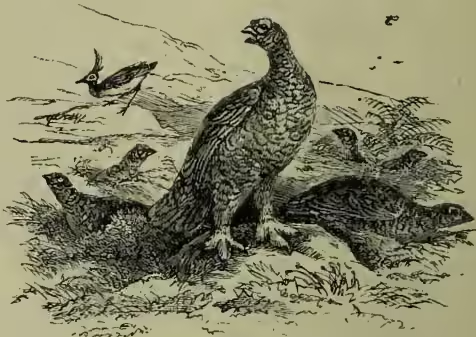
Returning now to British grouse (Tetraonidae), we have to deal with (1) the Capercailzie (Tetrao urogallus), (2) the Blackcock (T. tetrix), (3) the rare Ptarmigan (Lagopus mutus), and (4) the Red Grouse (L. scoticus). The first three are separately discussed; it remains to notice briefly the last, which is in a special sense the British grouse. This is strictly an insular ptarmigan which does not change its colour, and is very nearly related to the Willow Grouse (L. albus) of the Continent. It is widely distributed on the moors in the north of England, in Ireland, but above all in Scotland. The male measures 16 inches, and is predominantly reddish and chestnut-brown with some black and white. The female is rather smaller, and with more of the light chestnut plumage. The colour varies considerably in different localities. Pairing occurs in early spring; the nest is slight, and on the ground usually among heather; the eggs (eight to ten) are 'of a buffish-white ground colour, mottled with rich red or brown.' The female sits very close, and the male gives warning of danger. The birds feed on leaves and fruit of bilberry, tips of heather, sedge seeds, and the like.
Grouse are well known to be subject to a decimating disease, but neither in regard to the direct or indirect conditions of the epidemic is there any certainty. It was first noticed (1815-20) about the time when shootings began to be let and protection or over-preservation became common. Atmospheric conditions, sheep, sheep-wash, heather-blight, &c. have been blamed, while John Colquhoun, author of The Moor and the Loch, strongly maintained that the indirect cause was simply over-preservation. The destruction of birds of prey, which used to kill off unhealthy birds, must certainly have its nemesis. Tapeworms are often found in grouse, but are not regarded as of much import; a round worm (Strongylus) is possibly more injurious; most probably, however, the disease is due to bacteria of some sort, and runs riot in unnatural conditions.
Grouse-shooting has long been a popular sport with those living where the birds abounded, but it was not till near the middle of the 19th century that Southrons began to flock into Scotland for this sport, and shooting rents to grow rapidly. In many districts the 12th of August is the most important date in the year. Many thousands of acres now bring their owners large rents for grouse-shooting; there are said to be in Scotland in all, besides deer-forests, some 2400 separate shootings, on most of which grouse are found. Grouse occur in every Scottish county, but Perthshire is the chief grouse-shooting region. An area of 10,000 acres well stocked with birds, and having a shooting lodge, can hardly be leased for less than £500 per annum (Outdoor Sports in Scotland, 1889); if there be salmon and ground-game, the rent may be £600. The rents may be said to run from tenpence to half-a-crown an acre. In a good season, 500,000 brace may be shot. It is computed that every brace costs the sporting tenant a sovereign. Hence if each of the 2400 grouse-moors yield each on an average 200 brace, the total (960,000 birds) would represent a grouse-shooting rental for Scotland of £480,000.
See BLACKCOCK, CAPERCAILZIE, PTARMIGAN, SANDGROUSE; also D. G. Elliot, The Tetraoninae (New York, 1864-65); also in The Riverside or Standard Natural History, edited by J. S. Kingsley (Lond. and Boston); A. B. Meyer, Unser Auer-, Racket-, und Birkwild (Vienna, 1887, folio atlas with 17 plates of grouse); R. W. Shufeldt, Osteology of North America Tetraonidae; Bull,
U.S. Geol. Geogr. Surv. vi. (1881); manuals of Yarrell, Howard Saunders, &c.; Colquhoun, The Moor and the Loch (1851, 6th ed. 1884); Lord Walsingham and Sir R. Payne-Gallwey, Shooting (Badminton Lib. 1886); 'Ellangowan,' Outdoor Sports in Scotland (1869). For disease, see Zoologist, Rep. Brit. Assoc., and Journ. Roy. Micr. Soc.; Chapman, Bird Life on the Borders (1889); Klein, Etiology and Pathology of Grouse Disease (1892).