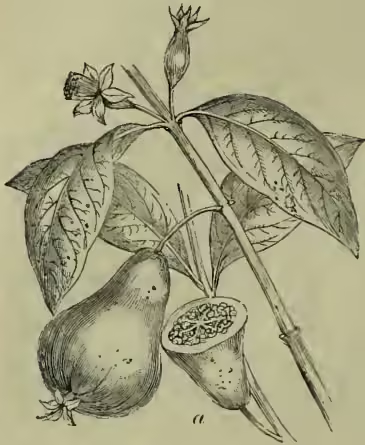
a, section of fruit.
Guava (Psidium), a genus of trees and shrubs of the natural order Myrtaceæ, mostly natives of tropical America, and some of them yielding fine and much-valued fruits. They have opposite entire, or almost entire leaves, a 3-5-lobed calyx, 4-5 petals, and a 1-5-celled berry with many-seeded cells.—The Common Guava or White Guava (P. pyriferum) is a low tree of 7-20 feet, with numerous branches, obtuse smooth leaves 2-3 inches long, and fragrant white flowers on solitary axillary stalks. It is said to be a native alike of the East and West Indies, and is now much cultivated in both. It is not improbable, however, that it was introduced into the East Indies from America, but it has now become fully naturalised; it is to be seen in the jungle around every cottage in Ceylon. It has long been occasionally grown as a stove-plant in Britain. The fruit is larger than a hen's egg, roundish or pear-shaped, smooth, yellow; the rind thin and brittle; the pulp firm, full of bony seeds, aromatic, and sweet. The jelly or preserve made from it is highly esteemed, and is now regularly imported into Britain from the West Indies and South America. The rind is stewed with milk, and is also made into marmalade. This fruit is rather astringent than laxative. Guava bnds, boiled with barley and liquorice, make a useful astringent drink in diarrhoea.—The Red Guava (P. pomiferum), also now common in the East as well as in the West Indies, produces a beautiful fruit, with red flesh, but not nearly so agreeable as the white guava. It is very acid.—The China Guava (P. Cattleianum), a native of China, produces fruit readily in vineries in Britain. It is a larger tree than the white guava. The fruit is round, about the size of a walnut, of a fine claret colour when ripe, growing in the axils of the leaves; the pulp purplish-red next the skin, becoming paler towards the centre, and there white, soft, subacid, in consistency and flavour resembling the strawberry. It makes an excellent preserve. It succeeds in the open air in the south of France.—On some of the mountains of Brazil grows a dwarf species of Guava, called Marangaba (P. pygmaum), a shrub, 1-2 feet high, with fruit about the size of a gooseberry, much sought after on account of its delicious flavour, which resembles that of the strawberry.—The Bastard Guava of the West Indies is a species of Engenia (q.v.).